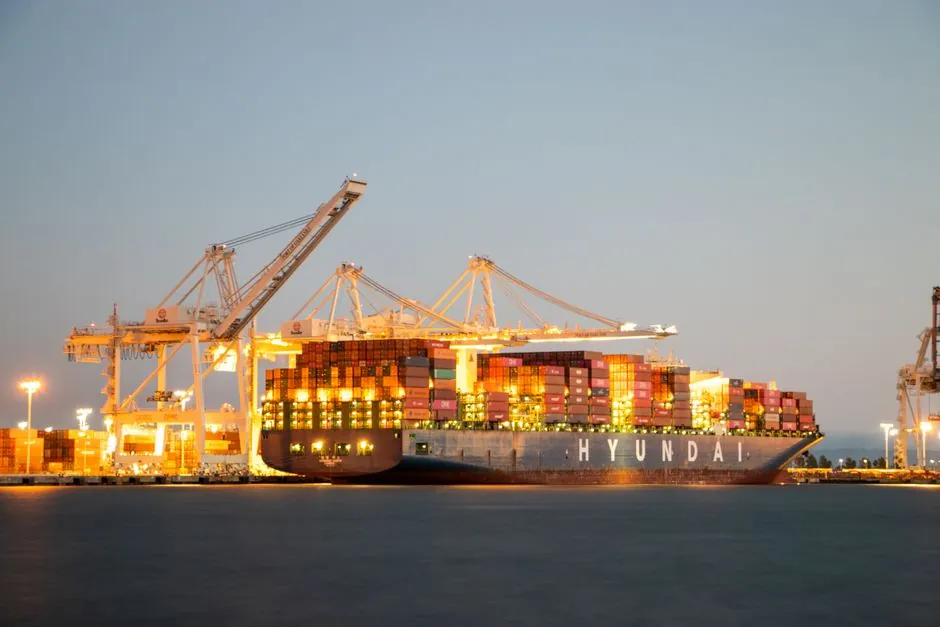
Port-side load securement is being reshaped by PET polyester strapping: widths of 12-32 mm, break strength 186-1,400 Kgf, and 406 mm cores are now the dominant specification across European container terminals, with 19 standard variants commonly stocked [S2].
Steel strapping's share of European heavy-duty packaging has fallen from 78% in 2005 to under 32%, while PET now accounts for the majority of industrial bundling in Germany, the UK, Italy, France, and Poland under EU PPWR recyclability rules [S2]. FMCSA cargo securement rules require the aggregate working load limit of all securement devices to be at least half the weight of the article being secured, which makes material choice a regulatory as well as a packaging decision [S3].
Material families: PET, PP, textile, steel at a glance
Four material families cover essentially every port-side use case, and the selection is driven by load profile, transit distance, and environmental exposure [S1]. PET (polyester) and steel both deliver very high tensile strength, while PP and textile sit in the low-to-medium bracket; tension relaxation is the real discriminator, with PET and textile keeping tension over long hauls and PP relaxing fastest [S1].
PP strapping is the most widely used and economical option, available in widths from 1/4" to 3/4" (roughly 6-19 mm), almost always embossed for added friction, and applied via hand tools or fully automated strapping machines [S3]. Steel remains specified for very heavy, hot, or sharp-edged cargo such as construction steel and metalworking exports, where its rigidity and temperature tolerance outweigh the snap-back and corrosion penalties [S1][S3].
PET vs PP vs textile vs steel: a four-criteria decision table
The criteria that drive port-side specification are tensile strength, tension relaxation (load retention), flexibility, and injury/material risk on failure. On those four axes the four families separate cleanly, and the table below is the working reference most procurement teams use [S1][S3].
PP: low-to-medium tensile, high relaxation, high flexibility, low cost, suited to cartons and parcels on short shuttles [S1]. PET: high tensile, low relaxation, high flexibility, recyclable, suited to heavy pallets, containerised cargo, and long-haul road/rail/sea links [S1][S2]. Textile: high tensile, low relaxation, high flexibility, reusable and weather-resistant, common in forestry, mechanical engineering, and truck-transport lashings [S1]. Steel: very high tensile, low relaxation, low flexibility, mandatory for some railroad transport, hot coils, and sharp-edged metal exports [S1][S3].
What PET actually delivers at the wharf
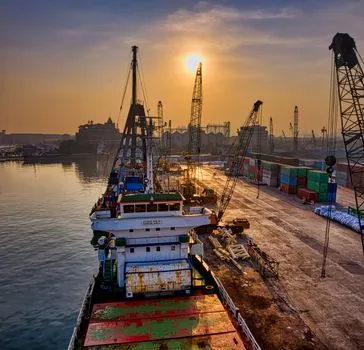
PET is produced by extruding molten resin into a flat profile and biaxially orienting it in the machine direction, aligning the polymer chains; that orientation is what produces both the high break strength and the elastic recovery that re-tensions the band as a load settles during a sea voyage [S2]. Two surface finishes are used: plain/smooth for friction welding with a battery tool, and embossed for buckle and woven systems [S2].
At a 12 mm width, a typical European PET variant delivers around 186 Kgf break strength, rising to roughly 1,400 Kgf at 32 mm, a seven-fold step that lets a single strap family cover everything from case-pallet securement to heavy break-bulk and coil crating [S2]. PET carries no snap-back injury risk, does not rust or mark the load, and is 100% recyclable under PPWR, three reasons procurement teams cite when switching from steel [S2].
Who should specify PET, and who still needs steel
PET is the right default for the bulk of port logistics work: pallet securing, containerised consumer goods, paper and forest products in standard coils, and most break-bulk exports moving on ro-ro or container loops [S4]. It is also the right call where operators want to avoid the sharp-edge injury risk that steel snap-back creates on a busy quayside [S1].
Steel is still specified where temperatures exceed PET's working envelope, where loads are sharp-edged enough to cut a polyester band, and where a few rail and heavy-haul road rules still mandate metallic strapping for specific commodity codes [S1][S3]. PP remains the economic choice for light, short-haul, indoor flows such as carton and parcel unitising, while textile is the pick for irregular shapes, reusable lashings, and forestry products [S1].
Selection workflow: cargo, route, environment
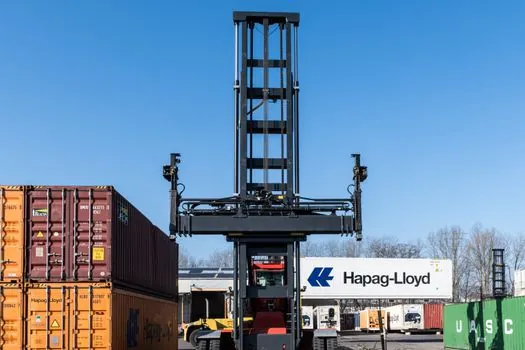
The three inputs that drive a port-side spec are cargo weight and shape, transport route length and mode, and the environmental exposure the band will see in storage and on the vessel [S1]. Heavy pallets on a 14-day sea voyage need a high-tensile, low-relaxation band, which is PET or textile; light cartons on a same-day road shuttle can run PP without issue [S1][S3].
For stretch-wrapped pallet loads moving through an export terminal, the stretch film spec map for electronics handling covers the wrap side of the equation, while PET strapping carries the tensile load that the film alone cannot [S3]. For automotive and engineering components routed via roro, the stretch film for automotive parts logistics reference pairs naturally with PET lashings on the same pallet. Sourcing at port scale typically runs 20-28 day lead times to Europe on a 90-coil pallet MOQ at 406 mm core [S2].
Limitations, failure modes, and what to verify on receipt
Common failure modes at the terminal are predictable: a strap that is too weak breaks in transit, a strap that is too rigid cannot absorb load settlement and releases tension, wrong width drops holding force below the FMCSA half-weight threshold, and the wrong material degrades under UV, moisture, or temperature before delivery [S3]. PET is not the right choice for sustained surface temperatures above its rated ceiling or for loads sharp enough to notch the band; steel remains the only safe option in those niches [S1][S2].
On receipt, verify width, break strength, core diameter (406 mm is the European standard), embossed versus plain finish, and supplier batch traceability; ISO certification and PPWR compliance documentation are the two documents most European buyers now request [S2]. Match the strapping band to the load profile, then match the logistics packaging system (wrap, edge protectors, dunnage) around it, and the freight claim rate drops measurably across the voyage [S3][S4].