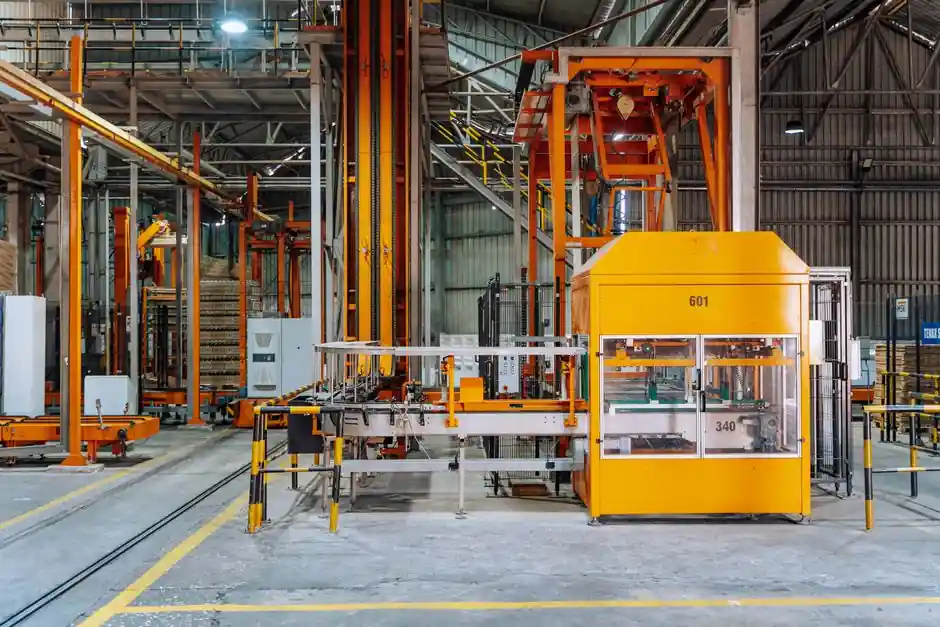
Machine stretch film pre-stretched beyond 250% by a powered film carriage is the baseline specification that separates automated warehouse wrappers from hand-applied pallet wrap, and it is the single largest driver of film-cost reduction per pallet shipped [S3].
Pairing that carriage with the correct resin family and gauge tier, namely 80 gauge cast for uniform loads and 100 to 120 gauge blown for irregular or extreme profiles, determines whether an automatic wrapper actually improves load containment or just accelerates bad wrapping [S4]. The same logic drives specification for broader plant automation projects covered in our electrical automation reference set.
Wrapper Classes: Throughput, Labor, and PLC Footprint
Three wrapper classes are commonly specified for distribution centers, and each maps to a distinct throughput and labor profile. Semi-automatic stand-alone wrappers are rated up to about 40 loads per hour and suit lower-volume zones or facilities running multiple wrappers in parallel [S1].
Automatic wrappers are PLC-based, conveyorized, and integrate into end-of-line packaging, trading higher capital cost for reduced labor per pallet and tighter wrap-pattern consistency [S1]. Mobile robotic units extend that automation envelope by relocating to the load rather than requiring conveyorized delivery, and are typically specified in 3000-series form factors for fully unmanned wrapping cells [S9].
Film Gauge and Manufacturing Process: A Spec Comparison
Cast clear film is the industry workhorse for high-speed optical scanners and WMS barcode reading, while blown film uses multi-directional molecular orientation to deliver higher puncture resistance and aggressive cling for extreme loads [S4]. The third option, hybrid blown-like cast film produced by multi-layer co-extrusion, bridges those two performance envelopes and is the default pick for irregular Type-B loads that still need scanner-friendly clarity [S4].
Thickness follows a similar tiered logic. 60 to 70 gauge (15.2 to 17.8 micron) is engineered performance film for light, uniform loads; 80 gauge (20.3 micron) is the multi-purpose industrial standard; 90 gauge (22.9 micron) is used for high-tension rigid containment; 100 to 120 gauge (25.4 to 30.5 micron) targets heavy machinery and construction; and 150+ gauge (38.1+ micron) is reserved for steel beams and rebar [S4]. This gauge tiering is the reason down-gauging from 80 to 60 gauge is feasible with engineered resin but never with commodity film, since down-gauging depends on pushing the film safely past its yield point without tear-off [S4].
Load Profile Mapping: Uniform, Irregular, Extreme
Load containment physics dictate which film to specify, and there are three load profiles that any spec sheet must cover. Uniform loads with no protrusions are the easiest case and pair naturally with cast performance film and high-speed automated wrapping tuned for consistent inward radial force [S4].
Irregular loads with staggered layers or sharp corners require higher puncture resistance and targeted mid-load PLI (pounds per linear inch) zone stability, and this is the optimal use case for hybrid blown-like cast films [S4]. Extreme loads, such as heavy machinery, steel beams, or jagged edges, require blown duty film at maximum tensile stress to achieve peak containment force [S4]. Hand films, by contrast, range from 5 to 18 inches in width and remain a low-volume tool, since manual application cannot deliver consistent containment force from the bottom to the top of a tall pallet [S5].
Machine Stretch Film Optimization: The ROI Lever
The film-and-machine combination is the unit of analysis, not the film alone, and high-performance machine film is what unlocks automated ROI. Modern stretch wrappers pre-stretch film by more than 250% during application, which means less plastic is consumed per pallet while containment force actually increases versus hand wrapping [S3].
Stability is a function of consistent engineered containment force, not raw thickness, and adding extra layers of low-quality wrap multiplies structural waste rather than improving load security [S5]. The 300% pre-stretch yield that high-performance cast and hybrid films are designed for is what makes aggressive down-gauging economically defensible on a real pallet line [S4]. Comparable containment logic shows up in flow-meter selection for process skids, which we cover in the flow meter reference page.
Selection Criteria: A Four-Axis Comparison
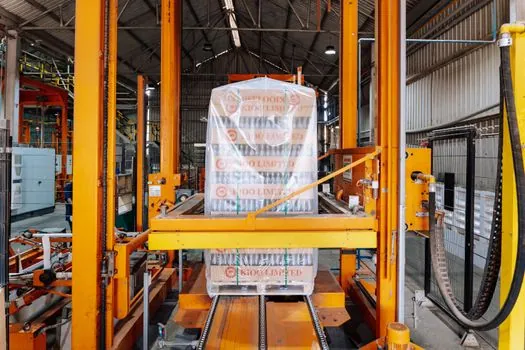
Four criteria usually decide stretch film specification on an automated line: load-profile fit, machine compatibility, throughput target, and cost-per-pallet. Cast clear film wins on scanner clarity and quiet unwind, so it is the default for uniform loads and WMS-gated warehouses [S4].
Hybrid cast film wins on irregular load profiles because it preserves barcode readability while adding blown-style tear resistance, and blown duty film wins on extreme profiles where maximum tensile stress and dual-sided aggressive cling matter more than optics [S4]. On the machine side, semi-automatic wrappers cap out near 40 loads per hour, while automatic and robotic units move into the dozens-to-hundreds range when conveyorized, which sets the throughput threshold at which 250%+ pre-stretch film carriages pay back their premium [S1][S3][S9].
Integration, Safety, and Maintenance Constraints
Modern wrappers are not stand-alone assets; they are nodes in a packaging line, and the spec sheet has to reflect that. Higher-end models link to warehouse systems and conveyors for hands-off operation, and integration with warehouse management software exposes per-cycle data on wrap count, tension, and maintenance intervals [S2].
Safety features such as light curtains, safety interlocks, protective guarding, and emergency stops are now standard on PLC-based wrappers and are a hard requirement for any unmanned or robotic cell [S1][S2]. Film compatibility is the other quiet constraint: machines that accept a range of film types, including heavy-duty and biodegradable grades, with adjustable carriages that switch between widths quickly, reduce changeover downtime on mixed-SKU lines [S2]. Choosing stretch film for industrial valve crating or pressure-instrument pallets follows the same compatibility logic, and our pressure transmitter reference page treats it the same way.
Common Mistakes When Specifying for Automation
The most expensive error on an automated line is pairing a state-of-the-art wrapper with sub-standard or mis-specified film, which leaves the line running fast but still producing unstable loads [S5]. A related error is treating film thickness as a proxy for hold strength, when in fact engineered films at 60 to 80 gauge routinely outperform commodity 100 gauge film on uniform and Type-B loads because of consistent pre-stretch and yield-point engineering [S4][S5].
A third frequent miss is ignoring the noise and clarity profile of cast versus blown film; blown duty film can defeat optical barcode scanners in WMS-gated facilities even when its mechanical performance is correct for the load [S4]. The same kind of compatibility oversight shows up in adjacent spec work, such as our warning tape selection for food processing buyer map, where film clarity versus scanner readability is the deciding factor. Plants that also handle process instrumentation should treat pallet containment for fragile instruments the same way they spec a pressure sensor shipment.
Trackable signals for any spec review in the next quarter: (1) any change in the 250% to 300% pre-stretch capability of new film carriages, since that band sets the cost-per-pallet math; (2) shifts in WMS-level wrap-cycle data capture on automatic wrappers, since per-cycle data is what turns a wrapper from a black box into a measurable line asset.