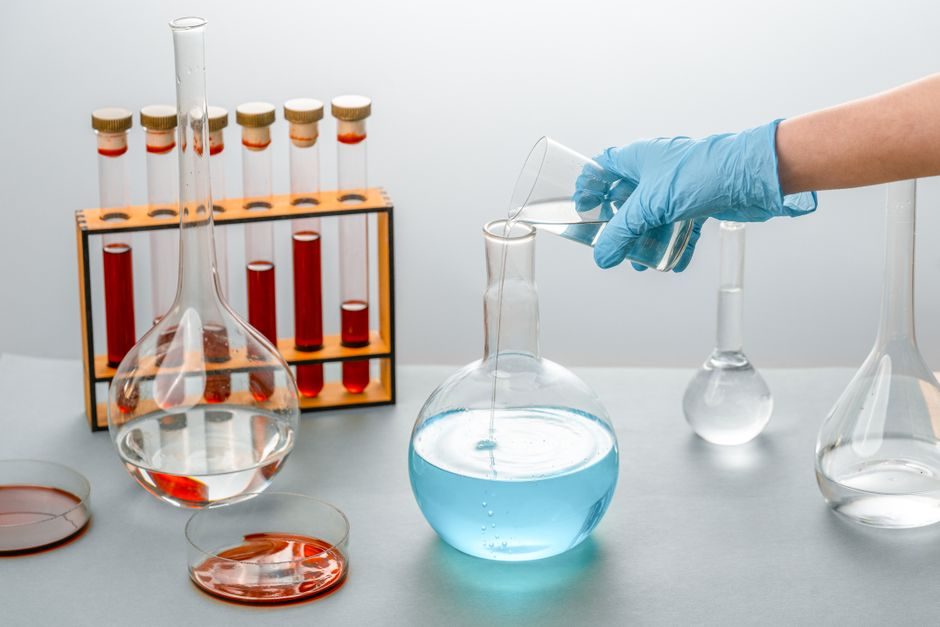
A pH meter reports hydrogen-ion activity (pH 0-14) through a glass reference/measuring electrode pair, while a turbidity meter reports suspended-solids load in NTU or FNU via 90° nephelometric light scatter [S3].
The two read entirely different physical quantities: pH meters output a voltage converted by the Nernst slope (~59.16 mV/pH at 25 °C), turbidity meters output a scatter intensity calibrated against formazin primary standards [S1][S3]. Multi-parameter analyzers in the 2026 Made-in-China catalog bundle pH, ORP, conductivity, DO, and turbidity into one probe head for drinking-water and aquaculture users [S1].
Sensor Mechanism: Glass Electrode vs Optical Nephelometry
A pH meter uses a sodium-ion-selective glass membrane that develops a potential versus a reference (typically Ag/AgCl + KCl), buffered through a liquid or polymer junction; the instrument converts mV to pH using temperature-compensated Nernst slope, then corrects for sample temperature with an integrated Pt100/Pt1000 element [S1].
A turbidity meter illuminates the sample with an LED (commonly 860 nm infrared, per ISO 7027) and reads scattered light at 90°, with a second detector for transmitted light to extend range up to several thousand NTU [S3]. Online turbidity probes from Cixi Instrument (CX-OT-1502) target power plants, municipal water, beverage lines, and pharma/epidemic labs, where 90° scatter is the published operating principle [S3].
Selection Criteria: pH Range, Junction Type, NTU Range, Optics
For turbidity, gate on: (1) method — nephelometric (90°, ISO 7027) vs ratio turbidimetric; (2) range — 0-100 NTU for drinking water, 0-4000 NTU for raw wastewater; (3) bubble rejection — ultrasonic or flow-cell design; (4) wiper — automatic mechanical wiper for fouling-prone river or RAS (recirculating aquaculture) service [S3]. Henan Bingsheng's online series ships with automatic wiper options on both turbidity and chlorophyll channels for aquaculture monitoring [S1].
Use Cases: Where pH Meters and Turbidity Meters Are Specified Separately
pH-only specs dominate in CIP (clean-in-place) return lines, boiler feedwater (target 8.5-9.2 with amine treatment), fermentation broth (4.5-7.0 depending on organism), and wastewater neutralization tanks where the discharge limit is the only data point needed [S1][S4].
Turbidity-only specs dominate in filter-backwash optimization, clarifier-overflow trending, membrane-protector interlock pre-RO, and beverage clarifier outlets, where the target is typically <1 NTU for finished water or <5 NTU for RO feed [S3]. INESA's pH500T benchtop and the I500T pH/Ion meter target lab and at-line quality control, while their portable M600L multi-parameter analyzer covers field audits on pH, ORP, conductivity, and turbidity in one handheld [S6].
Comparison: pH Meter vs Turbidity Meter Across Four Decision Criteria
Side-by-side on the criteria that drive a spec engineer: pH meters measure ion activity (0-14 pH) with mV input, use a glass membrane, suit chemical/reaction monitoring, and are typically US$243 for a benchtop pH-only unit on the 2026 Made-in-China wholesale listings [S5].
Turbidity meters measure light scatter (0-4000 NTU typical) with an optical input, use 90° nephelometry at 860 nm, suit solids/clarity monitoring, and are typically quoted in the same source listings as a multi-parameter analyzer with pH/ORP/TDS/EC/DO/Cl/turbidity bundled for US$675 per set [S5]. A multi-parameter water-quality meter in the 2026 catalog lists pH/DO/conductivity/turbidity as a portable digital tester at US$800-1,100 per piece, signaling that the combined-purchase price premium over a single pH unit is roughly 2-3× when handheld-grade is acceptable [S2][S4].
Who Should Use a pH Meter, Who Should Use a Turbidity Meter, Who Needs Both

Use a pH meter alone when the process target is a chemical reaction equilibrium (acid neutralization, enzyme activity, disinfection efficacy with breakpoint chlorination) and suspended solids do not affect the control loop [S1].
Use a turbidity meter alone when the process target is filter performance, membrane protection, or finished-water clarity, and pH is held constant by an upstream chemical feed [S3].
Specify both when raw-water intake, surface-water plant intake, or aquaculture RAS service is the application — surface water swings in pH (rain events) and turbidity (runoff) correlate and require joint trending for coagulant-dose trim [S1]. In WTP and aquaculture installations, Henan Bingsheng's combined pH + turbidity + chlorophyll + blue-green algae sensor suite is the typical Chinese-OEM packaging [S1]. For broader instrument-decision context, see Open Channel Flowmeter vs Thermal Mass Flowmeter: Spec Engineer's Decision Frame.
Limitations, Failure Modes, and What Each Instrument Cannot Do
A pH meter cannot quantify solids, will read incorrectly in high-organic samples when the reference junction is fouled (poisoned KCl), and drifts 0.1-0.3 pH per week in hot CIP service without recalibration; polymer-junction or double-junction electrodes address the poisoning failure mode [S1].
A turbidity meter cannot quantify dissolved species, is fooled by air bubbles (the wiper/flow-cell design mitigates this), and saturates above the optical design range without ratio scatter correction; color interferences in the visible band are bypassed by using 860 nm IR per ISO 7027 [S3]. Both sensor types share a common field failure: coating biofouling on the optical window or glass membrane, which is why automatic wipers and inline cleaning chemistries are specified on most online installations [S1][S3]. For the tradeoff picture on adjacent analytical instruments, see pH Meter vs Online pH Analyzer: Range, Output, Selection.
Sourcing, Standards, and 2026 Catalog Pricing Snapshot

At the June 2026 sourcing window, Made-in-China lists a portable pH/DO/conductivity/turbidity multi-parameter handheld at US$800-1,100 per piece (MOQ 1), a separate DO meter with probe at US$160-450, and a benchtop ion meter (pH + conductivity) at US$393 (MOQ 1) [S2][S4].
The pH-meter-only benchtop is listed at US$243 per set, while a seven-channel multi-parameter online analyzer (pH/TDS/ORP/EC/DO/Cl/turbidity) is US$675 per set, so the bundled price is ~2.8× a single-parameter pH unit at the wholesale tier [S5]. Standard anchors that govern the methodology: ISO 7027 for turbidity, ASTM D1125 for electrolytic conductivity, and the IUPAC pH definition; for higher-purity work, USP <645> conductivity limits apply. For thermometer-adjacent spec context, see Thermocouple vs Infrared Thermometer: Selection, Specs, and Tradeoffs.
Trackable next signals for spec engineers: monitor the 2026-06 Made-in-China pH/turbidity multi-parameter listings for any sub-US$700 combined-probe SKU aimed at the small-WTP segment, and watch for INESA's pH500T and M510T portable firmware updates covering turbidity-channel diagnostics on their conductivity meter family [S4][S6].