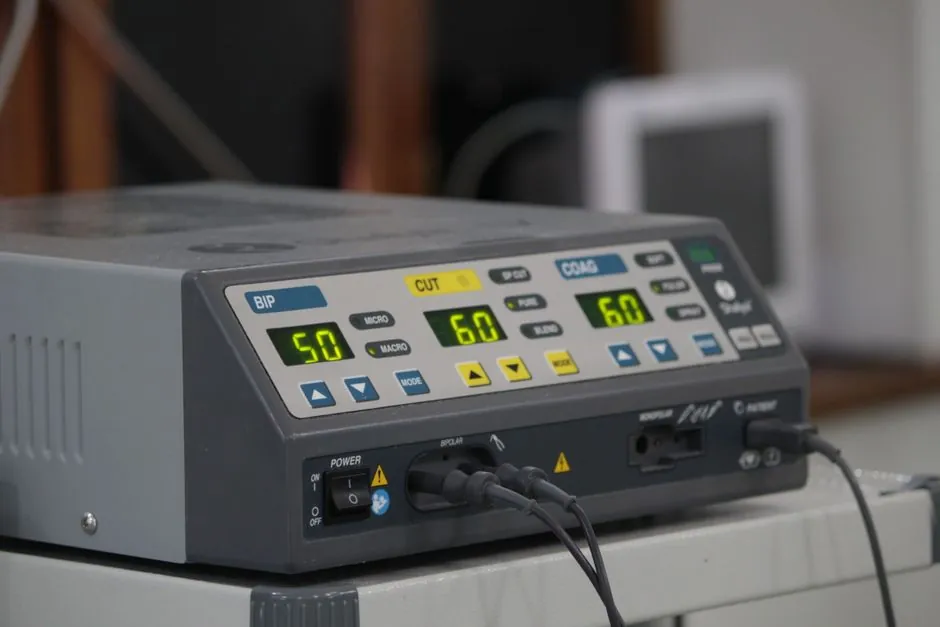
Industrial phased array ultrasonic testing (PAUT) hardware is a multi-line item: a 16:64PR portable instrument, multi-element probes, encoded scanners, and analysis software are sold as a system, with new-instrument list prices clustering in a USD 45,000-60,000 band for entry bundles and USD 150,000-250,000 for 64:128PR or 128:128PR racks with full option keys [S1].
Total cost of ownership over a 5-year window is dominated by probe and wedge replacement, annual calibration, and operator certification rather than the initial instrument, which is why a USD 80,000 instrument can carry a USD 25,000-40,000 annual recurring budget in a service-company deployment [S1].
What you are actually buying: the four cost pillars
PAUT procurement breaks into instrument (the pulser/receiver chassis), probe and wedge, encoded scanner (1-axis, 2-axis, or TOFD), and software seat plus option keys; TÜV Rheinland lists the typical workflow as customised multi-element set-ups with optimised angle and focus control, executed by qualified technicians, which is exactly the cost stack a buyer has to fund [S1]. A standalone 32-channel portable instrument without probes lists in the USD 20,000-35,000 band; a 64:128PR research-grade rack sits at USD 90,000-140,000 before options.
Probes are the second pillar and the most underestimated line. A standard 5 MHz, 64-element, 0.6 mm pitch linear PA probe runs USD 4,000-9,000 list; specialty probes (dual-linear, matrix, high-temperature up to 200 C) push to USD 12,000-25,000 each. Wedges are USD 800-2,500 each, and a realistic weld-inspection kit needs 6-12 wedges for nozzle, pipe, and fillet coverage, so USD 8,000-25,000 of wedge inventory is common.
Encoders and scanners are the third pillar: a 1-axis encoder is USD 1,500-3,500, a 2-axis encoded scanner is USD 4,000-12,000, and a motorised XYZ scanner for complex geometry starts at USD 15,000.
Phased array vs conventional UT vs TOFD vs radiography: a cost-driven comparison
PAUT inspection time on heavy-wall welds is significantly reduced versus conventional UT because multiple angles and focal laws are fired from one probe position, and the inspection can run in parallel with other construction activities because no radiation exclusion zone is needed, both of which lower installed-cost-per-joint even when the instrument is more expensive [S1]. Against radiographic inspection (RT), PAUT removes the evacuation cost, the film/digital-plate consumable, and the darkroom or CR-scanner line, which on a refinery turnaround can swing total cost of inspection by a factor of two even at a higher day rate for the PAUT crew.
Against TOFD alone, PAUT adds sizing and imaging but at higher hardware cost: a TOFD-only rig is roughly 40-60% of a comparable PAUT rig, and many buyers specify a TOFD channel pair alongside PAUT for a complete flaw-detection and sizing solution. Against phased array simulation, the simulation toolchain (for example MATLAB Phased Array System Toolbox, which covers beamforming, waveforms, and direction-of-arrival algorithms across phased array, radar, sonar, and acoustic applications) is a design-time asset, not a field instrument, and is licensed separately from any inspection unit [S2].
The 2x2 comparison below frames the procurement decision. PAUT: hardware USD 45,000-250,000, training curve steep (2-4 weeks for Level II), data archival full C-scan, consumables probes/wedges/encoder wear. Conventional UT: hardware USD 8,000-25,000, training curve shallow, no C-scan, consumables standard UT probes (USD 200-800). TOFD: hardware USD 30,000-90,000, training curve moderate, sizing excellent, consumables TOFD probes (USD 1,500-4,000). RT (film or DDA): hardware USD 0 if outsourced, training curve moderate, consumables film or digital plates, indirect cost of evacuation [S1].
Who a PAUT system is for, and who should not buy
PAUT pays back for owners inspecting austenitic and high-alloy welds, nozzle geometries, and heavy-wall components in power generation, chemical, and oil and gas service, where the time savings and parallel-work benefit show up on the production schedule [S1]. TÜV Rheinland specifically calls out special geometries (nozzles) and special materials (austenitic and high-alloy) as applications where its specialist PA equipment is deployed, and these are exactly the cases where conventional UT struggles and RT is the only legacy alternative.
PAUT is not a fit for shops doing low-volume, low-criticality welds, for in-house labs that only need a qualitative pass/fail on simple butt welds, or for buyers who cannot fund Level II/III operator training. A small fabrication shop running one ASME B31.3 spool per month is better served by a USD 8,000 conventional UT instrument and outsourced PAUT when required.
Service companies and third-party inspectors are the natural buyers because the day-rate model amortises the instrument across many short jobs; captive users in petrochemical and nuclear make sense when the inspection volume is above roughly 200 weld-joints per year.
Cost drivers that move the price
Channel count is the single largest driver. Moving from 16:64 to 64:128 doubles the pulser/receiver count and typically doubles the instrument list price; moving to 128:128 with phased raw-data capture (FMC) and full-matrix capture (FMC/TFM) software unlocks TFM imaging but adds USD 30,000-60,000 in hardware and software option cost. Probe inventory is the second driver and the one most often under-budgeted, because a credible weld kit needs 4-6 PA probes and 8-12 wedges in matched sets, and a single dropped wedge is a USD 1,500-2,500 write-off. [S1]
Encoder and scanner choice is the third driver: a manual 1-axis encoder at USD 1,500-3,500 is fine for straight butt welds; a motorised 2-axis scanner at USD 8,000-15,000 is required for nozzle and pipe circumferential scans. Software is the fourth driver, and option keys for TFM, TOFD add-on, and C-scan export are commonly priced per feature, with the full suite often 1.5-2x the base software seat price.
Calibration blocks, reference standards, and annual factory calibration are the fifth driver: a set of ASME/ISO calibration blocks (e.g. Operator certification (PAUT Level II per ASNT SNT-TC-1A or ISO 9712) is the sixth, with training plus examination in the USD 3,000-6,000 per operator range.
Standards, qualification, and what a buyer should ask for
Weld-inspection PAUT work in pressure-equipment and piping is typically executed against ASME Section V Article 4, ASME Section VIII / B31.3 acceptance, and ISO 13588 (PAUT of welds); the inspector statement of qualification and the procedure qualification record (PQR) must reference these documents and the operator must hold ASNT SNT-TC-1A or ISO 9712 Level II in PAUT. TÜV Rheinland's published service description explicitly anchors its PAUT work to standard requirements and to the consultancy step that determines suitability of the technical application, which is the gating activity before any instrument is mobilised [S1].
For the simulation side, if the buyer is also doing phased array design work in radar, sonar, or acoustic beamforming, MATLAB's Phased Array System Toolbox covers hybrid and digital beamforming, MIMO, matched filtering, and code generation for C/C++ and HDL targets [S2]; this is engineering design software, not an inspection product, and lives on a separate budget line.
Questions a spec engineer should put on the RFQ: pulser voltage and rise time, max PRF, number of active focal laws, supported TFM/PCI modes, encoder protocol, probe connector type (typically IPEX or ODU), data format openness (raw RF export, not just screenshots), calibration interval, warranty terms, and whether the software licence is node-locked, USB-dongle, or floating. These six items drive the 5-year cost more than the headline instrument price.
Total cost of ownership over 5 years
For a 64:128PR PAUT system deployed in a service-company configuration, a realistic 5-year TCO breakdown looks like: instrument depreciation 40-45%, probes and wedges 15-20%, software maintenance 10-12%, calibration 8-10%, operator training and recertification 8-10%, encoder/scanner maintenance 5-8%, and consumables/misc 5-7%. The instrument is less than half the 5-year spend, which is why the cheapest box on the quote is rarely the cheapest system in service. [S1]
For a low-volume user under 100 joints per year, outsourcing remains the lower-TCO path, and the user should specify a service contract with defined turnaround, written procedure, and Level III sign-off rather than buying a system.
For component-level specifications, see phased array ut, lighting equipment and electric lamps, and linear guide.
See also our earlier report, Simpson Manufacturing 8-K (27 Jul 2026): what a spec engineer can and cannot read from....