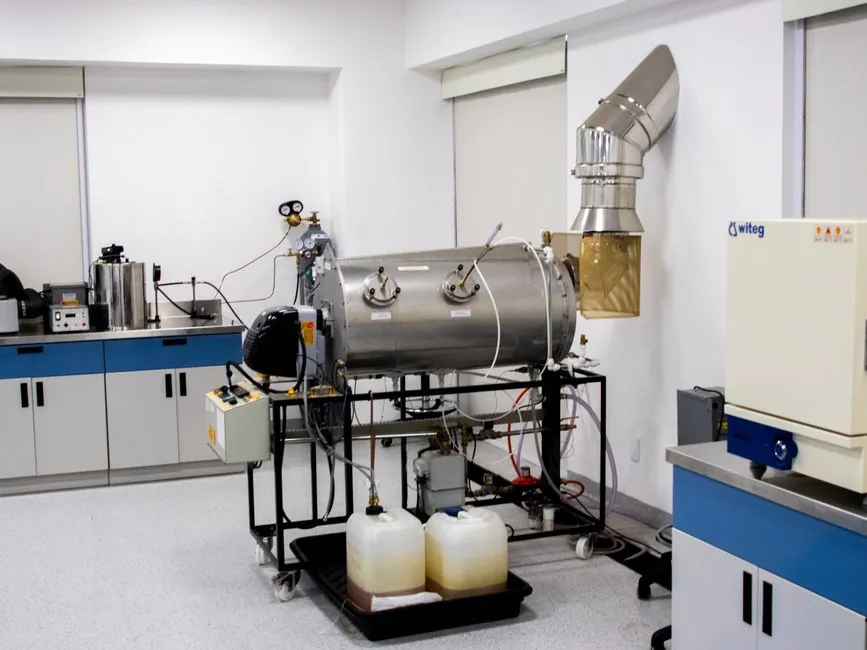
A temperature calibration bath is a stirred liquid heat source used as a reference environment for temperature measurement probes; selection is driven by four numeric gates: span (°C), working fluid volume (L), axial stability and uniformity (°C or mK), and maximum probe immersion (mm) [S1].
Across the 2025-2026 manufacturer catalog, spans run from -80°C to +660°C, tank volumes from 4 L to 200 L, and metrology-grade liquid baths reach stability of ±0.005°C in the -40°C to +300°C envelope most plants need [S1][S2]. For the 80% of process instrumentation that lands in the -45°C to +300°C window, the decision is mostly a fluid choice plus an immersion-length match, not a brand match.
Temperature range: which envelope rules out a dry block
Liquid calibration baths cover -80°C to +660°C as a single-instrument class, with WIKA's CTB9 spanning -45°C to +300°C, Kambic OB-7/2 LT at -40°C to +130°C, and AOIP ISOTOWER reaching 157°C to 660°C for high-temperature noble-metal thermocouples [S1].
Below -40°C, dry-block calibrators lose contact uniformity because aluminum block conductivity cannot compensate for probe sheath heat leak; SP FTS CharpyCool's mechanically refrigerated bath holds ±0.1°C at -80°C where dry blocks are typically derated or abandoned [S2]. Above 300°C, salt or nitrate baths in the ISOTOWER class are the standard metrology approach, since dry blocks oxidize and dry-well inserts drift faster than stirred fluids at the same setpoint [S1]. For a portable field unit, Eurotron ETB 140 bridges both worlds at -55°C to +140°C by switching between dry-block, stirred liquid bath, black-body, and surface-sensor modes in one chassis [S3].
Working volume and probe immersion: the mechanical fit
Bath capacity is the single spec that disqualifies half the catalog before any thermal metric is read: SP FTS CharpyCool ships 4 L and 8 L variants sized for 65 or 91 Charpy impact specimens, AOIP Neptune 915 holds 7 L with deep-immersion wells for long-stem probes, and Kambic's OB family scales in four fixed sizes of 7, 22, 50, and 200 L [S1][S2].
Immersion depth is the second mechanical gate: Kambic's vertical-flow design delivers up to 650 mm immersion, which matters for long industrial PRT sheaths and for multi-point thermocouple manifolds; fluke calibration's 6331/7341/7381 Deep-Well Compact Baths are explicitly described as "laboratory temperature baths designed for precise calibration of long-stem probes" [S1]. The rule of thumb from metrology practice: probe immersion must be long enough that stem conduction error drops below 1/3 of the target calibration uncertainty, which for a class A Pt100 at 0°C is roughly 150 mm in a stirred fluid. If the bath cannot physically submerge the probe to that depth, accuracy is a fiction regardless of controller quality.
Stability, uniformity, and the mK tier
Two numbers define a metrology-grade bath: stability (drift over time at the setpoint) and uniformity (spatial gradient between probe positions). The AOIP reference-resistor bath 455 quotes ±0.005°C stability in a 35 L tank from dew point to 40°C, the headline number for ultra-low-uncertainty work; the Eurotron ETB 140 in stirred-liquid-bath mode quotes ±0.02°C stability and ±0.004°C uniformity, the typical industrial-grade envelope [S1][S3].
For a process plant running ISO/IEC 17025-traceable calibration, the practical acceptance band is ±0.05°C or better; the Kambic OB-7/2 LT family is described as delivering "uniformity and stability in mK range" across the same -40°C to +130°C envelope where many dry-blocks are still spec'd [S1]. When reading a data sheet, watch for one of two omissions: a manufacturer that quotes only stability without a uniformity number, or a single combined "accuracy" figure that hides which spec is mK and which is tenths of a degree. Both are red flags for primary-level work; for shop-floor reference probes, the wider mK-tier numbers are adequate.
Liquid bath vs dry block vs fixed-point cell
Three technologies compete for the same calibration job, and the correct pick depends on required uncertainty, probe count, and budget: [S5]
1. Stirred liquid bath, -80°C to +300°C, typical ±0.01°C to ±0.05°C stability, 4-200 L volumes, best fit for batches of long-stem PRTs and thermocouples, fluid cost (silicone oil, ethanol-water, or water depending on span) and fume hood needed for high-temp fluids [S1][S2].
2. Dry-block / dry-well calibrator, -55°C to +1200°C, typical ±0.1°C to ±0.3°C, portable, no fluid, fastest cycle time, limited immersion and contact-dependent uniformity [S3].
3. Fixed-point cell, 0.01°C (water triple point) to 660°C (aluminum or silver freeze point), primary-laboratory uncertainty in the sub-mK range, requires dedicated furnace and operator training, AOIP's ISOTOWER family is the published industrial example for the high-temperature end [S1].
For under 100 mK target uncertainty, the field decision is liquid bath; for routine transmitter checks in a process calibration loop, dry block is faster and cheaper; for sub-10 mK primary work, a fixed-point cell is the only honest answer. The ETB 140 explicitly markets the hybrid path so a single instrument covers all three operating modes up to 140°C [S3].
Who a calibration bath is for, and who it is not for

Specifying a liquid calibration bath is the right call when the workload includes more than 5 probes per shift, when stem length exceeds 250 mm, when target uncertainty is below 50 mK, or when the working span sits below -40°C or above 300°C [S1][S2][S3]. These are the four practical gates; meeting any one of them justifies the bath over a dry-well.
A bath is the wrong call for a one-probe-per-week spot check on a 4-20 mA temperature transmitter with a 100 mm stem, for a hazardous-area loop where bringing silicone oil into a Zone 1 room creates an ignition or contamination problem, and for any application where the operator cannot be trained on fluid handling and hot-fluid burn risk. For field loops and short-stem sensors, a portable dry-block or a temperature controller-driven handheld dry-well is faster, safer, and adequate. Bath selection also has a real cost gradient: a 7 L mid-range industrial bath sits in the lower five-figure USD range, a 200 L Kambic-class metrology bath and a fixed-point furnace are an order of magnitude above that, and a CharpyCool -80°C mechanical-refrigeration bath with 8 L working volume is its own price tier again [S1][S2].
Standards, traceability, and the paperwork behind the numbers
Bath calibration output is only as good as its traceability chain: a working-standard bath should be calibrated against a reference PRT or thermocouple whose certificate is itself traceable to a national metrology institute, and the bath's own stability and uniformity numbers must be re-verified at intervals defined by the site's quality system, typically 6 to 12 months for ISO/IEC 17025-accredited labs [S5].
The hardware-side gating standard is the comparison method itself: in a stirred liquid bath, comparison between an unknown probe and a reference probe relies on both seeing the same fluid temperature, which is why Kambic's "unique vertical flow design" and Eurotron's stirred-bath stability spec both matter more than raw temperature monitor resolution [S1][S3]. The temperature recorder used on the reference side should have a resolution finer than 1/10 of the bath stability, or the data file will smear the real performance. For higher-tier traceability into the 0.01°C envelope, the AOIP 455 reference-resistor bath at ±0.005°C stability is the published industrial benchmark [S1].
Selection checklist and acceptance test
A defensible purchase and qualification sequence, based on the 2025-2026 catalog data, runs as follows. (1) Define the required span from coldest to hottest working setpoint, including a 10°C safety margin on each end for fluid limitations. (3) Define target stability and uniformity from the target calibration uncertainty divided by 4. (4) Confirm probe immersion length, and reject any bath whose stated immersion depth is below the longest probe stem. (5) Specify the fluid and confirm the bath supplier lists compatible fluids for the full span, then plan fume extraction for any oil bath above 150°C [S1].
The site acceptance test should reproduce, at minimum, three setpoints (low, mid, high) and measure stability over 30 minutes, uniformity across the working volume, and repeatability over three independent runs. Acceptance limits are typically the published stability and uniformity numbers plus 50% margin, not minus, and the temperature calibration bath should be rejected if any of the three runs drifts by more than 2x the published stability number [S1][S5].
Two signals to track over the next 6-12 months: first, how the mechanical-refrigeration -80°C class (SP FTS CharpyCool and similar) compresses in price as more suppliers enter, which will push the dry-block/bath crossover point lower in span; second, whether ISO/IEC 17025-accredited labs start publishing 2026-vintage uniformity data on baths with 50-200 L working volumes, which would let process plants re-evaluate the Kambic OB family for higher-throughput work [S1][S2].
See also our earlier report, Hopper Scale Selection: Load Cell, Mounting, and Certification Criteria.