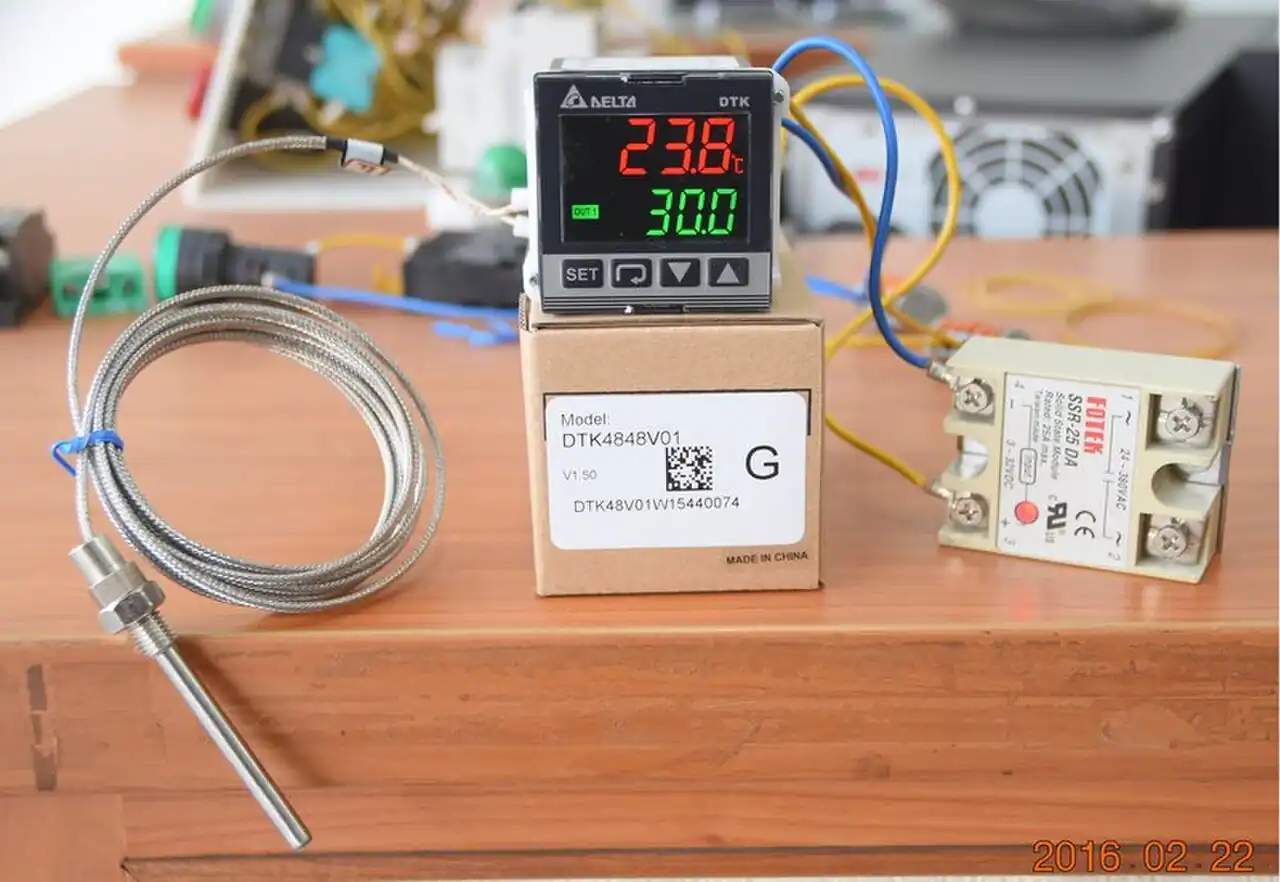
A temperature controller is the brain of a closed temperature loop: it reads a calibrated sensor, compares the measured value against a setpoint, and drives a heater or cooler so the process variable converges on that setpoint and holds. The most familiar form is the DIN panel instrument, a square fascia with a process display, a setpoint display, and a few keys, mounted through the door of a control cabinet or machine.
Beneath that simple face sit three engineering decisions that define the product: which control algorithm it runs (on-off, time-proportioning, or PID with auto-tuning), which sensor families it accepts (thermocouple, RTD, or linear), and which output family it uses to command the final control element (mechanical relay, SSR drive, triac, or analog 4-20 mA). This guide unpacks all three, then turns them into a selection sequence.
This guide is written for industrial purchasing engineers and design engineers. It covers 6 chapters, from control modes and controller types to sensor inputs, output families, PID tuning, and spec-sheet decoding, with 7 selection FAQs and brand comparisons, so you can build a complete temperature-control selection framework in about 30 minutes. Sensor and accuracy references follow public standards: IEC 60584-1 (thermocouples), IEC 60751 (Pt100 RTDs), IEC 61554 and the former DIN 43700 (panel cutout sizes), and IEC 61010 (safety of measurement, control, and laboratory equipment).
Chapter 1 / 06
What is a Temperature Controller
A temperature controller is an instrument that maintains a process temperature at a desired value by closing a feedback loop. The loop has three elements: an input sensor that measures the actual temperature, the controller that compares that measurement to the operator setpoint, and a final control element (the output) that switches or modulates a heating or cooling device. The defining feature is closed-loop operation: the output temperature is continuously measured and the manipulated variable continuously adjusted, in contrast to open-loop heating that applies a fixed power regardless of result.
This closed-loop discipline is what separates a controller from the simpler devices it is often confused with. A thermostat or a bimetal switch toggles a contact at one temperature with no display and no tuning. A temperature indicator merely shows a reading. A temperature transmitter conditions a sensor signal into a standard 4-20 mA output but does not, on its own, drive a heater. The temperature controller is the only one of these that contains the comparison logic, the control algorithm, and the actuation interface in a single instrument, which is why it sits at the center of nearly every thermal process and machine.
Functionally, the controller performs four jobs in sequence on every measurement cycle. It linearizes and cold-junction-compensates the raw sensor input into engineering units. It compares the process value (PV) to the setpoint (SV) to compute an error. It runs the control algorithm on that error to compute a manipulated variable between 0 and 100 percent. Finally it converts that percentage into an output signal appropriate to the wired actuator, whether that means closing a relay for part of a cycle, modulating a logic pulse to an external solid-state relay, or scaling a 4-20 mA current. High-end controllers add cooling channels, alarm relays, ramp and soak programming, and digital communication on top of this core.
The application range is vast because almost every industrial process is temperature-sensitive. Plastics extrusion and injection molding hold barrel and die zones within a degree or two. Heat-treat, brazing, and sintering furnaces ramp through recipes that can exceed 1200 degrees Celsius (about 2200 degrees Fahrenheit). Reactors, distillation columns, and crystallizers in chemical and pharmaceutical plants control reaction temperature for yield and safety. Packaging sealers, laboratory ovens, environmental chambers, food processing lines, and semiconductor diffusion furnaces all depend on the same instrument class, sized differently for accuracy, range, and channel count.
Four engineering metrics most often decide whether a chosen controller succeeds in service: control accuracy (how tightly it holds setpoint, a function of the algorithm and tuning, not just sensor accuracy), input flexibility (whether it accepts the sensor you already have), output suitability (whether its switching family matches the actuator and its cycle-life budget), and serviceability (spare-part availability, configuration tools, and communication for centralized monitoring). The cheapest panel meter and a process-grade controller can read the same temperature, yet differ greatly in how well they hold it and how long they last switching real loads.
Chapter 2 / 06
Controller Types and Form Factors
Temperature controllers are classified first by function and second by physical form. By function they range from single-purpose safety devices through general-purpose single-loop instruments to multi-loop and program controllers. By form they follow standardized panel cutout sizes so that one brand can be swapped for another without re-machining the cabinet door. Choosing the right class before comparing brands prevents the common mistake of buying an underpowered or overpowered instrument. The table below summarizes the main functional types.
Type
Loops
Defining Feature
Typical Applications
Limit controller
1 (safety)
Latching cutout, manual reset, no normal control
Furnace overtemp protection, burner safety
Single-loop general purpose
1
On-off and PID, auto-tune, alarms
Ovens, extruders, sealers, baths
Program (ramp-soak)
1 to 2
Timed setpoint segments, stored recipes
Heat treat, kiln firing, drying, curing
Multi-loop
2 to 32
Many inputs and outputs in one chassis
Multi-zone extruders, furnace banks
Valve motor drive (VMD)
1
3-point stepping output, no feedback slidewire needed
Steam and gas valve positioning
Limit controllers are safety devices, not control instruments. They have their own sensor and a latching output that de-energizes the heater contactor when temperature crosses a ceiling, and they require a manual reset before restart. Because thermal runaway often begins when the primary control loop or its sensor fails, the limit controller must use an independent sensor and an independent output. In North America, FM and equivalent approvals apply specifically to these limit devices for burner and oven safety. A limit controller is wired as a separate protective layer, never as a substitute for the process controller.
Single-loop general-purpose controllers are the workhorse. They provide selectable on-off and PID control, auto-tuning, one or more alarm outputs, and increasingly a serial or Ethernet communication port. Representative families include the Omron E5CC and E5EC, Eurotherm EPC3000 and 3200, Yokogawa UT55A and UT52A, West Pro-EC44, and Honeywell DC1000. These cover the overwhelming majority of machine and process setpoints from one zone up to a couple of zones.
Program controllers add ramp and soak profiling: the setpoint is moved automatically through timed segments to execute an unattended recipe. Entry-level units offer a handful of programs, while advanced models run 50 or more segments across multiple stored programs with event outputs at segment boundaries. The Yokogawa UP55A is a dedicated program controller; many single-loop families such as the E5CC and EPC3000 offer profiling as an option. Multi-loop controllers pack many loops into one chassis, which is economical for multi-zone extruders and furnace banks where a single communication-based instrument can manage up to 32 loops. Valve motor drive controllers issue raise and lower pulses to position a motorized valve through a three-point stepping output, useful for steam and gas heating where the actuator is a valve rather than an electric heater.
Physically, panel controllers follow IEC 61554 (which superseded DIN 43700) so that fascia and cutout dimensions are interchangeable across vendors. The standard cutouts are 1/16 DIN at 48 by 48 mm, 1/8 DIN at 48 by 96 mm, 1/4 DIN at 96 by 96 mm, and 1/2 DIN at 96 by 192 mm, with 1/32 DIN at roughly 24 by 48 mm for the smallest displays. The Omron E5CC, for example, is a 1/16 DIN instrument and the E5EC a 1/8 DIN instrument. Larger sizes buy bigger digits and more keys, not better control; the algorithm and inputs are what determine performance.
Chapter 3 / 06
Control Modes: On-Off, Proportioning, PID
The single most important parameter on a temperature controller is its control mode, because it determines how tightly the loop can hold setpoint and how hard it works the output device. Three modes dominate: on-off (two-position) control, time-proportioning control, and PID control. They are not interchangeable, and selecting the wrong one causes either constant oscillation or a worn-out actuator. The table below compares the three on the dimensions that matter in selection.
Mode
Steady-State Behavior
Typical Accuracy at Setpoint
Output Cycling
Best For
On-off (two-position)
Oscillates within hysteresis band
Plus/minus 1 to 5 degrees C
Slow, large mass
Room heat, baths, freezers
Time-proportioning
Reduced oscillation near band edges
Plus/minus 1 to 2 degrees C
Per control period
Bridging on-off and PID
PID (auto-tuned)
Settles on setpoint, no offset
Plus/minus 0.1 to 0.5 degrees C
Continuous or fast
Extruders, reactors, furnaces
On-off control is the simplest mode. The output turns fully on below the setpoint and fully off above it, separated by a hysteresis (deadband) to prevent contact chatter. For example, with a 68-degree setpoint and a one-degree band, the heater energizes at 67 and de-energizes at 68. The process therefore never sits exactly on setpoint; it cycles through the band continuously. On-off is appropriate where the load has large thermal mass, a few degrees of swing is acceptable, and the actuator is a contactor or mechanical relay that cannot switch quickly. Its virtue is simplicity and contact-life economy; its limitation is that it can never hold a tight setpoint.
PID control eliminates the offset and the oscillation. It computes a continuous manipulated variable between 0 and 100 percent from three terms: proportional action proportional to the present error, integral action that accumulates past error to drive steady-state offset to zero, and derivative action that responds to the rate of change to damp overshoot. The proportional term is set as a proportional band (the span over which output goes from 0 to 100 percent), integral as a time in seconds, and derivative as a time in seconds. As a concrete reference point, one mainstream controller ships with default constants near a proportional band of 8 degrees Celsius, an integral time around 233 seconds, and a derivative time around 40 seconds, which are then refined by tuning.
Time-proportioning is the bridge that lets a PID algorithm drive an on-off device. Since a relay or SSR can only be fully on or fully off, the controller expresses a percentage output as the fraction of a fixed control period for which the output stays on: at 50 percent and an 8-second period, the output is on 4 seconds and off 4 seconds. A long control period slows the response and a short one speeds it up, but a short period on a mechanical relay shortens contact life. The standard guidance is to set the control period to about 20 seconds for relay outputs and about 2 seconds for SSR outputs, where solid-state switching tolerates rapid cycling.
Direction matters too. For heating, the controller is set to reverse acting, increasing output as temperature falls below setpoint. For cooling, it is set to direct acting, increasing output as temperature rises above setpoint. Heat-cool controllers run both with separate PID sets and a deadband between them. PID constants are found either by manual tuning (Ziegler-Nichols open-loop or ultimate-gain rules, which target roughly 25 percent step overshoot) or by the controller's built-in auto-tune, which forces a controlled oscillation around setpoint, measures its amplitude and period, and computes the gains. Auto-tune must run on a representative load, because constants suited to an empty oven will overshoot a full one.
Chapter 4 / 06
Sensor Inputs and Standards
A controller is only as accurate as the sensor it reads and the input table it linearizes against. Most modern controllers are universal-input: the same terminals accept thermocouples, RTDs, and linear signals, selected by menu. Getting the input choice right means matching the sensor range, accuracy class, and wiring to the process, and confirming the controller supports that exact sensor designation. Thermocouple tolerances follow IEC 60584-1 and RTD tolerances follow IEC 60751. The table below lists the common input families.
Input
Standard
Typical Range
Notes
Thermocouple type K
IEC 60584-1
-200 to 1372 degrees C
Most common; Class 2 tolerance plus/minus 7.5 C at 1000 C
Thermocouple type J
IEC 60584-1
-210 to 1200 degrees C
Iron-constantan, lower cost, oxidizes above 540 C
Thermocouple type T
IEC 60584-1
-200 to 400 degrees C
Cryogenic and low-temperature accuracy
Thermocouple types R, S, B
IEC 60584-1
0 to 1800 degrees C
Platinum-rhodium for high-temperature furnaces
RTD Pt100
IEC 60751
-200 to 850 degrees C
Class A plus/minus 0.15 C, Class B plus/minus 0.3 C at 0 C
Linear current / voltage
Process signal
4-20 mA, 0-10 V
From transmitters or for remote setpoint
Thermocouples generate a small millivolt signal from the junction of two dissimilar metals and are the workhorse for wide ranges and high temperatures. Type K (nickel-chromium versus nickel-alumel) is the default general-purpose sensor, spanning roughly minus 200 to 1372 degrees Celsius. Under IEC 60584-1, a Class 2 type-K wire carries a tolerance of about plus or minus 7.5 degrees Celsius at 1000 degrees, so the sensor itself, not the controller, often dominates loop error at high temperature. Type J is cheaper but oxidizes above about 540 degrees. Types R, S, and B use platinum-rhodium for furnace ranges up to roughly 1800 degrees. Thermocouples require correct cold-junction compensation in the controller and matched extension cable, or an offset error appears.
RTDs measure the resistance of a platinum element that rises predictably with temperature. The 100-ohm Pt100 per IEC 60751 is the most common, with Pt1000 increasingly used for better signal-to-noise on short runs. RTD tolerance classes are tight: Class A is about plus or minus 0.15 degrees Celsius at 0 degrees and Class B about plus or minus 0.3 degrees, far better than a thermocouple in the overlapping range up to roughly 850 degrees Celsius. For Class A performance the element should be wired in three- or four-wire configuration so lead resistance does not add error. RTDs are preferred wherever accuracy and stability below 600 degrees matter, such as pharmaceutical and food processes.
Linear inputs let the controller read a process transmitter's 4-20 mA or 0-10 V signal directly, or accept a remote setpoint from a supervisory system. Indication accuracy on quality controllers is typically about plus or minus 0.1 to 0.5 percent of span plus or minus 1 digit; the Eurotherm EPC3000 quotes 0.1 percent universal-input accuracy with a 50 ms sample rate, and the Yokogawa UT55A quotes plus or minus 0.1 percent of span plus or minus 1 digit. The selection rule is straightforward: use an RTD for accuracy and stability below 600 degrees, a thermocouple for high temperature or wide range, and a linear input only when the measurement is already conditioned by a transmitter upstream.
Chapter 5 / 06
Key Specification Parameters
Reading a controller spec sheet means separating the parameters that drive selection from the marketing line items. Eight parameters truly matter: control mode, input type, output family and rating, indication accuracy, control period, alarm and event functions, communication protocol, and agency approvals. Each is explained below, with the output family deserving the most attention because mismatching it to the actuator is the most expensive error.
Output family and rating is the interface to the final control element, and four types dominate. A mechanical relay output is a dry contact, typically rated 3 to 5 A at 250 V AC resistive, used to switch a contactor or small heater directly; its contacts wear, so it should not cycle faster than roughly every 20 seconds. An SSR drive (logic) output is a low-power DC pulse, typically around 12 V at 20 to 40 mA, that switches an external solid-state relay with no moving parts, tolerating 1 to 2 second cycling for tight time-proportioning. A triac output is a self-contained solid-state switch, usually about 1 A, that drives small loads without an external SSR. A linear 4-20 mA or 0-10 V output is a continuous analog signal that drives a thyristor power controller, a proportional valve, or a VFD for the smoothest modulation.
Indication accuracy is the controller's own measurement error, expressed as a percentage of span plus a digit, for instance plus or minus 0.1 to 0.5 percent of span plus or minus 1 digit. This is distinct from sensor accuracy and from control accuracy. Sensor accuracy comes from the IEC 60584 or IEC 60751 class of the probe; control accuracy (how tightly the loop holds setpoint) comes from the algorithm and tuning. A controller with 0.1 percent indication accuracy reading a Class 2 thermocouple still inherits the sensor's several-degree tolerance, so it is a mistake to quote the controller figure as the loop accuracy.
Control period is the time-proportioning cycle time, set to suit the output device: about 20 seconds for relays and about 2 seconds for SSR drives. Alarm and event functions include high and low absolute alarms, deviation alarms (a band around setpoint, for example plus or minus 10 degrees from a 150-degree setpoint), band alarms, and loop-break detection that flags a failed heater or sensor. These outputs are wired to annunciators or interlocks, and their number and flexibility vary widely between entry-level and process-grade instruments.
Communication and approvals close the spec. Common protocols are Modbus RTU over RS-485, Modbus TCP, PROFIBUS, DeviceNet, EtherNet/IP, and Modbus over Ethernet, used to centralize setpoints, alarms, and trends in a SCADA or PLC system. Agency approvals matter for legal sale and insurance: UL and cUL for North America, CE for the European Union, and FM specifically for limit devices. Supply voltage is typically a wide range such as 85 to 265 V AC, with 24 V AC/DC low-voltage options, and operating ambient often spans roughly minus 20 to plus 65 degrees Celsius. Enclosure rating on the fascia is frequently IP65 or NEMA 4X for washdown and dusty environments.
One parameter that does not appear on the data sheet but governs total cost is configuration and serviceability: whether the unit auto-tunes reliably, stores multiple PID sets for gain scheduling, supports front-panel or software (USB) configuration, and has spare parts and firmware support available locally. A controller that tunes poorly or cannot be re-flashed becomes a maintenance liability long after the purchase price is forgotten.
Chapter 6 / 06
Selection Decision Factors
To turn the preceding five chapters into a specific model, follow the decision sequence below. Most selection mistakes come not from a single wrong answer but from deciding the brand before the loop requirements are nailed down. These eight steps double as a fixed RFQ template that a vendor can quote against without back-and-forth.
Control mode and accuracy target: Decide whether the loop tolerates on-off cycling (plus or minus a few degrees) or needs PID (plus or minus a fraction of a degree). PID with auto-tune is the safe default for any process held to specification; on-off suits large-mass loads where swing is acceptable.
Sensor input: Match the controller input table to the sensor you have or will install. Use an RTD Pt100 (IEC 60751) for accuracy and stability below 600 degrees Celsius, a thermocouple type K, J, or R/S/B (IEC 60584-1) for high temperature or wide range, and a linear input only for an already-conditioned transmitter signal.
Output family and rating: Select relay for contactor switching at slow cycling, SSR drive for tight time-proportioning into an external solid-state relay, triac for small direct loads, and 4-20 mA or 0-10 V for a thyristor power controller, proportional valve, or VFD. Confirm the contact or drive rating against the load.
Loop count and profiling: Choose single-loop for one zone, multi-loop for multi-zone machines, and a program (ramp-soak) controller where a timed recipe must run unattended. Specify the number of profile segments if profiling is required.
Form factor: Fix the panel cutout per IEC 61554, for example 1/16 DIN (48 by 48 mm) for compact cabinets or 1/4 DIN (96 by 96 mm) for larger digits, so the instrument drops into the existing door cutout.
Communication and alarms: Specify Modbus RTU, Modbus TCP, or Ethernet if the loop reports to SCADA or a PLC, and list the alarm and event functions needed (absolute, deviation, band, loop-break).
Safety layer: Wherever overheating is a hazard, add an independent limit controller with its own sensor and latching, manual-reset output, sized to FM or equivalent requirements for the burner or furnace, never sharing the process loop's sensor or output.
Approvals and environment: Confirm UL, cUL, and CE as the market requires, supply voltage (typically 85 to 265 V AC or 24 V AC/DC), ambient range, and fascia ingress rating (IP65 or NEMA 4X for washdown). Verify the relevant product safety standard, the IEC 61010 series, is met.
One last and commonly overlooked dimension is serviceability and tuning support: reliable auto-tune, multiple stored PID sets for gain scheduling across the operating range, front-panel or USB configuration, firmware upgradability, and local spare-part and calibration availability. Mainstream families that score well here include Omron (E5CC, E5EC), Eurotherm (EPC3000, 3200), Yokogawa (UT55A, UT52A, UP55A), West (Pro-EC44), Honeywell (DC1000), and Watlow basic and limit controllers, all of which offer universal inputs, auto-tune PID, and serial or Ethernet communication. These are reliable choices for production lines that must run for a decade after the purchase order is closed.
FAQ
What is the difference between a temperature controller and a thermostat?
A thermostat is a self-contained switch that opens or closes a contact at a fixed or dial-set temperature, with no display, no programmability, and no tuning. A temperature controller is a microprocessor instrument that reads a calibrated sensor (thermocouple or RTD), displays the process value and setpoint, runs a control algorithm (on-off, time-proportioning, or PID), and drives a heater or cooler through a relay, SSR drive, or 4-20 mA output. Controllers add auto-tuning, alarms, ramp and soak profiles, and digital communication; thermostats do not. In practice the term thermostat covers cheap bimetal or bulb-and-capillary switches, while temperature controller denotes a DIN panel instrument used in process and machine control.
When should I use on-off control instead of PID control?
Use on-off (two-position) control when the process has large thermal mass and slow response, when a few degrees of cycling around the setpoint is acceptable, and when the actuator is a contactor or mechanical relay that cannot switch rapidly: room heating, ovens, water baths, and freezers are typical. On-off control always oscillates within its hysteresis band, so it can never hold a tight setpoint. Use PID control when you need to eliminate steady-state offset and hold the process within a fraction of a degree: extruders, reactors, semiconductor furnaces, and plating lines. PID modulates output continuously from 0 to 100 percent, and on a relay or SSR output it expresses that percentage through time-proportioning. As a rule, set the control period to about 20 seconds for relay outputs and about 2 seconds for SSR outputs.
How does PID auto-tuning work on a temperature controller?
Most modern controllers auto-tune with a relay-feedback or limit-cycle method. The controller switches the output fully on and off around the setpoint, deliberately forcing a controlled oscillation, then measures the amplitude and period of that oscillation. From those two numbers it computes the ultimate gain and ultimate period and applies Ziegler-Nichols style rules to derive proportional band, integral time, and derivative time. The classic open-loop Ziegler-Nichols rules, published in 1942, target roughly 25 percent overshoot on a step. Auto-tuning takes a few minutes and must run on a representative load, because PID constants that suit an empty oven will overshoot a full one. Many controllers store multiple PID sets and gain-schedule between them across the operating range.
What sensor inputs do temperature controllers accept?
A universal-input controller accepts thermocouples, RTDs, and linear signals on the same terminals through menu selection. Common thermocouples are types J, K, T, E, N, R, S, and B per IEC 60584-1, covering roughly minus 200 to plus 1800 degrees Celsius depending on type. The common RTD is the 100 ohm platinum Pt100 per IEC 60751, with Pt1000 and older JPt100 also offered. Linear inputs include 0-10 V, 1-5 V, 0-20 mA, and 4-20 mA for connecting transmitters or remote setpoints. Indication accuracy on quality controllers is about plus or minus 0.1 to 0.5 percent of span plus or minus 1 digit. Always match the controller input table to the sensor you already have, and remember thermocouples need correct cold-junction compensation and matched extension cable.
What is the difference between relay, SSR drive, and 4-20 mA outputs?
A mechanical relay output is a dry contact, typically rated 3 to 5 A at 250 V AC resistive, used to switch a contactor or small heater directly; its lifetime is limited by contact wear, so it should not cycle faster than about every 20 seconds. An SSR drive (logic) output is a low-power DC signal, typically 12 V at 20 to 40 mA, that switches an external solid-state relay; it has no moving parts and can cycle every 1 to 2 seconds for tight time-proportioning. A linear 4-20 mA (or 0-10 V) output is a continuous analog signal that drives a thyristor power controller, a proportional valve, or a variable-frequency drive, and is the choice for the smoothest modulating control. Many controllers offer a triac output (around 1 A) as a self-contained alternative to an external SSR.
What is a ramp and soak profile, and which controllers provide it?
A ramp and soak (program) profile moves the setpoint automatically through timed segments: a ramp raises or lowers the setpoint at a defined rate, and a soak holds it for a defined dwell. Profiles chain many segments to run a complete heat-treat, drying, or firing recipe unattended, with event outputs firing at segment boundaries. Entry-level profile controllers offer a handful of programs, while higher-end units run 50 or more segments across multiple stored programs. Examples include the Omron E5CC and E5EC, Eurotherm EPC3000 and 3200, Yokogawa UP55A program controller, and West Pro-EC44. For pottery, glass, and metallurgical furnaces the profile feature is essential; for steady-state machine setpoints it is not needed.
Why do I need a separate safety limit controller?
A standard process controller and a safety limit controller serve different jobs and should be wired as independent layers. The process controller holds the setpoint during normal operation. A limit controller is a single-purpose safety device with its own sensor and a latching output that de-energizes the heater contactor if temperature exceeds a set ceiling, and it requires manual reset before the process can restart. Because a runaway often starts when the primary control loop or its sensor fails, the limit controller must not share that sensor or that output. For burner and oven safety, FM and similar approvals apply specifically to limit devices. The relevant product safety standard for these panel instruments is the IEC 61010 series for measurement, control, and laboratory equipment.