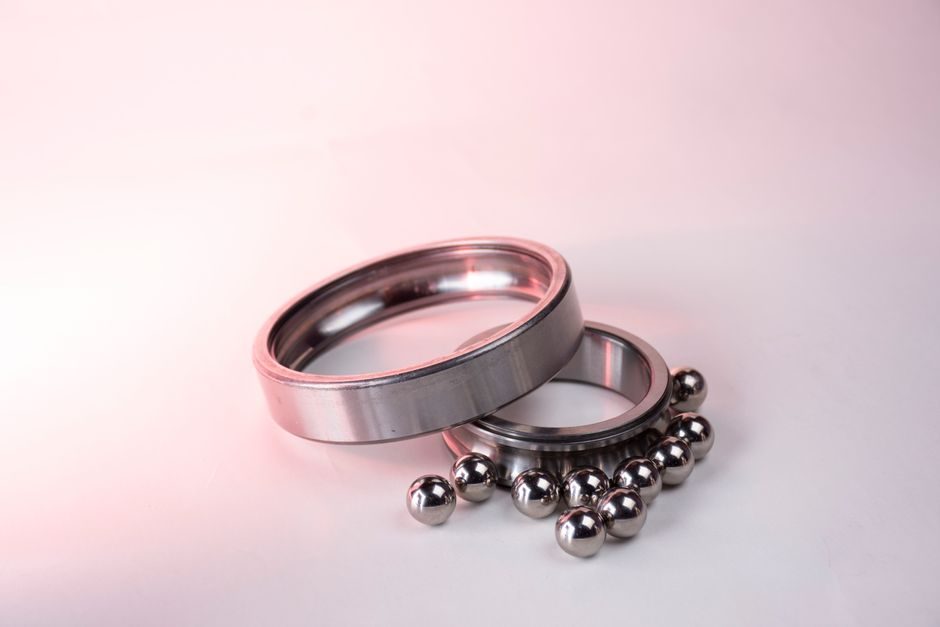
The most-quoted SKUs across mid-2026 RFQs remain UCP201, UCP205, UCP205-16 (1-inch bore), UCP206, UCF205 and UCFL204-205, with the bearing housing itself (P-series, F-series, FL-series empty housings) priced 30-50% below the assembled insert unit at the same bore [S2][S4].
Price bands by bore and series, mid-2026 ex-works
Catalogues from Chinese OEM/distributor sites show a tight cluster on the 12-30 mm bore family, which is where 70-80% of pillow block demand sits for conveyors, farm machinery and small motors [S2][S4]. A 12 mm UCP201 weighs 0.6 kg and measures 40 mm OD x 27.4 mm wide; the 25 mm UCP205 steps to roughly 0.7-0.8 kg, and the 30 mm UCP206 to about 1.0-1.1 kg, with the housing weight scaling roughly with the bolt footprint rather than the insert diameter [S2]. Inserts above 40 mm bore (UCP208-UCP215) are still in stock at most wholesalers but are no longer the mainstream promotional SKUs [S4].
UCP205-16, the 1-inch (25.4 mm) imperial-bore variant, is consistently carried as a separate SKU with a 5-15% premium over the metric UCP205 at most industrial distributors, because the insert grinding run is shorter and inventory turns are slower [S4]. For cost-down RFQs on conveyor duty, plant buyers frequently substitute the metric UCP205 in place of UCP205-16 if the shaft tolerance permits, and the savings are visible at the line-item level on a 200-piece PO [S4].
Material cost drivers: cast iron vs pressed steel vs stainless
Grey cast iron remains the default housing material for UCP/UCF/UCFL 200-series and 300-series pillow blocks, with pressed steel (SPCC / SPHC) housings priced 25-40% below cast iron at the same bore and stainless 304 housings running 2.5x-3.5x cast iron [S4]. The insert inside the housing is almost always a 6200-series or 6300-series deep-groove ball bearing with a setscrew locking collar on the extended inner ring, regardless of housing material [S2][S4].
For washdown, food-grade and marine duty, the cost step up is the stainless insert plus stainless housing combination, not either item alone. Mixed builds (stainless insert in cast-iron housing) are a common cost-saving compromise at distributors but are not rated for the same cleaning chemistry as full stainless units [S4]. On the pillow block bearing buying guide the housing-vs-insert material split is laid out SKU by SKU with the same cast-iron baseline.
Insert grade and clearance: where the real cost gap opens
Chinese-origin inserts (Cixi, Shandong, Linqing clusters) sit at the bottom of the price stack, with ABMA STD-20 (formerly ABEC-1) grade chrome-steel inserts priced roughly 20-35% below Japanese ABEC-3 (P0/P6) inserts of the same 6205-6206 reference [S1][S5]. Bore tolerance is typically +0 / -0.008 mm to -0.012 mm on the metric UCP205, which is enough for general conveyor and fan duty but tight for precision spindles [S2].
Insert load rating is the second lever: a standard 6205 insert in a UCP205 is rated around 14 kN dynamic and 6.95 kN static, while a heavier 6305 insert swap (in the UCP305 housing) raises that to roughly 22.5 kN dynamic and 11.2 kN static, for a 40-60% price premium on the assembled unit [S2][S4]. Buyers running higher radial loads (bucket elevators, agitator shafts) regularly jump from UCP to UCP300-series rather than upsizing the bore, because the larger ball complement in the same shaft diameter gives more fatigue life per dollar [S4].
Flange and housing variants: how they shift the line item
UCF (4-bolt square flange) and UCFL (2-bolt oval flange) units share the same insert as UCP at a given bore, so the price delta is almost entirely the housing casting. Industry catalogues show UCF205 around US $4-US $8 and UCFL204 around US $3-US $7 at 25 mm bore, compared with UCP205 at US $3-US $7 for the same 25 mm insert [S4]. The empty P-housing (cast iron, no insert) for a 205-class footprint is typically US $1.50-US $3, which is useful for maintenance buyers who only need to swap a damaged insert and keep the housing [S4].
Mounting hardware is a small but visible cost line: most 200-series UCP units ship with two M10 or 3/8" bolts and a grease nipple, but stainless units routinely omit the bolts, adding US $0.30-US $0.80 per unit to the buyer's BOM [S4]. Bearing-housing importers buying into Africa and South-East Asia frequently RFQ the housing and insert separately to dodge the assembled-unit premium, a pattern visible in 2022-2026 buyer RFQ logs [S3].
MOQ, packaging and freight: the landed-cost levers
Ex-works pricing assumes a standard 20-foot container load (roughly 20,000-30,000 assembled units for UCP205-class SKUs, depending on packaging) [S1][S4]. Standard export packing is a plastic bag inside a small individual box, then a master carton of 20-50 units; a switch to bulk poly-bag packing (no inner box) typically saves US $0.05-US $0.15 per unit and is a common ask on RFQs above 5,000 pieces [S4].
FOB Ningbo or FOB Qingdao terms dominate the Chinese-offer sheet; landed cost into Long Beach or Rotterdam for a full 20-foot container of UCP205 adds roughly US $0.40-US $0.90 per unit on 2026 freight benchmarks, with the spread driven by Bunker Adjustment Factor (BAF) and Suez-Cape routing mix [S4].
Sourcing signals worth tracking through 2026-H2
For cross-spec comparison, a roller bearing buying guide lays out the parallel price logic for cylindrical and spherical roller inserts, and the self-aligning bearing cost guide covers the 2200/2300-series insert swap that is sometimes used as an alternative to a 300-series pillow block.
For component-level specifications, see pillow block bearing, linear guide, and crossed roller guide.