
Industrial buyers sourcing roller bearings in mid-2026 face a US$0.30–150 per-piece FOB band on Made-in-China.com listings, with 70 manufacturers offering 359 active SKUs across 10 product families [S1]. The decision tree starts with load direction: radial-only duty points to cylindrical or needle, combined axial-radial loads force tapered, and misalignment over 0.5° pushes the spec toward spherical roller.
Price is not a clean proxy for quality — a US$0.30 Chinese-market tapered 33019/Q (95×145×39 mm) and a US$150 SKF-class equivalent differ mainly in material cleanliness (vacuum-degassed steel), heat-treatment consistency, and tolerance class (P0 vs P2). Buyers who skip the spec sheet and chase the lowest unit price typically burn that saving in premature spalling within the first 6–12 months of service.
Four Roller Families, Four Job-to-Be-Done Profiles
Tapered roller bearings handle combined radial + axial loads and dominate automotive hubs, gearboxes and rolling-mill roll necks; the catalog benchmark 33019/Q measures 95×145×39 mm with a pressed-steel or brass cage [S3]. Cylindrical roller bearings carry the highest radial loads per cross-section, routinely specified to ISO 15 dimension series, and run with separable inner or outer rings to simplify mounting in large industrial gearboxes. Spherical roller bearings absorb misalignment of 0.5°–2° and are the default for vibrating-screen, paper-mill and gearbox input shafts. Needle roller bearings use rollers under 6 mm in diameter for high-load, low-profile applications — NRA / NRB / ZB series from Qingdao Fuqin source at US$0.001–0.005 per piece at 100-piece MOQ, with G2 / G3 / G5 precision classes offered [S6].
Cross-roller guides sit in the adjacent linear-motion family and are commonly cross-referenced in the same RFQ — buyers evaluating a ZTVR2030-5Z cross roller guide at US$9.08–11.84 per set should map the equivalent radial-roller logic against the roller bearing decision tree, since load path and lubrication regime follow the same rules. The four families are not substitutes: a needle roller cannot absorb the angular misalignment that justifies a spherical, and a cylindrical roller cannot carry the thrust component a tapered resolves in a single row.
Material and Precision-Class Levers That Move Price 3–10×
Two spec gates drive the bulk of the per-piece price gap. First, material: 52100 chrome steel (1.0% C, 1.5% Cr) is the cost baseline, case-hardened low-alloy steels such as 20CrMnTi add roughly 20–40% for higher impact toughness, and M50 or Cronidur 30 high-speed tool steels push the figure past 5× for aerospace or M50-specified spindles. Second, tolerance / precision class: the Chinese P0 (ABEC-1) → P6 (ABEC-3) → P5 (ABEC-5) → P4 (ABEC-7) → P2 (ABEC-9) ladder is explicit on every Made-in-China.com spec sheet, with P0 to P4 commonly quoted in the same quote line. [S1]
Cage material is the third lever buyers miss most often. Pressed-steel cages suit dry, low-RPM service; brass or PEEK/phenolic cages are mandatory where temperatures climb above 180 °C or where vibration could otherwise fracture a stamped cage. A 22208-class spherical roller bearing on a Changzhou Nanyi quotation carries the same US$0.01–30.00 unit band as a 22207 variant — the model-number extension (CC, CA, MA, MB suffix) is where the cage and bore-tolerance code lives, and the spec sheet, not the headline price, tells the buyer what is actually being shipped.
Cross-Reference Discipline for Replacement and Aftermarket RFQs
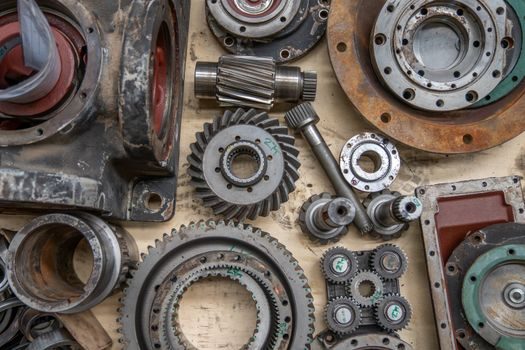
Replacement buying is its own workflow and accounts for a large share of 2026 search traffic on OEM cross-reference pages. A Bucyrus-Erie 26-856-210 heavy-equipment roller bearing cross-references to Timken H247548ASM90022 factory number [S2]; a CR BR2684 cross-references simultaneously to SKF K2684, Bower 2684, Joy Mfg 95X2684 and ABC 2684 [S4]; a Le Tourneau C354 maps to ACDelco WOR210 and RHP FLW50OR with NSN 7541064 listed [S5]. When the OEM part number is the starting point, factory-number cross-referencing across 3–4 brands is the fastest way to widen the bid pool and to check whether a lower-priced factory is licensed to brand the part under warranty.
For buyers specifying under a tapered roller bearing family RFQ where condition monitoring or longer L10 life is required, the constraint shifts from price-per-piece to total cost per million revolutions, and the answer is usually a class-7 or class-5 tolerance with controlled-cleanliness steel — never the cheapest P0 row on the listing page. Where the duty is heavy road-equipment or rolling-stock pinion service, the road roller duty cycle book (continuous low-speed high-impact loading) sets the same material upgrade rule.
Casters, Linear Guides and the Boundary Cases
Roller-bearing terminology bleeds into several adjacent categories that buyers must separate before pricing. Casters-roller-bearing SKUs (Shen Zhen Veich Precision at US$0.84–2.99 per 2-unit MOQ) are non-precision, large-clearance rollers for trolley and furniture wheels — these are NOT interchangeable with machine-grade cylindrical rollers of the same OD, despite identical-looking web listings. Linear-guide rollers and crossed roller guide cages (ZTVR2-5Z class at US$1.23–1.33 per 10-piece MOQ) are precision-ground and run in matched sets; they are catalogued separately from rotational roller bearings and carry a 5–20× price premium per roller for the same OD. [S2]
For buyers standardising procurement under a linear guide platform with bolted-joint locking hardware on the carriage, the material and spec interplay mirrors other 2026 spec-driven guides — see how Spring Washer Selection: 4 Lockable Spec Gates for 2026 Buyers lays out a four-gate model that translates almost directly to a bearing tolerance + material + cage + lubrication gate set.
MOQ, Lead-Time and Total-Cost Levers in the China Sourcing Lane
Made-in-China.com RFQ behaviour in June 2026 shows two patterns buyers should price in. First, MOQ is negotiable to a fault: pillow-block and small-diameter tapered sets list at 1-piece MOQ, but the FOB tier typically only opens at 500–1,000 pieces — the headline unit price is rarely the shipped unit price. Second, the spread on a single model number can be 100× (e.g. 22207 spherical roller US$1.00–50.00 per piece at 1-piece MOQ) — that spread is tolerance class, not model ambiguity, and quoting without a P-grade and cage suffix is asking for the wrong shipment. [S3]
Buyers standardising FOB-China procurement across fastener, washer and bearing lines should track a roller chain alongside the same supplier for agricultural or conveyor applications, since most Chinese bearing factories in the Liaoning / Shandong cluster also factory-roll roller chain to ISO 606 — same supplier audit, same QC, and the combined container lowers landed cost per kg of imported mechanical hardware.
Failure Modes and Specification Defects to Reject at PO Stage
Three field-failure modes dominate 2026 warranty returns on Chinese-market roller bearings. Premature spalling inside the first 2,000 hours points to sub-spec cleanliness or case-hardness depth — request inclusion rating (ASTM E45 method A or DIN 52099) and case depth reading (typically 1.5–2.5 mm for 20CrMnTi parts) before PO. Cage fracture at start-up points to wrong cage material for the temperature or acceleration profile; specify brass M or PEEK TN suffix where vibration or thermal cycling is present. False brinelling during transport appears within the first 50 hours and is a packaging failure — request rotation-prevented shipping sleeves or vacuum-bag nitrogen-padded pack, particularly for P5 and tighter bearings. [S4]
Standards discipline matters here: dimensional interchangeability is covered by ISO 15 (radial bearings), ISO 355 (tapered), ISO 104 (thin-walled), ABMA STD-20 (tolerances), and material by ASTM A295 (52100) or ASTM A534 (case-carburised). Buyers who require downhole, sour-service or aerospace certification should map to NACE MR0175 / ISO 15156 for sour H₂S environments and AMS 6278 / AMS 6491 for M-series high-speed steels — none of which are satisfied by a default P0 52100 part.
For procurement teams consolidating 2026 hardware spend, the same FOB-band and MOQ-true-cost discipline documented in Spring Washer 2026 Price and Cost Guide: FOB Bands, Material Levers and Sourcing applies one-for-one to roller bearings, and the bolt-joint spec logic in Spring Washer vs Locking Assembly: 2026 Spec Cut for Bolted Joint Buyers is the closest analogue for cage-and-retainer selection on a mounted bearing assembly. Track two Q3-2026 signals: (1) whether suppliers default to P0 or P6 in the absence of a stated tolerance — that is the new price-war floor, and (2) whether the cross-reference ecosystem (Timken, SKF, NSK, NTN, Koyo, FAG, ABC, Bower, Joy) continues to be honored under a single OEM part number, which controls the addressable bid pool on any replacement RFQ.