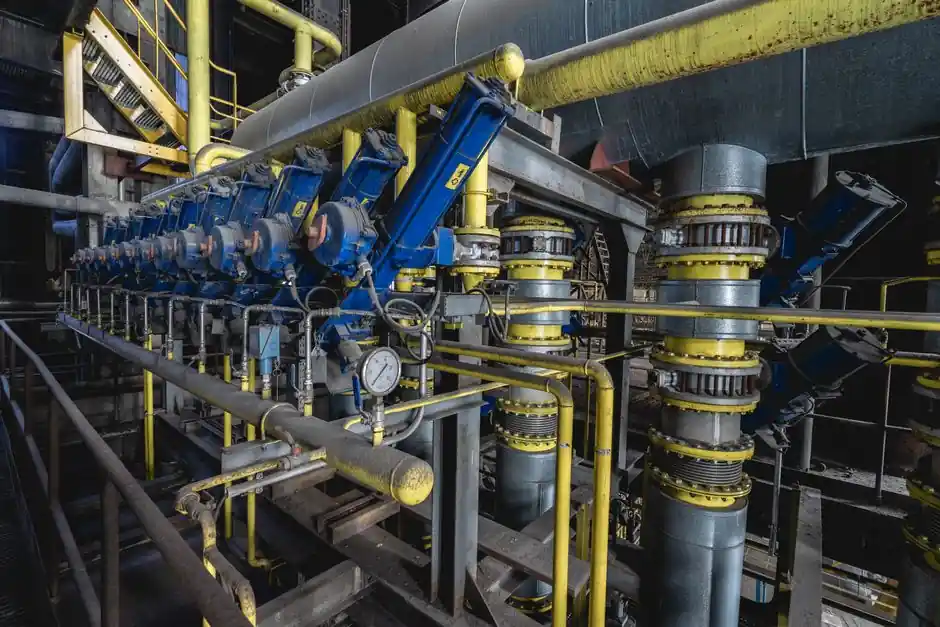
Pillow block bearings for pulp and paper applications are specified by matching insert type, seal architecture, and housing material to the wet-end, press, dryer, or calender section where the unit will run, with spherical roller pillow blocks dominating heavy-load dryer and calender rolls [S2][S4].
Across the industry, pillow block shaft diameters commonly span 5/8 inch to 5 inch, alignment tolerance is held within 0.05 mm, and re-lubrication every 3 to 6 months supports 30,000 to 50,000 hour service life in general industrial installations [S3]. NSK's TL-Series spherical roller bearings maintain dimensional stability up to 200°C through carbonitrided case hardening, addressing inner-ring hoop-stress fractures that drive chronic dryer cylinder failures [S4]. For a baseline on housing shapes, inserts, and locking styles, see the pillow block bearing encyclopedia entry.
Section-by-section load and contamination map
Paper machines expose pillow blocks to four distinct service environments, and the selection logic changes with each. Wet-end and Fourdrinier sections run saturated with water, pulp fibers, and chemicals at moderate temperatures, so the limiting factor is seal integrity rather than load capacity. Press sections add cyclic radial shock from the roll nip, pushing the specification toward spherical roller inserts with machined brass cages and heavy-contact lip seals. [S3]
Dryer and calender sections are the thermal extreme. NSK documents inner-ring fractures from shaft temperature rise as a recurring failure mode in this zone, and their TL-Series addresses it with carbonitriding that produces a case-hardened inner ring rated for stable operation up to 200°C [S4]. Timken's SAF split-block spherical roller pillow blocks are explicitly listed for pulp and paper equipment, combining cast-iron or cast-steel housings with high-capacity spherical roller bearings and a split construction that lets maintenance crews service the unit without pulling the shaft [S2]. Across all sections, contamination ingress is the dominant failure driver; published industry guidance attributes over 50% of bearing failures to contamination, which is why seal selection outweighs base bearing capacity in most selection meetings [S1].
Insert type and locking mechanism decision logic
Three insert families cover the majority of paper-machine pillow block applications. The UC series uses set-screw locking on a sealed deep-groove ball bearing and is the lowest-cost option for light-to-medium radial loads with unidirectional axial loading. The UK series uses a tapered bore with adapter sleeve and locknut, giving precise clearance control for heavier loads and higher speeds. The UEL series uses an eccentric locking collar, which trades a small amount of concentricity for easier field removal during roll changes. [S1]
For paper-machine dryer and calender rolls, spherical roller pillow blocks (SAF, SN, or TL style) replace the ball insert entirely because the radial load, misalignment window, and thermal growth exceed what a deep-groove ball insert can sustain. Timken specifies its SAF pillow blocks for shock loads, wide operating temperature ranges, and lubrication flexibility, all of which map directly onto paper-machine dryer-section requirements [S2]. NSK narrows the recommendation further: their TL-Series is positioned specifically for dryer rolls and calender sections where inner-ring hoop stress from shaft temperature rise is the documented failure mode [S4]. A useful cross-reference for general housing and seal logic is the agricultural pillow block bearing selection guide, which covers the same UC, UK, and eccentric collar families in a less demanding environment.
Seal architecture for wet-end versus dryer-section service

Seal design is the single highest-leverage variable in paper-machine pillow block specification. In wet-end and press sections, a triple-lip or heavy-contact nitrile seal with a secondary flinger is the common baseline; the goal is to keep stock water, fiber, and white water out of the bearing cavity while retaining grease. In dryer and calender sections where temperature is the constraint, fluoroelastomer (FKM) seals rated for continuous 200°C service are required to match the bearing steel's thermal limit [S4].
Labyrinth seals paired with grease-packed cavities are an alternative where particulate contamination dominates over water ingress, such as reel and winder sections with paper dust and broke. The trade-off is that labyrinth seals do not retain grease as effectively as contact lip seals, so re-lubrication intervals must shorten. Across all paper-machine sections, the published re-lubrication cadence is 3 to 6 months for general industrial pillow blocks, and high-temperature dryer sections typically run on the shorter end of that range [S3]. NSK's industry-specialist program explicitly lists inspection, diagnostics, root cause failure analysis, and scheduled maintenance as the service backbone for paper-mill customers, which reflects how often seal and lubrication issues, not bearing fatigue, drive the actual failure stream [S4].
Housing material and mounting for paper-machine frames
Cast iron remains the default housing material for paper-machine pillow blocks because of its vibration damping and machinability, with cast steel specified for the largest SAF pillow blocks where shock loads are routine [S2]. Ductile iron is the common upgrade when impact resistance matters more than raw compressive strength, such as on press-section rolls where nip loading is cyclic. Stainless-steel and thermoplastic housings appear in paper-machine pilot lines and laboratory facilities, but the production-scale paper machine is dominated by cast-iron and cast-steel pillow blocks.
Mounting is a fixed-plus-expansion pair: one pillow block is installed as the fixed bearing to locate the shaft axially, and the other is installed as the expansion bearing to allow thermal growth of typically 0.5 to 1.5 mm per meter of shaft length as the roll heats to operating temperature [S5]. For the larger split-block spherical roller units, the installation sequence is to lightly bolt the housing, set the position by hand, fully torque to the manufacturer's specification, and then verify axial freedom of the shaft before locking the expansion unit [S5]. Misalignment beyond the self-aligning window of the insert, typically ±2° to ±5° for spherical outer-ring inserts, induces edge stress and is one of the more common specification errors in retrofit work [S1]. For related selection logic in a different harsh environment, see the wind power pillow block bearing selection guide.
Comparison: insert families on four paper-machine decision criteria

Set-screw ball (UC), eccentric collar ball (UEL), adapter-sleeve ball (UK), and spherical roller (SAF/TL) inserts line up differently against the four criteria that drive paper-machine specification: radial load capacity, maximum continuous temperature, misalignment tolerance, and field serviceability. Set-screw UC is the lowest cost and easiest to install but offers the lowest load capacity and is limited to roughly 120°C continuous with standard nitrile seals. Eccentric-collar UEL adds easier removal for a small cost premium and similar thermal limit. Adapter-sleeve UK provides the most precise clearance control and handles higher speeds, but requires a spanner wrench and locknut torque procedure. [S5]
Spherical roller inserts in SAF or TL pillow blocks sit in a different category on all four axes: radial load capacity is several times that of any ball insert, continuous temperature rating reaches 200°C with the TL-Series steel [S4], misalignment tolerance is the full ±2° to ±5° window of the spherical outer ring [S1], and field serviceability is enabled by the split housing that lets crews replace the bearing without removing the shaft [S2]. The trade-off is unit cost and weight: an SAF pillow block can weigh several times a comparably sized UC unit, and the housing footprint requires more frame real estate. For most paper-machine applications outside dryer and calender rolls, the ball-insert families remain the cost-effective default; for dryer, calender, and large press rolls, spherical roller pillow blocks are the documented specification [S2][S4].
Failure modes that override the catalog selection
Three failure modes drive most paper-machine pillow block replacements, and each has a specific selection countermeasure. Inner-ring fracture from hoop stress, caused by shaft temperature rise in dryer sections, is addressed by carbonitrided case-hardened inner rings rated for 200°C operation [S4]. Contamination-driven lubricant degradation, responsible for over 50% of bearing failures industry-wide, is addressed by seal upgrades (triple-lip, FKM, or labyrinth) and a 3 to 6 month re-lubrication cadence rather than a longer factory interval [S1][S3]. Misalignment-induced edge loading, common in retrofit installations on existing paper-machine frames, is addressed by verifying the self-aligning window of the insert (±2° to ±5° for spherical outer-ring designs) and re-shimming the housing foot before final torque [S1][S5].
A fourth, less obvious failure mode is installation contamination: grease contaminated with metal particles or shop dust during mounting is one of the top causes of early bearing failure, which is why published installation procedures call for clean gloves, lint-free cloths, and clean shaft surfaces before the bearing is unpacked [S5]. For paper machines specifically, the additional risk is white-water carryover into the grease cavity during the first hours of operation after a roll change, so many mills specify an initial re-lubrication at 40 to 80 operating hours following a new install, ahead of the standing 3 to 6 month interval.
Sourcing, standards, and what to verify on the OEM datasheet

Pillow block bearings for paper machines are not governed by a single dedicated industry standard; instead, the relevant references are general rolling-bearing standards (ISO 15 for radial ball bearings, ISO 104 for spherical roller bearings) plus the OEM's own load-rating and speed-limit tables. NSK's TL-Series datasheet should be checked for the 200°C dimensional-stability rating and the case-hardening depth, both of which are the documented differentiators against conventional through-hardened bearings [S4]. Timken's SAF pillow block datasheet should be checked for the basic dynamic load rating (C), basic static load rating (C0), limiting speed, and the recommended housing bolt torque, all of which vary with bore size and housing style [S2].
For general industrial pillow block specifications, the published alignment tolerance of 0.05 mm and the 30,000 to 50,000 hour service-life range are useful baselines, but paper-machine operators should treat these as lower bounds rather than guaranteed values because contamination and temperature exposure in this industry are routinely more severe than the general industrial baseline [S3]. The most reliable specification path is to provide the OEM's industry specialist team with the section of the machine, the shaft diameter, the operating temperature, the radial and axial load, the speed, and the contamination profile, and to request a written application review. NSK publicly commits to this workflow through their paper-machine specialist program, which is staffed by personnel with a combined 300+ years of mill-floor experience [S4]. For context on how the broader bearing supplier landscape ranks on capacity and lead time, see the 2026 bearing market share and supplier ranking.
Trackable signals to watch over the next planning cycle: published 200°C-rated FKM seal options for the TL-Series pillow block family (currently documented for the bearing steel, with seal thermal rating to be verified per bore size on the OEM datasheet); updates to ISO 104 spherical roller bearing load-rating factors for paper-machine service factors; and any new TL-Series or SAF bore sizes covering the upper end of the 5 inch pillow block shaft range documented in the general industrial specification [S2][S3][S4].
The underlying component specifications are covered under lighting equipment and electric lamps, and aac block.