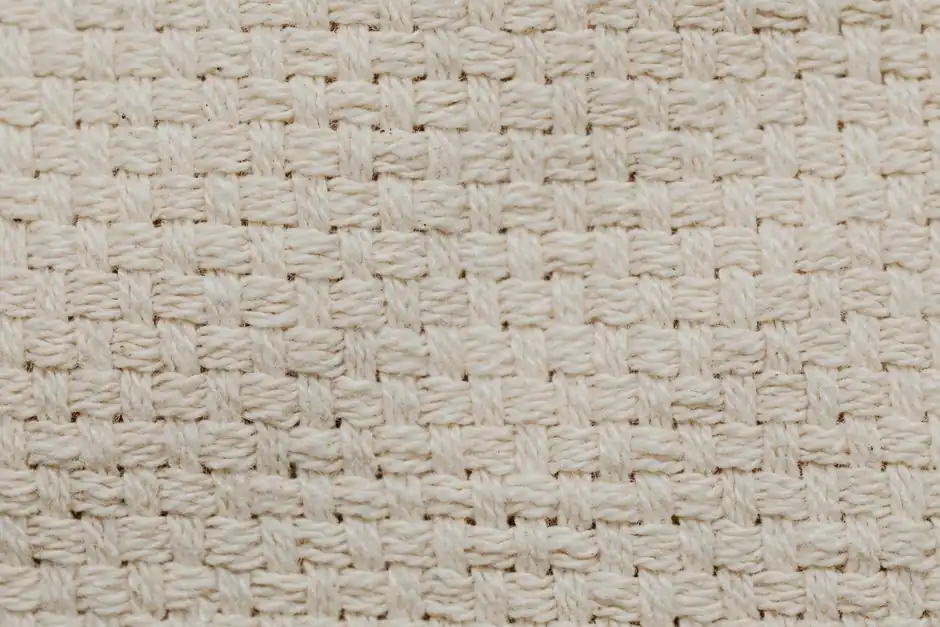
Twill weave drapes more easily than plain weave because its tow floats over two warp ends before interlacing under two, reducing crimp and giving the fabric the slack needed to wrap compound curves [S2][S3].
Plain weave, by contrast, interlaces every tow one-over-one-under, which locks fiber orientation tightly and resists the in-plane shear that a layup needs to fold over a contour [S1][S5]. For a flat tube, a 2D panel, or any cosmetic surface where a subtle, low-reflectance pattern is wanted, plain weave is the standard choice; for a 3D moulded part, twill is the default production option across automotive, sporting goods, and most aftermarket carbon panels [S4][S6].
How weave pattern actually changes drapability
The two patterns differ at the level of the interlace. In a plain weave, each tow passes over one perpendicular tow and under the next, giving the shortest possible float length and the highest interlace frequency, which translates directly into low in-plane shear and high fabric stability [S2][S3]. A 2×2 twill floats over two tows and under two tows, so the interlace frequency is roughly halved and the fabric can shear at the crossover points without the tows themselves having to bend hard, which is the mechanical basis of drapability [S2][S3]. The 4×4 twill variant goes further, passing over four and under four, which improves formability again but at the cost of fabric stability, and is therefore less common than 2×2 in production laminates [S2].
The practical consequence of the lower interlace frequency is reduced crimp angle, because the tow does not have to deflect as sharply at each crossover. Lower crimp means fewer stress concentrations in the cured laminate, which is one reason twill is preferred for parts that are loaded in bending after moulding rather than loaded purely in tension in a flat panel [S1][S2]. The same mechanism, however, also explains the well-known cosmetic difference: the longer floats in twill create the diagonal chevron or "twill line" that reads as a 3D pattern even on a flat surface, while plain weave reads as a tight 1×1 checkerboard that is only visible up close [S1][S4].
Decision matrix: plain weave vs 2×2 twill on the criteria that matter for forming
Across the sources, the comparison lines up consistently on four decision criteria. On stability, plain weave is highest, twill is moderate, because its interlace frequency holds the tow orientation closer to 0°/90° under handling [S2][S5]. On drapability or formability, the order reverses: twill is moderate-to-high, plain is low, with the 2×2 twill described as offering "moderate formability and moderate stability" and the 4×4 as having "slightly more formability than 2×2 twill" but less stability [S2]. On mechanical performance, the difference is described as "marginal" for typical cosmetic-and-structural parts [S4], with plain weave characterised as "slightly stronger" because the tighter pattern packs more fibre per unit area [S1]. On resin consumption and finished part weight, twill's ability to cover complex shapes with less material and lower resin uptake can reduce laminate weight compared with a plain weave forced to bridge the same geometry [S1].
The accompanying table distils this in the form most engineers actually use it: plain weave is the right answer when the part is flat or only gently curved, when maximum in-plane stability is needed during layup and cure, or when a subtle, non-reflective cosmetic surface is required; 2×2 twill is the right answer when the part has compound curves, when hand layup over a 3D tool is the process, or when the production team needs the most widely available carbon fabric on the market, which twill is [S4][S6]. If the requirement pushes further into deep-draw or highly compound geometry, the next step up is a harness satin weave (4HS, 5HS, 8HS), which trades still more stability for still more drape and is the historical answer for the most contoured composite parts [S2][S3].
Where each weave is actually used in production
In the motorcycle aftermarket, twill is dominant: Aprilia, BMW, Yamaha, and Kawasaki OEM carbon pieces are twill, while Ducati and MV Agusta use plain weave, according to a 2019 supplier breakdown that still reflects current catalogue offerings [S4]. The reason is process-driven: most aftermarket body panels are moulded over compound-curve tools, and shops prefer 2×2 twill because it conforms without the bridging and resin-rich corners that plain weave produces on the same tool [S1][S4]. For cosmetic flat trim, console inserts, and badging where a tight, low-glare pattern is desired, plain weave remains the specified finish, and its 1×1 checkerboard is also the weave most often called out in design guides as "subtle" because the pattern is hard to read at normal viewing distance [S4][S6].
Outside cosmetics, plain weave shows up where the laminate is essentially two-dimensional: flat sheets, tubes, and simple 2D curves, where the fabric's high stability keeps the fibre orientation locked at 0°/90° and the harsh crimp that plain weave introduces is not a fatigue concern because the part is not flexed in service [S2][S3]. The fatigue point is worth flagging: the same tight interlace that makes plain weave stable also creates the largest crimp angles in the tow, and these crimps act as stress concentrations that can weaken the part over time under cyclic loading, which is one of the reasons twill is preferred for dynamically loaded moulded parts even though the raw tensile numbers are similar [S1][S2].
Limits, failure modes, and what to watch on the shop floor
Plain weave's main forming failure mode is bridging, where the fabric spans a concave corner instead of conforming, leaving a resin-rich void underneath; this is most often seen on deep-draw or tight-radius tools and is the single most common layup defect that pushes a design from plain to twill [S1][S3]. Twill's main failure mode is fabric distortion: the lower interlace frequency that gives it drape also allows the tows to skew under handling, so a 2×2 twill laid up carelessly will not hold a true 0°/90° fibre orientation, and the cured part will be slightly twisted or off-axis from the intended ply schedule [S2][S7]. This is why twill is described as needing more careful handling than plain weave during cut, kit, and layup, and why shops that run high-mix production often spec 2×2 twill but inspect ply orientation with a template or laser projector before bagging [S7].
A secondary practical point is tow selection. The weave pattern is independent of tow count, but a 3K tow (3,000 filaments per tow, about 0.125 in wide for a standard 3K) produces a tighter-looking pattern than a 12K or 15K tow at the same weave, which affects both drapability and cosmetics [S2]. For deep-draw parts where every bit of formability helps, a 3K 2×2 twill is a common specification; for flat panels where a more pronounced weave is wanted for visual effect, a 12K 2×2 twill is also common and is the more abundant product in the supply chain [S2][S6]. Sourcing-wise, 2×2 twill in 3K is the most widely stocked carbon fabric and is the lowest-risk choice when lead time matters [S6].
Specifications, sourcing signals, and where to go next
For procurement, the actionable signal is that 2×2 twill, typically 3K tow at 200 g/m² areal weight, is the default carbon fabric carried by composite distributors and is therefore the shortest-lead-time option for most layup work, while 4×4 twill and harness satin weaves are typically special-order [S2][S6]. If the part specification calls for a 3K 2×2 twill with a 200 g/m² (±5%) areal weight and a 1.0 m nominal fabric width, that SKU is in stock at the major North American and European distributors, whereas the same fabric in a 4×4 twill or a 4HS satin will usually be a 2 to 4 week lead time [S2][S6]. For a deeper comparison of how woven fabric stacks up against braided sleeve on tubular carbon parts, the braided sleeve vs woven fabric selection guide covers the same drapability question in a tubular geometry.
Two trackable signals to watch in 2026 are the continued shift of motorcycle OEM catalogue trim from 2×2 twill to plain weave for matte-finish models, which several aftermarket suppliers flagged in 2019 as a styling trend [S4], and the gradual replacement of 3K twill with 1.5K or 1K tow "ultra-fine" twill in premium sporting-goods applications, where the cosmetic pattern is finer than 3K but the drapability is similar [S2]. For engineers writing a weaving specification today, the safe baseline remains 2×2 twill for any moulded part with compound curvature, plain weave for flat or 2D-curve laminates, and a step up to 4HS or 8HS satin only when the geometry has been demonstrated to exceed the forming limit of 2×2 twill in prototyping.