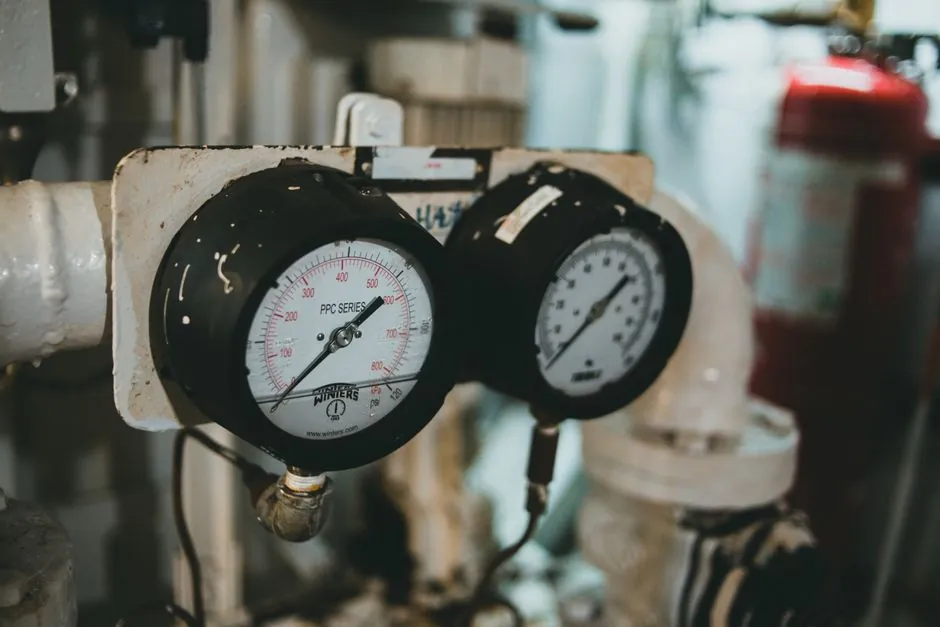
Rack-and-pinion pneumatic actuators across major OEM lines accept a supply pressure band of 2.5 to 8 Bar (approximately 36 to 116 psi) of clean dry or lubricated instrument air, with output torque proportional to that pressure [S1]. Spring-return and double-acting variants share the same pressure rating but differ in how torque is generated and recovered [S5].
Specifying an actuator from a datasheet without reconciling it against the valve's breakaway and dynamic torque, the minimum available air pressure at the actuator inlet, and the required stroke time is the most common path to a field failure [S3]. Engineers routinely treat the compressor setpoint as the working pressure, when the regulator drop, tubing restriction and simultaneous-valve events can pull the actuator inlet pressure well below that number [S4].
Supply Pressure Range and the Air Quality Envelope
Air Torque 4th-generation rack-and-pinion units carry a published operating supply pressure range of 2.5 to 8 Bar and accept either dry or lubricated air, with the lubrication sealed for life at the factory [S1]. The same family lists a standard temperature window of -20°C to +80°C, with special versions for extremes, and is qualified under ISO 9001 with unit-level serial traceability [S1].
The 2.5 Bar lower bound is the practical minimum at which the actuator can still develop rated breakaway torque on a dirty or lightly lubricated service; the 8 Bar ceiling is the structural maximum operating pressure (MOP), above which a relief valve or regulator is required to prevent piston seal and end-cap damage [S1][S4]. Compressor setpoint is not the same as the pressure at the actuator port: a regulator, a 4-way solenoid, length of tubing and quick-exhaust valves all sit between the header and the cylinder, and any one of them can pull the working pressure below the compressor setting during a two-second stroke [S3].
How Torque Is Generated: Piston Area Times Pressure
The output torque of a rack-and-pinion pneumatic actuator equals the piston pressure (air supply pressure) multiplied by the pitch radius (lever arm) of the rack-and-pinion geometry [S6]. In a spring-return unit, the air stroke produces output torque after compressing the return springs, so the net torque available to the valve is the air-generated torque minus the opposing spring torque at that angular position [S7].
WTMI / Flotite C-Series datasheets report double-acting torque from 115 to 28,500 lbf-in and spring-return torque from 50 to 16,500 lbf-in at 80 psig (about 5.5 Bar) supply [S5]. Linear torque output from 0° through 90° stroke is a deliberate design feature of opposed-piston rack-and-pinion geometry, and is the property that lets the datasheet publish a single rated torque figure per spring set per supply pressure rather than a torque curve [S5]. Diaphragm actuators follow the same F = P × A principle but replace the piston with a flexible diaphragm, so torque is set by diaphragm diameter, supply pressure and the opposing spring rate [S8].
Selecting Air Supply Pressure for Torque Sizing
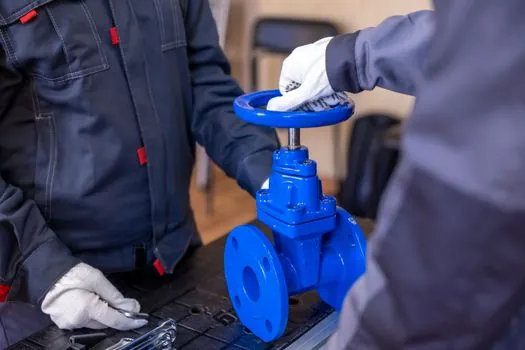
Assured Automation's quarter-turn sizing guidance defaults to 60 or 80 psi (about 4.1 or 5.5 Bar) as the working pressure for actuator selection, with the caveat that the value used must be the minimum pressure guaranteed at the actuator inlet, not the compressor setpoint [S9]. Increasing the supply pressure increases both the available torque and the volume of air consumed per stroke, so there is no free lunch in simply raising the regulator setting [S3].
Industry practice on the sizing margin is consistent: WTMI's worked example takes a maximum valve torque of 2,600 + 500 = 3,100 lbf-in, then adds a 20% safety factor to land on a required operating torque of 3,720 lbf-in against an 80 psig air supply [S5]. Emerson community guidance reaches the same conclusion: the regulator setpoint should protect against the actuator's MOP, and the minimum supply pressure must be the basis for torque output, with a relief valve fitted where the regulated pressure could otherwise exceed the actuator's pressure rating [S4].
Air Consumption: Three Numbers, Three Different Questions
A pneumatic actuator datasheet typically states chamber volume per stroke; converting that to free-air consumption requires absolute, not gauge, supply pressure [S3]. Three derived values are needed to size a complete valve package: normalized air per stroke (NL/stroke or SCF/cycle) for comparing actuators and sizing air receivers, average demand (Nm³/h or SCFM) for compressor loading, and peak stroke flow (NL/min during travel) for the solenoid valve, tubing and quick-exhaust sizing [S3].
Plant-wide compressor capacity and the solenoid valve are not interchangeable: a valve that strokes once an hour can still fail a two-second closing requirement if the local flow path is undersized, while sizing the compressor from the simultaneous sum of all peak flows will grossly overstate the real load when valves do not move together [S3]. The practical check is mechanical: measure pressure at the actuator port and time both travel directions on the installed package, not on the bench [S3].
Comparison: Spring-Return vs Double-Acting vs Diaphragm

On torque output at a fixed 80 psig supply, the WTMI C-Series offers 115 to 28,500 lbf-in double-acting and 50 to 16,500 lbf-in spring-return from the same body, with springs field-convertible to swap modes [S5]. Air Torque 4th-generation rack-and-pinion accepts the same 2.5-8 Bar supply across both modes and is qualified to ISO 5211 and VDI/VDE 3845 mounting interfaces [S1]. Diaphragm actuators trade linear torque output and compact envelope for a soft, spring-loaded characteristic, with output set by diaphragm area, supply pressure and spring rate rather than by rack-and-pinion pitch radius [S8].
ABB UP-series universal pneumatic rotary actuators target a different envelope: damper, fan-inlet-vane, lever-operated valve, turbine governor and fluid-drive applications where the duty is modulating rather than on/off, and accept either electric or pneumatic control signals for proportional positioning [S2]. Comparing the three topologies on the same decision criteria, double-acting wins on raw torque density and cycle life up to about 1 million cycles, spring-return adds fail-safe positioning at the cost of roughly 40% of the available torque, and diaphragm offers the simplest stroking characteristic with the lowest moving-part count but the smallest torque envelope [S5][S8].
Standards, Interfaces and Sourcing Signals
ISO 5211 defines the actuator-to-valve mounting interface (output drive, bolt circle, stem dimensions) and is the standard quoted by both Air Torque and WTMI / Flotite datasheets [S1][S5]. VDI/VDE 3845 covers the accessory interface, including the NAMUR solenoid mounting slot and switch-box geometry that allow a solenoid or positioner to be fitted without a custom bracket [S1][S5]. For torque and pressure rating conformity, datasheets are typically issued under a manufacturer's ISO 9001 quality system with per-unit serial traceability rather than a third-party product certification [S1].
The 2.5 to 8 Bar pressure band, the 80 psig (5.5 Bar) sizing default, the 20% torque safety factor and the 90° linear-torque stroke window are the four numbers that recur across current rack-and-pinion datasheets, and the differences between product lines sit in cycle life, corrosion package and temperature window rather than in the core pressure-torque relationship [S1][S5][S9].
For sizing consistency, capture the minimum and maximum pressure available at the actuator inlet (not at the compressor), the chamber volume from the actuator datasheet, and the valve breakaway plus dynamic torque under service conditions; size the torque at the minimum pressure with a 20% margin, and size the air supply at the maximum instantaneous flow during a two-second stroke [S3][S4][S5]. Engineers working on adjacent fluid-power hardware can cross-check pump-side pressure and packing behaviour against plunger pump power end tolerances and plunger vs piston seal placement when the actuator is driven from a pneumatic-pneumatic booster or paired with a hydraulic supply. Reference background on pneumatic actuator selection and on pneumatic valve actuator sizing is available in the site encyclopedia, alongside torque sensor and torque wrench tester entries for verifying the bench torque values a datasheet quotes.