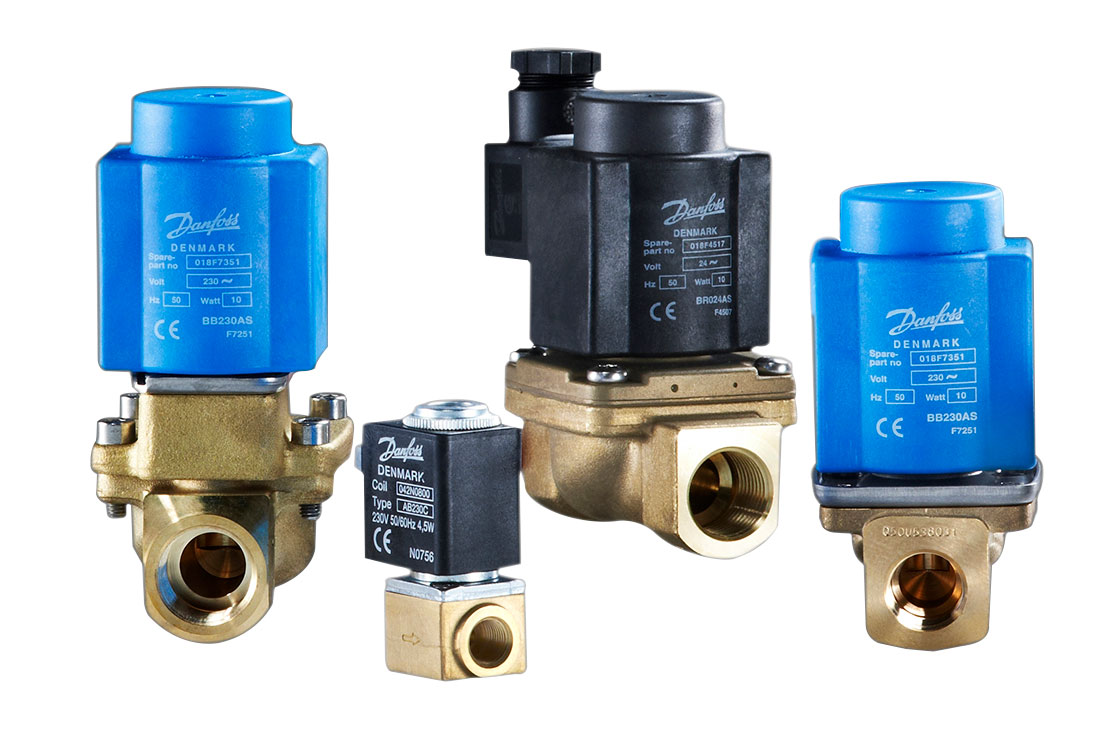
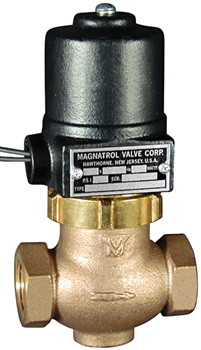
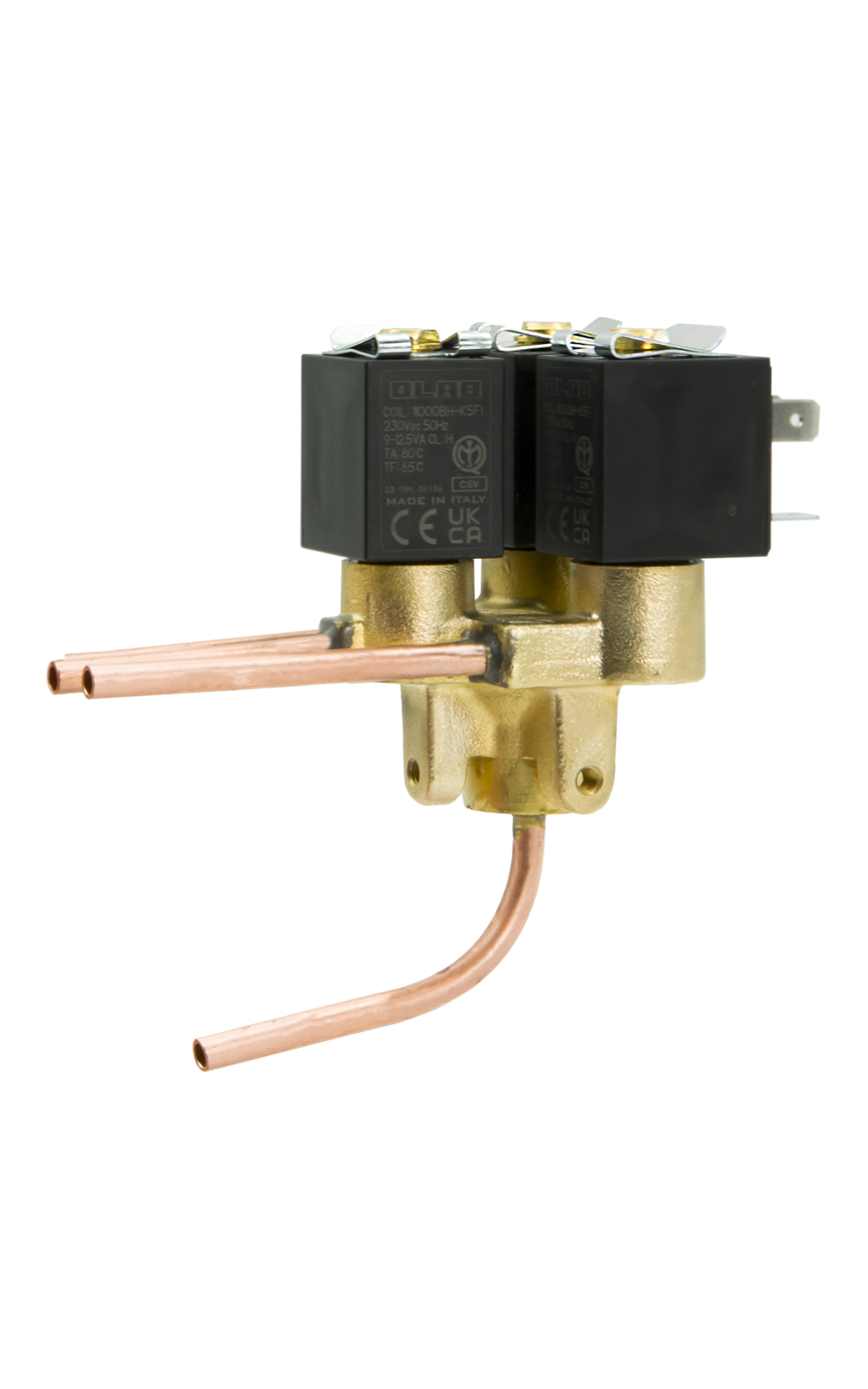
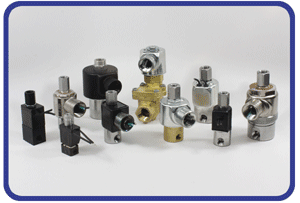
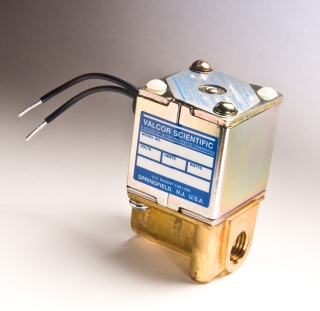
A solenoid valve is an electromechanically operated valve that uses an electric coil to switch the flow of a liquid or gas on and off. When current energizes the coil, the resulting magnetic field moves a ferromagnetic plunger that either opens the flow orifice directly or releases a pilot path so line pressure does the work. Because it converts a low-power electrical signal into a fast mechanical action with no external moving linkage, the solenoid valve is the standard automated shutoff and pilot element across process plants, pneumatic systems, water treatment, refrigeration, and machine tools.
The two architectures that define the category are direct-acting and pilot-operated, and the two attributes that define a given build are its port-and-position function (2/2, 3/2, 5/2) and its de-energized state (normally closed or normally open). This guide decodes those choices, the coil ratings, seal materials, and flow coefficients, then turns them into a selection sequence.
Photo: InterCity(IC), CC BY-SA 4.0, via Wikimedia Commons
This guide is written for industrial purchasing engineers and design engineers. It covers 6 chapters from what a solenoid valve is, through direct-acting versus pilot-operated architectures, port-and-position functions, body and seal materials, coil and flow specifications, to a structured selection sequence, with 7 selection FAQs and manufacturer comparisons. Parameters reference manufacturer datasheets (ASCO Series 210 and Burkert), the NAMUR VDI/VDE 3845 actuator mounting interface, IEC 60529 ingress protection, and IEC 60079 hazardous-area standards.
Chapter 1 / 06
What is a Solenoid Valve
A solenoid valve has two functional parts: the solenoid, an electromagnetic coil wound around a tube, and the valve body, which contains the orifice the fluid must pass through. The solenoid converts electrical energy into mechanical energy. When current flows through the coil, it creates a magnetic field that pulls a movable ferromagnetic core, called the plunger or armature, along the axis of the tube. The plunger carries a sealing element that either uncovers or covers the orifice. When the current is removed, a return spring pushes the plunger back to its rest position. This is the entire operating cycle, and it is what makes the solenoid valve the simplest reliable way to turn a fluid line on or off with an electrical signal.
The defining attribute of a solenoid valve is its de-energized state. A normally closed (NC) valve is sealed when no power is applied and opens only while energized, which is the fail-safe choice for most shutoff duties because a power loss stops the flow. A normally open (NO) valve passes flow when de-energized and closes only while energized, which suits applications such as cooling or venting lines that must stay open if control power is lost. The same valve cannot be both; the rest state is fixed by which side of the seat the spring holds the plunger against.
Solenoid valves sit between the control logic and the mechanical world. In a process plant, a PLC or DCS output card drives the coil, and the valve translates that bit into a physical flow change in milliseconds. They are used as final shutoff elements for water, air, gas, steam, and light oils; as pilot valves that drive larger pneumatic or hydraulic actuators; and as the switching elements inside dosing skids, analyzers, refrigeration circuits, and irrigation manifolds. Wherever an electrical signal must become a fluid action quickly and repeatably, the solenoid valve is the default.
The principle dates to the nineteenth-century discovery that a current-carrying coil behaves as a magnet, but the solenoid valve as an industrial product matured in the twentieth century alongside electrical process control. The American manufacturer ASCO, founded in 1888, is widely credited with developing the modern industrial solenoid valve and its long-running Series 210 (the 8210) remains an industry reference. European makers such as Burkert and Festo and Japanese makers such as SMC and CKD later built broad ranges for fluid control and pneumatics, so today the category spans from sub-watt micro-valves on analytical instruments to large 2-1/2 inch process valves moving cubic metres per minute.
Four engineering attributes govern whether a solenoid valve fits a duty: the actuation architecture (direct-acting or pilot-operated), the port-and-position function, the wetted materials and seal compound, and the coil and flow ratings. The chapters that follow take each in turn, because choosing the wrong one of these is the root of nearly every field failure, from a pilot valve that will not open at low differential to a nitrile seal swelling in steam.
Chapter 2 / 06
Direct-Acting vs Pilot-Operated
The single most important architectural decision is whether the coil opens the main orifice itself, or whether it opens a tiny pilot orifice and lets the line pressure open the main valve. This choice sets the minimum operating pressure, the maximum flow, the coil power, and the response time. Getting it wrong produces a valve that either cannot open at low differential or cannot pass the required flow.
Direct-acting valves connect the sealing element directly to the plunger. The coil's magnetic force lifts the plunger and its seal off the orifice against the spring, the fluid pressure, and gravity. Because nothing else assists the coil, a direct-acting valve operates from a differential of 0 bar, which is the only architecture that works on dead-ended lines, vacuum, or near-zero-pressure systems. The penalty is flow: the coil can develop only a modest force, so the orifice and the achievable flow are small, and a larger orifice demands a physically larger and hotter coil. Direct-acting valves are therefore concentrated at small port sizes and lower flows.
Pilot-operated valves, also called servo-assisted, use the plunger to open a small pilot orifice in the diaphragm or piston that separates the inlet from the chamber above it. Opening the pilot lets the chamber pressure bleed to the outlet; the higher inlet pressure then lifts the whole diaphragm, exposing the large main orifice. A small coil thus controls a large flow because the line pressure is the muscle. The catch is that this scheme needs a minimum pressure differential across the valve, typically in the range of 0.3 to 0.5 bar, between inlet and outlet to lift the diaphragm. Below that threshold the diaphragm will not move even with the coil energized, which is the classic cause of a pilot valve that fails to open. A combined or assisted-lift design links the plunger mechanically to the diaphragm so it can open from 0 bar yet still benefit from pilot assistance at pressure, bridging the two architectures.
The table below compares the two architectures on the parameters that drive selection.
Attribute
Direct-Acting
Pilot-Operated (servo-assisted)
Minimum differential to open
0 bar
~0.3 to 0.5 bar
Typical port size
M5 to 1/2 inch
3/8 to 2-1/2 inch
Flow capacity
Low
High
Coil power for given flow
Higher
Lower
Works on vacuum / dead-end
Yes
No (needs differential)
Sealing element
On the plunger itself
Diaphragm or piston
Typical use
Analyzers, dosing, low-pressure lines
Water, air, gas process shutoff
A practical rule follows from the table: if the line can run at or near zero differential, or can ever be dead-ended, choose direct-acting or assisted-lift. If there is reliable line pressure and you need substantial flow from a small coil, choose pilot-operated. The most common field mistake is fitting a cheap pilot-operated valve on a low-head water line and then finding it will not actuate, because the available differential never reaches the rated minimum.
Chapter 3 / 06
Port and Position Functions
Solenoid valves are classified by a two-number code: the count of fluid ports and the count of switching positions. The first number is the ports, the second is the positions. This code, combined with the normally closed or normally open rest state, fully describes what a valve does. Confusing the function code with the rest state is a frequent ordering error, so this chapter separates them clearly.
Function
Ports
Positions
Typical Role
2/2
2
2
On-off shutoff of a single line
3/2
3
2
Drive single-acting cylinder; pilot a larger valve
Double-acting cylinder with mid-position hold/vent
2/2 valves are the workhorses of fluid shutoff. They have an inlet and an outlet and switch between fully open and fully closed. Almost all process water, air, gas, and steam shutoff valves are 2/2, available as normally closed for fail-safe stop or normally open for fail-safe pass. The ASCO 8210 is a representative 2/2 pilot-operated family in brass and stainless steel covering 3/8 to 2-1/2 inch ports.
3/2 valves add an exhaust port. The common port is switched between a pressure port and an exhaust port, so the device downstream can be pressurized or vented through the same valve. This makes the 3/2 the natural way to drive a single-acting (spring-return) pneumatic cylinder, and it is also the standard element for piloting a larger pneumatically actuated process valve: the small 3/2 supplies or vents air to the actuator, and the actuator strokes the big valve. In process control these pilots frequently follow the NAMUR VDI/VDE 3845 mounting pattern so one valve fits many actuator brands.
4/2, 5/2 and 5/3 valves belong to pneumatics. A 5/2 valve has a pressure port, two cylinder ports, and two exhaust ports, and it is the standard way to extend and retract a double-acting cylinder: energizing the coil sends air to one side while the other side exhausts, and switching reverses both. A 5/3 valve adds a centre position so the cylinder can be held or vented mid-stroke, which matters for safe stopping. These pneumatic valves are usually pilot-operated internally and are dominated by SMC, Festo, and CKD ranges.
Independently of the port code, every valve is either normally closed or normally open in the de-energized state, and many bodies are offered both ways. The rule of thumb is to pick the rest state that is safe on power loss: a fuel or process-stop line is normally closed so a fault stops the flow, while a cooling-water or vent line that must not be cut off is normally open. For 3/2 pilots driving an actuated valve, the rest state is chosen so the big valve fails to its safe position, open or closed, on loss of either electrical or air supply.
Chapter 4 / 06
Body and Seal Materials
Two material decisions define media compatibility: the valve body and wetted internals, and the elastomer of the seat seal and diaphragm. The body sets the structural and corrosion limits; the seal compound, which is the smallest and cheapest part, is the most common cause of premature failure when it is mismatched to the medium or temperature.
Brass is the default body for compressed air, water, light oils, and inert gas. It is inexpensive, machinable, and adequate for the large majority of utility duties; the ASCO 8210 and most general-service ranges offer a brass body as standard. Brass is not suitable for demineralized or aggressive water, ammonia, or chloride-bearing media, where it dezincifies or corrodes. Stainless steel (304 or 316/316L) is specified for corrosive media, steam, food and pharmaceutical service, and outdoor or marine environments. It costs more and is offered as an alternative body on the same series. For low-cost OEM and irrigation duties, reinforced polymer bodies (such as glass-filled nylon or PA) are used with water and air.
The seal compound must be matched to both the chemistry and the temperature of the medium. The four mainstream elastomers and PTFE cover almost all duties; the table below summarizes their working ranges and best fit.
NBR (nitrile) is the standard general-purpose compound, with excellent oil and fuel resistance, used for compressed air, water, and light hydrocarbons up to roughly +80 degrees Celsius. It is moderate on weathering and ozone and is unsuitable for steam, brake fluid, and polar solvents. EPDM is the choice for hot water, low-pressure steam, weak acids and bases, and outdoor exposure, working from about -40 to +140 degrees Celsius, but it swells in oils, greases, and hydrocarbons. The two are nearly opposite in oil tolerance, so confirm which the application needs before ordering.
FKM (Viton) resists fuels, oils, and a broad range of chemicals at elevated temperature, roughly -10 to +140 degrees Celsius, making it the upgrade from NBR for hydrocarbon and chemical service; it is not suitable for steam or for certain polar solvents and esters. PTFE is chemically inert against almost all media and tolerates roughly -30 to +180 degrees Celsius, so it is reserved for aggressive chemicals and high-purity duties, accepting that its hardness reduces sealing elasticity. VMQ (silicone) spans the widest temperature band for dry gas and food-contact use but is weak against steam, fuels, and abrasion. As with body material, always cross-check the manufacturer chemical-compatibility chart for the exact concentration and temperature before committing.
Chapter 5 / 06
Coil, Flow and Spec Parameters
Beyond architecture, function, and materials, a solenoid valve is defined by its coil ratings, its flow coefficient, and a handful of pressure and protection parameters. These are the numbers on the datasheet that decide whether the valve fits the electrical supply, passes the required flow, and survives the environment.
Coil voltage is offered in common steps: 12 V DC, 24 V DC, 24 V AC, 110 to 120 V AC, and 220 to 240 V AC. The coil must match the available control supply, and a coil wound for one voltage cannot simply be run on another. AC versus DC is a real engineering choice, not a formality. A DC coil draws a constant current, is rated in watts (a small 2/2 pilot coil is commonly 8 to 12 W), and has no inrush, which suits PLC and DCS outputs and intrinsically safe loops. An AC coil is rated in volt-amperes and exhibits a high inrush current that drops to a lower holding current once the plunger seats. A critical failure mode follows: if an AC plunger jams and cannot seat, it keeps drawing the high inrush current and the coil can overheat and burn out within minutes, whereas a DC coil simply continues at its rated current.
Insulation class and duty matter for continuous service. Coils are wound to thermal classes such as F (155 degrees Celsius) or H (180 degrees Celsius), and most industrial valves are rated for continuous (100 percent ED) duty so they can stay energized indefinitely. Where a valve is energized for long periods, the holding power and the ambient temperature together set the coil temperature, so verify the continuous rating rather than assuming it.
Flow coefficient is expressed as Cv or Kv. Cv is the flow of water in US gallons per minute that passes the valve at 1 psi differential; Kv is the flow of water in cubic metres per hour at 1 bar differential at 20 degrees Celsius. The two convert as Kv is approximately 0.86 times Cv. The flow coefficient depends on the orifice diameter and the internal body shape, not on the thread size, so two valves with the same 1/2 inch port can differ by several times in Cv. Do not size by thread alone; compute the required Cv or Kv from the design flow and available pressure drop, then choose a valve that meets it with margin. The orifice diameter (in millimetres) is the governing geometric parameter and is listed alongside the coefficient.
The remaining spec-sheet parameters that drive selection are summarized below.
Operating pressure range: the minimum and maximum inlet pressure. For pilot-operated valves the minimum is the differential needed to open (often 0.3 to 0.5 bar); the maximum is the rated working pressure, commonly up to tens of bar for water and air valves.
Media and ambient temperature: two separate limits. The medium temperature is bounded by the seal compound (see Chapter 4); the ambient temperature is bounded by the coil insulation class.
Response time: the open or close delay, typically tens of milliseconds for direct-acting valves and somewhat longer for pilot-operated valves that must move a diaphragm.
Enclosure / ingress protection: the coil and connector IP rating per IEC 60529, such as IP65 (dust-tight, water jets) or IP67 (temporary submersion); outdoor or washdown duty needs IP67 or above.
Hazardous-area certification: for explosive atmospheres the coil must carry ATEX or IECEx marking (for example Ex mb IIC T4 Gb for encapsulated coils, or Ex d for flameproof), plus NEPSI for China and FM or CSA for North America, all referencing the IEC 60079 series.
Electrical connection: the connector form, commonly a DIN 43650 (form A/B/C) plug, M12, or flying lead, which must match the field wiring.
Chapter 6 / 06
Selection Decision Factors
To turn the preceding chapters into a specific model, follow the decision sequence below. Most selection mistakes come not from a single wrong number but from settling a downstream choice before an upstream one, for example fixing the port thread before confirming the available differential. These eight steps can serve as a fixed RFQ template.
Medium, pressure and differential first: identify the fluid, its working pressure, and the differential actually available across the valve. If the differential can fall near zero or the line can be dead-ended, you must use direct-acting or assisted-lift; only with reliable differential can you use pilot-operated.
Function and rest state: choose the port-and-position code (2/2 for shutoff, 3/2 for single-acting or pilot, 5/2 for double-acting cylinders) and then the de-energized state, normally closed or normally open, picked so that power loss leaves the process in its safe condition.
Flow sizing: compute the required Cv or Kv from the design flow and available pressure drop, then select an orifice and valve coefficient that meets it with margin, rather than sizing by thread size.
Body and seal materials: set the body (brass for air and water, stainless for corrosive, steam, or hygienic service) and the seal compound (NBR, EPDM, FKM, PTFE, or VMQ) against the medium and its temperature, cross-checked on the chemical-compatibility chart.
Coil supply: specify the voltage (12/24 V DC, 24/110/230 V AC), AC or DC per the inrush and DCS considerations, the power, the insulation class, and the continuous-duty rating.
Process and electrical connection: select the thread or flange (G, NPT, M, or DN/PN flanged) and the electrical connector (DIN 43650, M12, flying lead) to match existing piping and wiring.
Protection and certification: set the ingress protection (IP65, IP67) and any hazardous-area, sanitary, or pressure-equipment certification (ATEX/IECEx/NEPSI/FM, 3-A/EHEDG, PED), and for actuator pilots confirm the NAMUR VDI/VDE 3845 interface if required.
Total cost of ownership: weigh purchase price against coil reliability, seal life in the actual medium, and the cost of an unplanned shutdown. A valve chosen with the right architecture and seal outlasts a cheaper mismatched one many times over.
One last commonly overlooked dimension is serviceability: whether spare coils and seal kits are stocked locally, whether the coil can be replaced without breaking the process seal, and whether the manufacturer maintains the series long term. Established ranges such as the ASCO 8210, Burkert Types 6213 and 6011, Parker Skinner, and the SMC, Festo, and CKD pneumatic families are supported with documented spares and wide regional availability, which is why they remain the default for plant standardization even when a generic valve is cheaper at the moment of purchase. Always confirm the exact orifice, coil voltage, seal, and certification on the manufacturer datasheet before ordering, because a single series spans dozens of build variants.
FAQ
What is the difference between a direct-acting and a pilot-operated solenoid valve?
A direct-acting valve uses the coil's magnetic force to lift the plunger and open the orifice directly, so it works from 0 bar differential and is the only choice where there is no line pressure to borrow. Its flow is limited because the coil can only develop a few tens of newtons. A pilot-operated valve uses the small plunger to open a pilot orifice, then lets the line pressure itself push the main diaphragm open, which gives much higher flow and larger port sizes from a small coil. The trade-off is that a pilot valve needs a minimum pressure differential, typically 0.3 to 0.5 bar, between inlet and outlet to actuate, so it will not open against zero or reversed differential.
What do the 2/2, 3/2 and 5/2 valve designations mean?
The first number is the count of fluid ports and the second is the count of switching positions. A 2/2 valve has 2 ports (inlet and outlet) and 2 positions (open and closed); it is a simple on-off shutoff valve. A 3/2 valve has 3 ports and 2 positions, switching a common port between a pressure port and an exhaust port, which is used to drive single-acting cylinders or to pilot a larger process valve. A 5/2 valve has 5 ports and 2 positions and is the standard way to drive a double-acting pneumatic cylinder forward and back. The function is independent of whether the valve is normally closed or normally open in its de-energized state.
Why does my pilot-operated valve not open even though the coil is energized?
Pilot-operated valves depend on a minimum pressure differential across the valve to assist the diaphragm. If the inlet-to-outlet differential is below the rated minimum, typically around 0.3 to 0.5 bar, the line pressure cannot push the diaphragm up even though the pilot orifice is open, so the valve stays shut while drawing full coil current. Confirm there is real flow demand and head downstream, verify the inlet pressure, and check that the bleed hole in the diaphragm is not clogged with debris. If the application genuinely runs at near-zero differential, the correct fix is to specify a direct-acting or an assisted-lift (combined) valve instead.
How do I choose between NBR, EPDM, FKM and PTFE seals?
Match the seal to the medium and temperature. NBR (nitrile) is the default for compressed air, water, light oil and fuels up to roughly +80 degrees Celsius, but it fails on steam and polar solvents. EPDM suits hot water, steam, weak acids and bases, and outdoor use from about -40 to +140 degrees Celsius, but swells badly in oils and hydrocarbons. FKM (Viton) handles fuels, oils and aggressive chemicals over a wide range, roughly -10 to +140 degrees Celsius, but is poor on steam and certain polar solvents. PTFE is nearly universally chemically inert and tolerates roughly -30 to +180 degrees Celsius for aggressive media, but is harder and less elastic, so it is reserved for chemical and high-purity service.
What coil voltages and power ratings are typical, and should I use AC or DC?
Common coil voltages are 12 V DC, 24 V DC, 24 V AC, 110 to 120 V AC and 220 to 240 V AC. DC coils are rated in watts (a small 2/2 pilot coil is often 8 to 12 W) and draw a constant current with no inrush. AC coils are rated in volt-amperes and exhibit a high inrush current that collapses to a lower holding current once the plunger seats. Choose DC where you want defined current, no inrush, and DCS or PLC compatibility; choose AC where mains is convenient and faster pull-in is acceptable. A jammed AC plunger that cannot seat keeps drawing inrush current and can burn the coil within minutes.
How do I size a solenoid valve using Cv or Kv?
Cv and Kv are flow coefficients: Cv is the US gallons per minute of water at 1 psi differential, and Kv is the cubic metres per hour of water at 1 bar differential at 20 degrees Celsius. They convert as Kv is about 0.86 times Cv. Size by computing the required Cv or Kv from your design flow, fluid density and available pressure drop, then select a valve whose coefficient meets or exceeds it with margin. Do not pick by port thread alone: a 1/2 inch valve can range from below 1 to over 4 Cv depending on its orifice. Oversizing wastes the differential you need to keep a pilot valve open, while undersizing starves the process.
What enclosure and hazardous-area ratings should I specify?
For general industrial duty, specify the coil and connector ingress protection: IP65 resists dust and low-pressure jets, IP67 adds temporary submersion, and washdown or outdoor duty should be IP67 or higher (NEMA 4/4X equivalents). For potentially explosive atmospheres, the coil must carry hazardous-area certification such as ATEX or IECEx, with a marking like Ex mb IIC T4 Gb for encapsulated coils or Ex d for flameproof housings; China requires NEPSI and North America requires FM or CSA. Process-control pilot valves for actuators frequently follow the NAMUR VDI/VDE 3845 mounting interface so a single valve fits many actuator brands.
Solenoid Valve Manufacturers
Source-backed product routes. Open a company dossier for procurement scope and cited evidence.