ISO 8573-1:2010 remains the binding reference for compressed air purity in industrial pneumatic systems, classifying air by three contaminant axes (solid particles, water, oil) on a numeric scale where Class 0 is user-defined and stricter than Class 1 [S2][S5].
SAE International lists 73 active standards under its Pneumatic Systems taxonomy, covering specification, design, manufacturing, and maintenance of compressed air equipment used across automotive, aerospace, and process industries [S3].
ISO 8573-1 Purity Classes by Application
ISO 8573-1 grades air on three independent axes. Particle class is set by both particle size and quantity per cubic meter, water class is set by pressure dew point, and oil class is set by total oil content in mg/m³, with Class 0 reserved for user-defined specifications in medical, pharmaceutical, and high-end electronics use [S5]. Recommended particle classes for industrial work are Class 6-7 for general factory automation, Class 4-5 for precision pneumatic control, and Class 2-3 for electronics manufacturing [S5].
Food and primary packaging lines have no single mandated purity under FSMA cGMPs (CFR Title 21 §117.40); instead, end users run a risk assessment and adopt a published benchmark. The Safe Quality Food (SQF) guideline, for example, specifies a final 0.01 µm filter stage with 99.999% efficiency at the point of use for direct food contact [S2]. Starting from a typical 7:4:4 compressor output (solid:water:oil), a properly cascaded treatment train can deliver a 1:4:2 class output that still satisfies ISO 8573-1:2010 [S2].
Contaminant Sources and Component Failure Modes
Four sources feed solid particles into a compressed air line: ambient dust ingested at the compressor intake, rust and scale from the pipework, wear debris from compressor and valve internals, and installation residue such as metal shavings and seal fragments [S5]. Particles scratch cylinder bores and piston rods, stick valves, accelerate seal wear, and erode positioning accuracy on automated cells [S5].
Moisture is the second silent killer. Atmospheric water vapor condenses once the air cools after compression, then migrates downstream as liquid, corroding valves, washing lubricant out of cylinders, and freezing in cold-environment drop legs if drainage is inadequate [S5]. Oil carryover from a lubricated compressor adds a third contaminant class, with carryover measurable in mg/m³ and bounded by ISO 8573-1 oil classes [S5]. For broader context on how quality spec gates stack across fluid-power systems, see this hydraulic system manufacturing quality breakdown.
Air Treatment Train: FRL Sequence and Maintenance Baseline
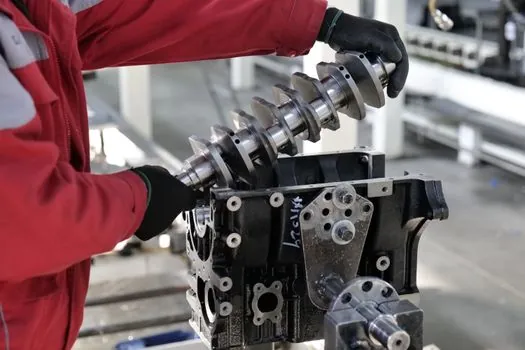
Every pneumatic system needs an air treatment train sized to the ISO 8573-1 class the downstream equipment actually requires. The standard build is filter-regulator-lubricator (FRL) in that order, with the regulator output stability verified and the filter pressure drop logged at every shift [S1]. Before any checklist is run, a baseline of normal operating pressure, compressor run hours, air consumption pattern, and acceptable filter pressure drop must be recorded, otherwise deviations cannot be flagged [S1].
Compressor health sets the ceiling. Inspect for abnormal cycling frequency (often a leak or clogged-filter symptom), temperature rise, and oil carryover; cooling system and intake filter condition must be logged at every service interval because the cheapest place to fix a contamination problem is at the source, not downstream [S1]. Drain functionality on moisture separators is the single most neglected item: even small amounts of entrained water corrode valves, wash lube from cylinders, and shorten seal life by a measurable margin [S1].
Food and Pharmaceutical Spec Stack: Beyond ISO 8573-1
For direct food contact and end-of-line packaging, ISO 8573-1 is necessary but not sufficient. cGMPs under FSMA require the end user to define an internal air quality target because the regulation itself sets no numerical threshold [S2]. Bodies that publish usable numeric recommendations include the British Compressed Air Society (BCAS), 3A Sanitary Standards, the German VDMA mechanical engineering industry group, and Safe Quality Food (SQF) [S2].
Filtration efficiency is the first line of defense. SQF's 99.999% efficiency at 0.01 µm at the point of use is the de facto benchmark when an end user has not run its own risk assessment, and a Festo MS-series air filter is one example of a commercially available element that hits 99.9999% efficiency in that envelope [S2]. Two more contamination vectors are routinely missed: leaking fittings and exhaust ports from valves mounted above the food zone, both of which can blow particulates directly over the product, so exhaust must be ducted to a safe area or the valve relocated [S2].
Leak Detection, Pneumatic Actuator Health, and Lifecycle Cost
Leaks are the most expensive hidden defect in a compressed air distribution system. Automated leak detection tied to a baseline consumption profile alerts the plant when air usage drifts outside an envelope, then drops system pressure during idle windows to cut energy cost [S2]. The same baseline is what makes a preventive maintenance plan auditable: filters clog, regulators drift, lubricators under-deliver, and fittings loosen gradually, with no single failure visible until they compound [S1].
For pneumatic actuators specifically, the maintenance gate is smooth stroke and response, consistent extension/retraction times, and absence of internal bypass, all checked against the application duty cycle [S1]. The more aggressive the cycle rate (automotive assembly, high-speed packaging), the tighter the air quality spec must be, because every particle and every milligram of water shortens seal life on a predictable curve. Pneumatic actuator selection and pneumatic conveyor sizing should both reference the ISO 8573-1 class the system will actually deliver at the point of use, not the class the compressor is rated for on the nameplate.
Standards Bodies and What They Actually Cover
SAE International's Pneumatic Systems taxonomy groups 73 standards covering system specification, design, manufacturing, and maintenance, with adjacent coverage under Power & Propulsion and Quality, Testing & Safety committees for cross-domain rules [S3]. ISO 8573-1:2010 sets the air purity class definitions that nearly every other pneumatic spec references, either directly or by reference through a customer-specific purity spec [S2][S5].
FSMA cGMPs (CFR Title 21 §117.40) add the cleanability and cross-contamination obligations for any pneumatic equipment in a food or pharma plant, and they leave the numeric air quality target to the end user's risk assessment [S2]. For a foundational read on the pneumatic domain itself, the SAE taxonomy page is the canonical index of which standard governs which subsystem.
Selection Criteria: Picking the Right Purity Class
Three decision gates drive an ISO 8573-1 spec. First, the most sensitive downstream component sets the floor: a Class 4-5 particle spec is the lower bound for precision pneumatic control, and Class 2-3 is the floor for electronics manufacturing [S5]. Second, the compressor output defines the head start: a typical lubricated screw compressor at 7:4:4 needs a three- or four-stage treatment train to reach 1:4:2 at the point of use, with each stage cutting one or more classes by a known factor [S2]. Third, food and pharma add a regulatory layer that can override the ISO spec with a 0.01 µm, 99.999% final filter at the point of use when direct contact is possible [S2].
The wrong gate to compromise on is leakage control. A useful comparator for the metallurgy and seal choices that sit downstream of the air treatment train is this bellows seal selection guide, which lays out the same spec-first logic for a related fluid-control component.
Track these signals over the next quarter: (1) any revision or amendment to ISO 8573-1, (2) SAE committee ballots in the Pneumatic Systems taxonomy that change FRL or actuator test methods, and (3) FSMA enforcement actions under §117.40 that publish a numerical air quality target, which would force a rewrite of every food-plant pneumatic spec that currently relies on the SQF or 3A benchmark.