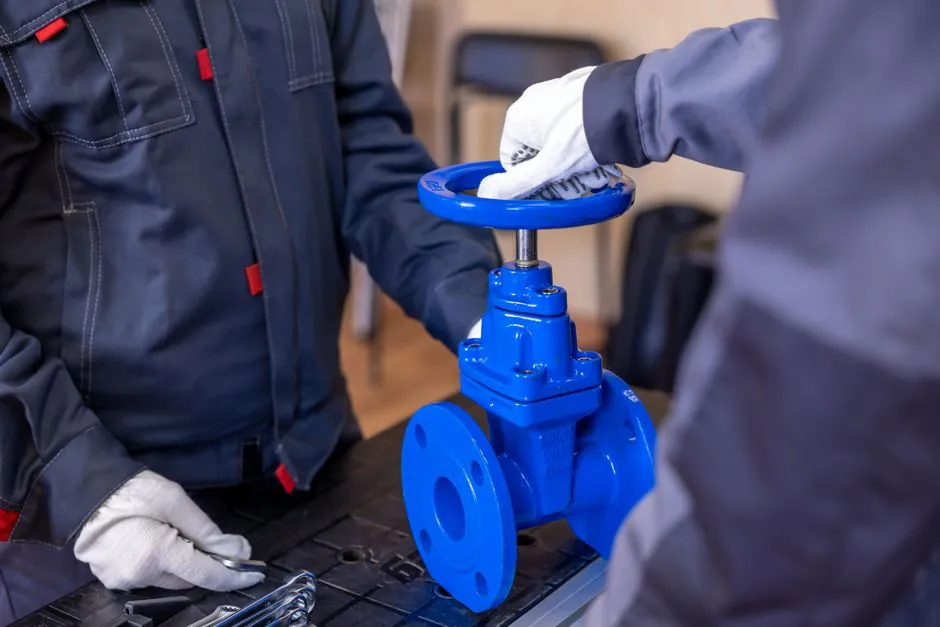
Use corrosion-resistant pneumatic valve actuators with IP68 protection for seawater desalination isolation, and specify fail-safe single-acting drives where loss of air pressure must not change a valve's safe position.
Selection depends on seawater chemistry, actuator travel, valve torque, air availability, fail position, cycling rate, and maintenance access across pretreatment, reverse osmosis, post-treatment, and brine systems [S1][S3][S4].
Actuator Types Matched to Desalination Duties
Rack-and-pinion pneumatic actuators suit quarter-turn isolation valves, while scotch-yoke mechanisms provide high-torque linear output for plug and gate valves [S4][S5]. Double-acting pneumatic drives use compressed air to open and close the valve, whereas single-acting actuators return the valve to a specified position when the air supply fails [S6].
For emergency isolation, chemical dosing, or high-pressure seawater service, single-acting operation is generally the safer selection because the stored mechanical force establishes the fail position without continuous electrical power [S5][S6]. Double-acting actuation offers faster two-direction travel and lower actuator size, but it requires a reliable air supply and a deliberate fail-action calculation [S6][S10].
Actuator output must be checked against the valve's maximum operating torque, not merely its nominal torque. Include the valve pressure class, seat design, differential pressure, pipe velocity, closing direction, and any manufacturer safety factor in the sizing calculation [S2][S3].
The pneumatic rack-and-pinion actuator is the mainstream choice for quarter-turn isolation, but repeated seawater service makes stem material, coating compatibility, and cycle-life testing as important as air consumption.
Corrosion Resistance Starts with the Complete Wet End
Seawater exposure requires region-specific material selection because salinity, temperature, pretreatment chemicals, and biofouling alter corrosion rates [S3]. The actuator housing and exposed drive components require a compatible stainless grade or coating system, while valve wetted parts need an alloy or lining suitable for the complete process stream rather than for seawater alone [S1][S3].
Bray identifies peroxide-cured EPDM, nylon-coated discs, duplex construction, corrosion-resistant alloys, resilient seats, and PFA lining as part of its seawater-desalination valve offering [S4]. These material choices must be matched to the relevant chloride concentration, oxidant exposure, temperature, and pressure because no single seat or metal construction is universally suitable [S3][S4].
Specify the required ingress rating, corrosion coating, stainless fasteners, and the operating atmosphere before accepting a generic actuator model [S1][S3].
For heavier duty involving phosphoric acid, ferric chloride, hypochlorite, or other pretreatment chemicals, do not infer compatibility from a valve datasheet without checking the chemical concentration and temperature [S3][S4]. The actuator itself should be isolated from splash and condensation where practical, with its air supply kept dry and filtered.
Air Supply, Fail-Safe Behavior, and Control Architecture
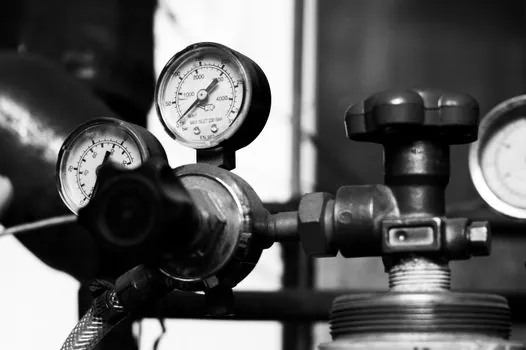
The actuator must be selected from measured or guaranteed instrument-air conditions, including available pressure, pressure variation, flow capacity, air quality, and the distance from the compressor or receiver [S2][S6]. A nominal air-pressure value alone does not establish trip capability; the air-main sizing must also cover valve opening demand, exhaust demand, and simultaneous operation of connected actuators [S2].
Define the required fail action as one of fail-close, fail-open, or fail-last-position before selecting single- or double-acting construction. A spring-return actuator can provide fail-close or fail-open behavior, while a double-acting actuator requires an external stored-energy arrangement if a specific position must survive loss of air [S5][S6].
For throttling applications, a pneumatic diaphragm actuator with a positioner is the relevant architecture because it converts controller pressure into controlled stem displacement [S6][S10]. For isolation, a pneumatic valve actuator is simpler, faster, and less sensitive to positioner calibration, but it requires a positive mechanical shutoff mechanism to limit leakage.
Position feedback should be specified where operators and SCADA need confirmed open or closed status. A limit switch or proximity sensor provides discrete state confirmation, while a positioner provides continuous travel feedback [S4][S5]. Instrument-air accessories should include a filter, regulator, and controlled lubrication only where compatible with the selected actuator [S5].
Desalination Applications and Valve Compatibility
Pretreatment duties include raw seawater intake, screening, pumping, filtration, disinfection, and chemical injection; reverse-osmosis duties include concentrate, permeate, feed control, and membrane flushing; post-treatment includes remineralization, pH adjustment, and carbon-dioxide dosing [S4]. The actuator must suit the specific valve geometry, not the entire plant as one homogeneous service.
Two-way pneumatic valves provide simple isolation, three-way valves divert or mix flow, and four-way valves coordinate multiple actuator directions or backwash sequences [S2]. Ball and butterfly valves are commonly used for full-open or full-closed isolation, while globe or diaphragm-type control valves are used where proportional regulation is required [S9].
Pneumatic actuation is common in desalination because it supports rapid operation and fail-safe positioning, whereas electric actuation offers broader positioning capability but introduces motor, gearbox, and power-supply failure modes [S5][S6][S10]. For chemical-injection and other hazardous-area duties, explosion-protected pneumatic equipment can avoid the ignition risks associated with electric motors [S2][S6].
Butterfly valves fit large-bore, quarter-turn isolation duties, ball valves provide tight shutoff in compact packages, and plug valves accommodate multi-port or high-pressure isolation configurations [S5][S9]. Each geometry changes the required actuator torque, stem loading, and permitted seat arrangement, so actuator selection must follow valve selection rather than precede it.
What Pneumatic Actuation Does Not Solve
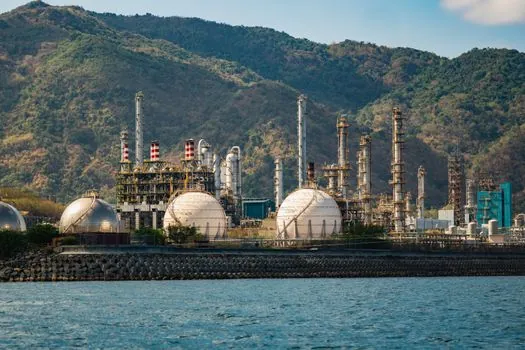
A pneumatic actuator cannot compensate for an undersized air system, a chemically incompatible stem, a damaged seat, or a valve selected outside its pressure rating. Corrosion can begin at the stem, exposed coupling, positioner, fasteners, or solenoid package even when the main housing is stainless [S1][S3].
Fail-safe action is also a system property. Back-pressure from the air header, a failed pilot regulator, trapped cylinder pressure, or slow exhaust can delay movement or produce an unintended intermediate position [S6][S10]. Specify the required movement time and verify it at minimum available air pressure, not at nominal pressure alone.
Continuous throttling requires a different selection discipline from on-off isolation. A quarter-turn actuator without a positioner is generally unsuitable for accurate flow regulation, and a control actuator must be matched to the valve's flow characteristic, rangeability, and required stroke [S9]. The pneumatic cylinder and pneumatic fitting components must also be selected for the installation pressure and environment rather than accepted as generic accessories.
Procurement Checklist and Acceptance Tests
Specify at least the valve type, model or series, port size, pressure class, design temperature, flow medium, corrosion allowance, seat material, stem material, actuator orientation, fail action, and required output torque [S3][S7]. The actuator datasheet should also state air-pressure range, allowable travel or rotation, mounting interface, cycle-life rating, enclosure protection, coating system, and position-feedback options [S1][S6].
Require factory evidence that actuator output exceeds the valve's calculated maximum operating torque at the specified minimum air pressure and valve temperature. A torque test alone is not sufficient if the test omits seat friction, stem force, closing direction, and dynamic effects.
Inspect the actuator and valve as a tagged assembly before installation. Confirm that the serial number, model, mounting orientation, fail action, calibration settings, and wetted-material declarations match the purchase specification [S4]. The supplier's product families include Series 98 scotch-yoke pneumatic actuators, resilient-seated butterfly valves, segmented ball valves, PFA-lined butterfly valves, Series 54 proximity sensors, and Series 5A resin switch boxes, but model selection still requires project-specific sizing [S4].
For deeper isolation-valve decisions, compare the actuator duty with butterfly valve selection for seawater desalination, then confirm torque, seat compatibility, and fail action against the selected valve rather than treating actuator and valve as independent products.
Track two signals during procurement: minimum guaranteed actuator torque at minimum air pressure, and documented compatibility of every wetted or externally wetted material with the specified seawater and chemical service. Resolve either gap before approving the package.