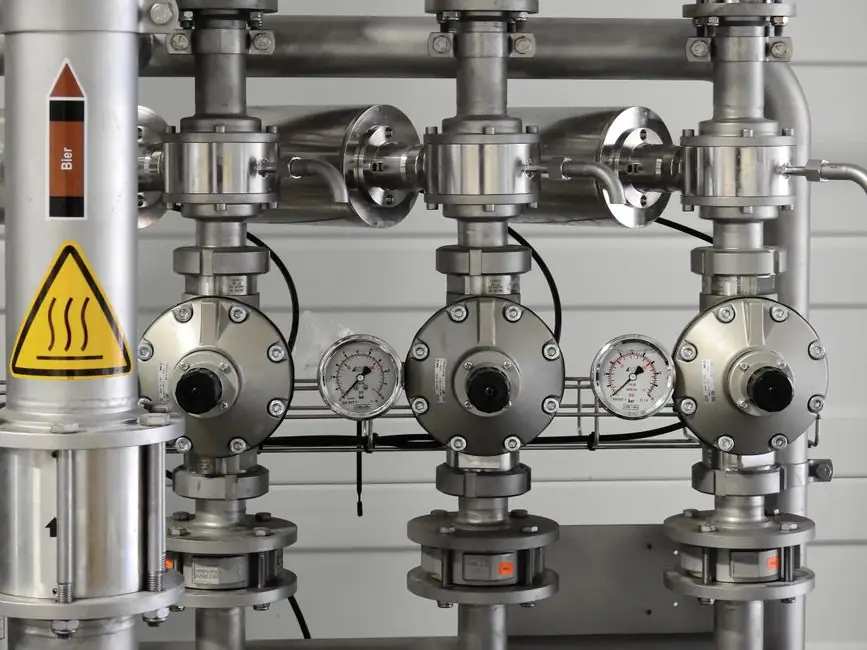
Pneumatic irrigation actuators are selected in four stages: valve torque, linear or rotary motion, air action, and ISO 5211 interface [S5].
The normal duty is rapid on/off control of butterfly, ball, plug, gate, or globe valves, but spring-return, double-acting, rack-and-pinion, and scotch-yoke options solve different safety and torque requirements [S2][S3][S4].
Define the irrigation valve and operating duty
Rotary actuators suit quarter-turn ball, plug, and butterfly valves, while linear actuators suit gate, globe, and pinch valves [S4]. A pneumatic cylinder is the appropriate concept for linear motion, but its rated thrust must be converted to the force required at the valve stem rather than compared directly with valve torque.
For every application, record the valve type, bore and connection class, closure member, fluid, pressure range, and opening or closing torque. The installation environment, required cycle life, duty cycle, actuation speed, manual override, and fail-safe requirement also affect the final selection [S4]. These data form the sizing case and prevent a generic actuator from being selected on bore alone.
Electric operation is more suitable where the system performs few isolated valve movements, while pneumatic operation becomes more credible when rapid response, distributed compressed air, or stored spring energy provides an operational advantage [S1][S3]. The actuator should still be checked against the available air pressure and piping rather than classified by drive type alone [S3].
Compare the main actuator configurations
Both use ISO 5211 mounting, so the valve interface does not distinguish them [S5].
This is a comparison point, not a universal capacity rule. Actual selection must use manufacturer torque curves and the valve supplier's maximum torque with margin [S7].
Size from the complete torque curve

A pneumatic actuator's usable output depends on air pressure, mechanism efficiency, and valve torque over the complete travel [S3][S5]. Rack-and-pinion sizing normally requires enough output throughout the stroke, while scotch-yoke sizing requires particular attention to seating and unseating torque at the end positions [S5].
Spring-return sizing is driven by two separate loads: the air must overcome valve resistance and drive the spring through the stroke, while the spring must provide enough stored energy to return the valve to its required position [S7]. Use the valve's rated opening and closing torque, minimum available supply pressure, and actuator manufacturer sizing factor; do not select only from nominal maximum torque [S7].
For irrigation systems, include the pressure needed to open the valve against its design operating pressure, not merely the pressure difference across a closed valve. Also check the torque required to move the closure member away from the seat at both the start and end of travel. Seating loads, line pressure, and valve geometry determine those peaks [S2][S7].
A pneumatic valve actuator should therefore be specified with the complete valve data sheet, minimum and maximum air pressure, required failure action, and the manufacturer's torque calculation. The actuator's maximum torque rating alone does not demonstrate that it can operate the valve throughout the stroke.
Choose the correct fail-safe action
Air-to-open actuation increases valve opening as supply pressure rises, while air-to-close actuation decreases opening as pressure rises [S3]. These terms describe the powered stroke; spring-return units also need a specified failure position such as fail closed or fail open [S2].
Fail closed is normally preferred for irrigation isolation valves where continued flow after loss of instrument air could waterlog a zone or create an unsafe operating condition. Fail open may be appropriate for a drain or bypass valve whose safe state requires flow, but it should not be selected without reviewing water hammer and downstream equipment consequences. The pneumatic diaphragm actuator is one possible pneumatic execution, while rack-and-pinion and scotch-yoke are common rotary mechanisms [S3][S4][S5].
Double-acting units use compressed air for both strokes and normally remain in the last position when air is lost [S5]. That behavior can be intentional where no safety position is required, but it is not equivalent to a fail-safe design. If the irrigation network requires a known state after air failure, specify the required position explicitly in the purchase specification.
Match the installation and pneumatic supply
ISO 5211 is the cited mounting standard for both principal rotary pneumatic mechanisms [S5]. Confirm the exact ISO 5211 size and flange pattern from the valve datasheet before ordering. A compatible actuator can still be mechanically unusable if the shaft, coupling, stem height, or valve-to-actuator orientation does not match [S5].
Actuator output force is proportional to air pressure, while capacity also depends on operating time and the size of the piping needed to deliver air [S3]. Consequently, minimum supply pressure, pressure loss in local piping, line sizing, and valve stroke time belong in the same calculation. A pneumatic fitting or pneumatic tubing selected only by inlet thread size can restrict flow and prevent the valve from reaching its specified cycle time.
Use clean, dry compressed air and account for corrosion, dirt, and heat exposure because pneumatic mechanisms can seize when contaminated or corroded [S3]. Filters, regulators, and instrument-air treatment should protect the actuator. Exhaust location also matters in enclosed pump houses: add suitable pneumatic silencer equipment where exhaust noise and debris require control.
Identify unsuitable applications and failure modes
A pneumatic actuator is a poor default for an irrigation valve with no compressed-air supply, a duty requiring prolonged holding without reliable air pressure, or an application where electrical actuation provides better position control [S1][S3]. A spring-return unit can also consume more air than a double-acting arrangement because stored spring energy must be replenished on every cycle [S3].
The main failure modes are incorrect torque sizing, loss of the required fail-safe action, insufficient air pressure, restricted flow from undersized tubing, contamination, and mechanical incompatibility at the mounting interface [S3][S5][S7]. Air loss can leave a double-acting valve in its last position, while an incorrectly specified spring can fail to return a valve against line pressure [S5][S7].
Pneumatic actuation is not a substitute for accurate valve selection. For broad, hydraulic-network control, balancing valve selection for irrigation systems addresses upstream flow distribution, while this guide addresses the actuator that opens and closes the selected isolation or control valve.
Issue a complete procurement specification
The procurement package should identify the valve type and size, fluid and operating pressure, opening and closing torque, stroke time, cycle frequency, available air pressure, fail action, ISO 5211 interface, and mounting orientation [S3][S4][S7]. For spring-return units, include the required spring direction, minimum supply pressure, and calculated return torque. For rotary units, request the full torque curve rather than one peak rating [S5][S7].
Require a manufacturer sizing calculation against the project valve data, rated operating pressure, and minimum supply pressure [S7]. The document package should also cover accessories, position indication, manual override, tubing interface, air preparation, and environmental exposure. Electric or hydraulic actuation should be compared when the required cycle rate, holding behavior, or power availability conflicts with pneumatic operation [S1][S3].
The shortlist logic is direct: use a rotary rack-and-pinion unit for a torque-stable butterfly-valve duty, a scotch-yoke unit for a large ball valve with high seating torque, a linear pneumatic cylinder for gate or globe service, and a spring-return mechanism whenever loss of air must produce a specified position [S4][S5]. Reject any candidate whose published torque curve cannot meet the valve's calculated demand at the minimum project air pressure.