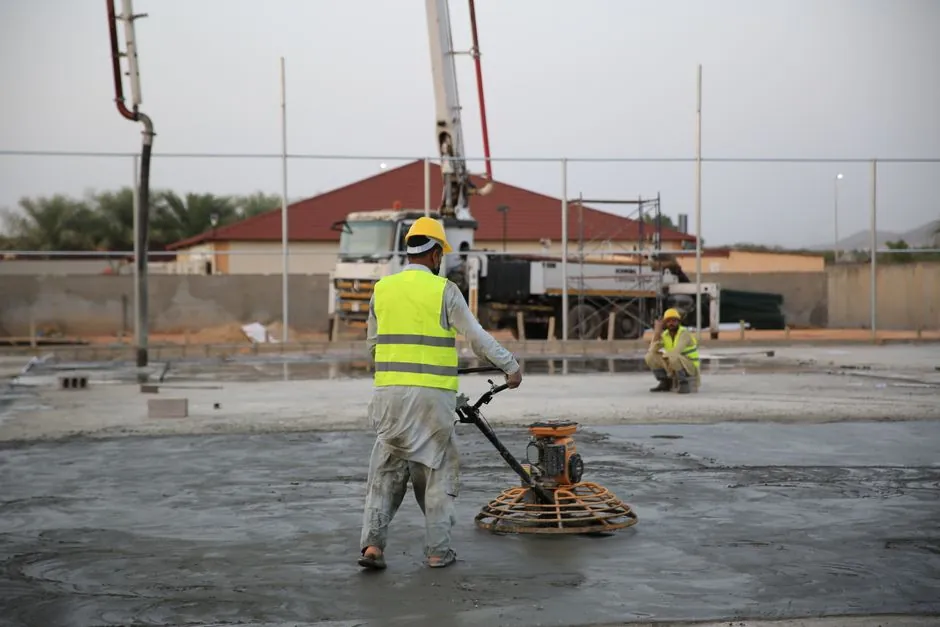
A 60 m3/hour pour needs 2 to 4 poker vibrators running simultaneously, with a 5th unit kept on standby, assuming standard 38 to 75 mm probes on a 6 to 10x-diameter insertion grid [S1][S2].
Single-operator compaction throughput on standard equipment ranges from 3 m3/hour at low power to 12 m3/hour at the high end of typical handheld pokers, so a 60 m3/hour pour sits well above any single-operator envelope [S5]. Each insertion is held 5 to 15 seconds before slow withdrawal, and over-vibration creates its own weak planes, so a slow tempo is non-negotiable [S3].
Compaction Throughput Per Operator
Operator-driven compaction rates scale with poker power and frequency, with a single unit compacting 3 m3 to 12 m3 of concrete per hour on standard commercial equipment [S5]. At the low end (3 m3/hour), 60 m3/hour would demand 20 operators, which is plainly not how a pour is run; at the high end, 5 operators suffice. In practice, crews of 3 to 4 operators are the typical fit, because each insertion takes 5 to 15 seconds, withdrawal rate is roughly 1 inch/second, and probe re-insertion cycle time caps how fast any one operator can move down a placement line [S3].
For deeper or heavier pours, the field rule on withdrawal rate and hold time lines up with this throughput math, since a 5-second hold and a 1 in/s withdrawal limit each insertion cycle to roughly 25 to 30 seconds including reposition. That timing converts directly into the number of probes active on a 60 m3/hour placement.
Probe Diameter, Radius of Action, and Insertion Grid
Vibration points should be spaced 6 to 10 times the poker diameter apart, depending on the mix's fluidity; dry mixes need tighter 6x spacing, fluid mixes can run 10x [S1]. Standard probe diameters span 25 to 100 mm, with 25 to 60 mm being the typical handheld range and 38 to 75 mm covering the majority of slab, wall, and column work [S1][S2]. A 60 mm probe, for example, calls for 360 to 600 mm spacing between insertions, and its radius of action roughly equals 8 to 10x the diameter, which is why spacing and radius of action are essentially the same engineering quantity in the field.
Probe frequency sits in the 12,000 to 16,000 vpm band for standard high-frequency electric pokers driven by a converter, while 200 Hz external-frequency models run even higher for commercial and civil infrastructure pours [S2]. High-frequency is the better choice for pours above 6 m depth or where long transmission shafts (up to 16 m standard, with 1 m of extra length over pour depth as the rule of thumb) are needed [S1].
Calculating the Active Poker Count for 60 m3/Hour

Working the math: 60 m3/hour equals 1 m3/minute, and a 60 mm probe acting over a 500 mm radius of action covers roughly a 0.785 m3 cylinder slice per insertion. With 25 to 30 second cycles, one operator can finish about 2 to 2.4 insertions per minute, so a single 60 mm operator can keep up with about 1.5 to 1.9 m3/minute of placement in standard slab work. That keeps 3 operators on the safe side, 4 in reserve, with 1 additional poker held as a hot spare to cover operator rotation and unit failure. [S2]
For 38 mm probes, the radius of action drops to roughly 300 mm and the coverage per insertion falls to about 0.28 m3, so 4 to 5 operators are needed to keep up with the same 60 m3/hour rate, since insertion spacing drops to 230 to 380 mm and cycle time per probe does not change materially. For 75 mm probes, 2 to 3 operators handle 60 m3/hour because the radius of action extends to roughly 600 to 750 mm and each insertion covers about 1.1 to 1.8 m3 of concrete.
Type Comparison: Electric, Pneumatic, Combustion, High-Frequency
Electric poker vibrators on 110V or 220V supply are the workhorse for indoor and stationary pours, with two sub-classes: high-frequency (built-in motor) and low-frequency (external motor) [S2]. Pneumatic pokers run on compressed air and are intrinsically safe for explosive atmospheres, which is why they are common in mining and industrial environments, while petrol and diesel units are reserved for remote sites with no electricity and where high torque outweighs emission concerns [S2].
High-frequency units fed by a 50/60 Hz to 200 Hz converter are widely used on commercial and civil infrastructure projects where faster, more effective compaction justifies the converter capital cost [S2]. For a 60 m3/hour pour, the high-frequency electric or pneumatic route is the typical pick, because sustained 12,000 to 16,000 vpm output keeps the radius of action stable across a continuous shift, whereas low-frequency pokers lose amplitude as concrete stiffens.
Who This Sizing Is For, and Where It Breaks Down
Three to four active pokers is a sound fit for a standard slab or wall pour at 60 m3/hour, where rebar spacing accommodates a 38 to 75 mm probe and placement depth is under 6 m. Five or more pokers are not productive at this throughput and the operators start stepping on each other in the placement line. One poker is never enough: 60 m3/hour exceeds any single-operator envelope from 3 to 12 m3/hour by a factor of 5 to 20 [S5].
Where the 3 to 4 figure breaks: heavily reinforced sections that force 25 mm probes and tight 150 to 250 mm spacing, deep pours above 6 m that need 16 m transmission shafts and high-frequency conversion, and dry, low-slump mixes that need 6x-diameter insertion spacing instead of 10x. In all three cases, plan for 5 to 8 active pokers and 1 to 2 spares on a 60 m3/hour placement.
Field Rules That Move the Number
Three operating rules drive the active count: 5 to 15 seconds per insertion, slow vertical withdrawal, and a 6 to 10x diameter insertion grid, all of which cap how fast any one operator can work a placement line [S1][S3]. The radius of action is proportional to poker diameter and amplitude, inversely proportional to poker weight, and damped by the concrete itself, which is why a heavier 75 mm head can out-work a 38 mm head even on a 60 m3/hour pour [S1].
Two final factors that swing the count upward: ambient temperature and concrete slump, both of which shorten working time and force a higher active count to beat the set. Two factors that allow a lower count: self-compacting concrete (SCC), which needs only spot verification, and formwork geometry that lets one operator cover two insertion points in quick succession.
Track the next two signals on a 60 m3/hour pour: measured radius of action on the first truck (rebar emergence, bubble trail cutoff) and insertion cycle time at the 30-minute mark (any rise past 30 seconds means one more poker is needed). Spare poker count, weighted by site power availability and fuel for combustion units, is the second signal to log.
Spec-level background on the components involved: pressure transmitter, flow meter, and industrial valve.