
A concrete needle vibrator should be pulled upward at roughly 1 inch per second (≈25 mm/s), with each insertion held 5 to 15 seconds before withdrawal, according to multiple current field guides [S1][S2][S3].
The figure is not a marketing number: it is the convergence point of three independent 2024-2025 construction references, anchored in turn by ACI 309R-05, Guide for Consolidation of Concrete, which names internal vibration as the primary method for normal-weight mixes [S4]. Frequency sits in a 8,000-12,000 vibrations per minute band, so the head consolidates by steady oscillation rather than brute shaking [S3][S4].
Withdrawal Rate: Why 1 inch/second, and What Happens Faster
Slow upward travel at about 25 mm/s lets the concrete reflow into the void left by the retreating needle; the head's effective radius (typically 4-10× the needle diameter) keeps consolidating the surrounding mix as it rises [S1][S2].
Pulling the poker out fast traps a vertical air channel inside the column of concrete the needle just occupied, because the mix cannot flow inward quickly enough to fill the gap [S1]. NRMCA CIP 6 lists such channel voids among the defects that accelerate reinforcement corrosion once water finds a path in [S4]. The corrective action is purely operator-side: keep the poker vertical, hold it briefly, and let the head do the work as it ascends.
Hold Time, Insertion Spacing, and Layer Re-Penetration
A typical insertion lasts 5 to 15 seconds, with the upper end triggered by mix stiffness, reinforcement density, and the vibrator's power rating [S3][S4].
Field signals that consolidation is complete: large air bubbles stop rising to the surface, the paste develops a uniform glossy sheen, and aggregate settles without segregation [S3]. Spacing between insertions should be roughly 1.5× the visible radius of action, and the poker should re-penetrate the previous lift by 50-100 mm (2-4 inches) so the two layers knit together instead of forming a cold joint [S3]. The general-purpose concrete vibrator lineup covers this whole envelope, with needle diameters from 25 mm to 100 mm and the 32-38 mm band dominating slabs, footings, and standard wall pours [S2].
Needle Size vs. Withdrawal Speed: When to Adjust
Withdrawal speed does not change with needle diameter; what changes is the radius of action, and therefore the spacing and depth strategy around the same 25 mm/s pull [S2][S3].
Comparison across the three common needle bands:
25-28 mm needles (small): radius of action about 100-150 mm, suited to narrow columns, thin walls, dense rebar cages, and precast moulds. Smaller radius means more insertion points and slower area coverage, but minimal disturbance in shallow forms [S2].
32-38 mm needles (medium): radius of action about 150-250 mm, the workhorse for foundation walls, driveway slabs, garage floors, and standard footings. Best balance of penetration and maneuverability [S2].
45-70 mm needles (large): radius of action up to 400 mm or more, used for mass pours, deep beams, and heavily reinforced piers. Larger head consolidates more concrete per vertical pass, so the same 1 inch/second withdrawal still leaves a much bigger consolidated column behind [S2].
Heavy industrial pours occasionally run up to 100 mm heads, but the 25-60 mm range covers standard construction [S2]. For foundations and slabs, the medium band is the default; only switch down when rebar spacing forces it, and only switch up when lift depth exceeds roughly 1 m.
What Goes Wrong: Over-Vibration, Under-Vibration, and Bad Withdrawal
Over-vibration in highly workable or wet mixes segregates the paste from the aggregate: heavy aggregate sinks, fines and water rise, and the surface becomes prone to scaling and dusting [S3][S4].
Under-vibration leaves entrapped air around rebar and form corners, which is exactly the failure mode ACI 309R-05 and NRMCA CIP 6 both warn against: honeycombing, surface voids, and reduced durability that lets water reach the steel [S4]. Bad withdrawal (jerking the needle out) adds a third defect: a vertical air channel that runs the full depth of the lift, invisible from outside but a direct water path once forms are stripped [S1]. The remediation ladder is consistent across sources: slower pull, more insertions, correct head size for the lift geometry, and a trained operator rather than a stronger machine. Site engineering teams running concrete consolidation programs treat withdrawal rate as a measured field variable, not a feel-based habit.
Who This Rule Applies To, and Where It Doesn't
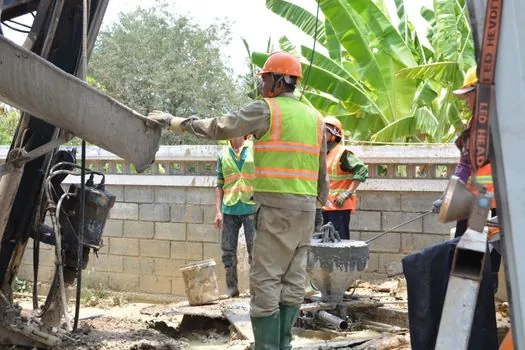
Internal vibration with a needle at 1 inch/second applies to cast-in-place slabs, beams, columns, walls, and footings, which together cover the bulk of structural work on commercial and infrastructure sites [S3][S4].
It does not apply to external (form-mounted) vibration on precast beds, where the form is vibrated from outside and no withdrawal event occurs [S3]. It also does not apply to self-compacting concrete (SCC) mixes designed to flow under their own weight; SCC typically receives only light re-vibration or none at all, and forcing the standard 5-15 second insertion window can cause segregation. For standard mixes with 75-125 mm slump, the rule holds; outside that window, lift geometry and rebar congestion should drive the call. The cement and concrete mix reference page covers the slump ranges where 1 inch/second withdrawal is the right default.
Standards, Frequencies, and Operator Variables
ACI 309R-05 names internal vibration as the primary consolidation method for normal concrete and lists operating frequencies in the 9,000-12,000 vpm band for most common head sizes [S4].
Field references broaden that range to 8,000-12,000 vpm to cover smaller heads and lower-power units [S3]. Either way, the operating envelope is wide enough that withdrawal rate, not frequency, becomes the dominant operator-controlled variable. Adjacent process variables that move with it: insertion depth (must re-penetrate the prior lift by 50-100 mm), spacing (1.5× effective radius), and slump (75-125 mm is the band where the 5-15 second hold matches mix behaviour) [S3]. Out of that band, expect longer holds for stiffer mixes and shorter holds for wetter ones, with the same 25 mm/s upward pull throughout.
Adjacent Process Risks: When Withdrawal Discipline Pays Off Elsewhere

The same controlled-speed principle shows up in adjacent rebar and formwork operations on a pour day, and the failure modes overlap in interesting ways. [S4]
Poorly consolidated concrete around a bent rebar cage mirrors the bar-bending schedule problem: spec is correct on paper, execution slips in the field. Reading a bar bending schedule properly is what gets the rebar shape into the form so the needle can actually reach the corners at the right spacing. On precast and bridge decks, the same operator discipline of vertical penetration plus slow steady withdrawal governs stud-welding parameter selection, where a hurried gun angle produces the same kind of hidden defect that a yanked vibrator leaves behind. Treat the 1 inch/second figure as a process-control number, not a tip, and the rest of the pour-day workflow tends to tighten up with it.
Two signals worth tracking through the next quarter: ACI Committee 309 work on a refreshed consolidation guide, and the gradual shift of mid-size contractors toward variable-frequency electronic drives that hold 10,000 vpm across the full battery state, which tightens the link between the 5-15 second hold and the 1 inch/second pull. Either one will refine, not replace, the field rule in use today.