
Closed-cell spray polyurethane foam delivers R-6.0 to R-7.5 per inch and acts simultaneously as a Class II vapor retarder, an air barrier, and a thermal control layer when applied at 1.5 inches or more, which is why most U.S. commercial envelope assemblies now default to it over open-cell and fiberglass alternatives [S1][S5].
Selection in 2026 runs through three decision gates: the ASHRAE 90.1 prescriptive R-value for the project's climate zone, the moisture/structural exposure of the assembly, and installed cost in a 1.00 to 4.50 USD per square foot band for closed-cell versus 0.45 to 1.00 USD for open-cell [S1][S2].
Closed-Cell vs Open-Cell: Decision Criteria for the Envelope
Closed-cell spray polyurethane foam at 1.5 to 2.0 lb/ft³ density out-performs open-cell on every quantitative axis except acoustic absorption and upfront cost: R-6.0 to R-7.5 per inch versus R-3.5 to R-3.7, Class II vapor retarder versus vapor-permeable, structural-rigid versus non-structural, and minimal versus meaningful water absorption [S1][S5]. Achieving R-21 in a 2x4 steel-stud wall with open-cell requires roughly 6 inches of cavity, which is usually impractical on a commercial slab line, whereas closed-cell hits the same R-21 target in about 3 inches [S1].
Open-cell spray foam, density 0.4 to 1.2 lb/ft³, expands to about 100x its liquid volume and absorbs sound far better, so the standard spec pattern is closed-cell on the exterior envelope and below-grade, open-cell on interior partitions and ceilings where acoustic performance and a 0.45 to 1.00 USD/sq ft budget matter more than moisture control [S1]. Open-cell is not for below-grade or high-moisture exposure because it absorbs water and is not a vapor retarder [S1][S5].
Climate Zone, Code Targets, and the ASHRAE 90.1 R-Value Gate
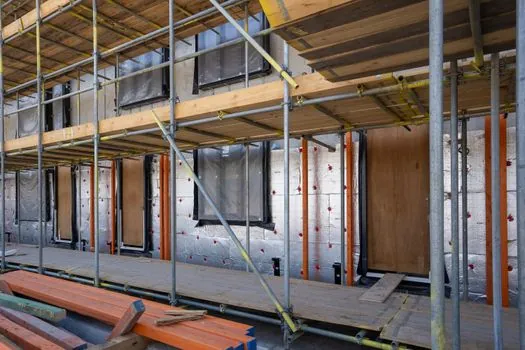
ASHRAE 90.1 sets prescriptive minimum R-values for walls, roofs, and floors across eight U.S. climate zones, and most jurisdictions file against ASHRAE 90.1-2019 or a state-amended version, so confirm the edition before locking the spec [S2]. The standard treats continuous insulation and cavity insulation as separate targets, and on steel-framed walls continuous insulation is required across most U.S. climate zones, which is where rigid polyurethane insulation board is most often layered over the steel studs to satisfy the ci line item.
Polyurethane foam's R-5.7 to R-7.0 per inch range lets designers hit ASHRAE continuous-insulation targets in thinner assemblies than glass wool (R-3.2/inch) or rock wool, which is a hard constraint on tight envelope footprints and parapet conditions [S2][S4]. On a COMcheck submittal, the framing-factor adjustment behaves differently for continuous and cavity insulation, so stacking the two values in the wrong field is a common rejection trigger worth flagging in the spec writer's checklist [S2].
Operating Limits, Density, and Fire Behavior
Standard building-grade polyurethane foam is rated for continuous service from approximately -50°C to +120°C, which covers almost all commercial envelope and cold-storage conditions, including chilled-water pipe insulation and refrigeration envelopes where PU foam is structurally important outside building shells [S3][S5]. Closed-cell density sits at roughly 2 lb/ft³ (32 kg/m³) and open-cell at about 0.5 lb/ft³ (8 kg/m³), and that density gap drives both the R-value and the structural contribution [S5].
Polyurethane foam is combustible and must be treated with fire retardants to meet commercial code, whereas glass wool is non-combustible by nature, so the spec must include the listed thermal-barrier or ignition-barrier covering on any exposed interior PU foam per the local IBC chapter 26 provisions [S4]. ENERGY STAR classifies sprayed polyurethane foam as an advanced application requiring a certified installer, which is a contract-document item not an optional check [S1].
Cost, Installed Thickness, and Acoustic Trade-Offs
Installed cost tracks performance: closed-cell runs 1.00 to 4.50 USD per square foot, open-cell 0.45 to 1.00 USD, and rigid PU board typically lands inside the closed-cell band depending on facing and thickness, while glass wool stays at 0.60 to 1.00 USD/sq ft but delivers only R-3.2 per inch [S1][S4]. The payback case is straightforward: a warehouse-style office that switched to PU foam reported a 35% drop in summer cooling costs, and a glass-wool retrofit on a residential attic reported a 28% drop in winter heating costs, both against pre-retrofit baselines [S4].
Where acoustic attenuation is the dominant spec driver, open-cell wins on sound transmission class and should be specified in interior partitions, conference rooms, and tenant demising walls even when the exterior envelope is closed-cell [S1]. Closed-cell should not be specified purely for acoustic gain; its sound performance is moderate, and the premium per square foot is not justified by STC alone [S1].
Material Comparison: Polyurethane Foam vs Glass Wool vs Aerogel

On the four decision criteria that drive commercial spec, polyurethane foam leads on R-value per inch (R-6.0 to R-7.5 closed-cell) and moisture resistance, while glass wool leads on fire performance and lowest installed cost, and aerogel leads on thinnest-profile premium applications where per-inch R-value must be maximised inside a very tight cavity [S4][S6]. Cost per square foot ranks glass wool lowest (0.60 to 1.00 USD), polyurethane foam mid (1.00 to 2.00 USD for board, up to 4.50 USD for closed-cell spray), and aerogel highest by a wide margin in most published 2026 comparisons [S4][S6].
For most commercial projects the choice is not binary: high-density closed-cell SPF is the only product that performs all four principal control-layer functions (water, air, vapor, thermal) at once when sprayed directly on masonry or exterior sheathing, which is the Building Science Corporation position cited in current contractor guidance [S1]. A typical assembly stacks closed-cell spray on the exterior face, masonry insulation or rigid PU board at the ci line, and open-cell spray or fiberglass in the stud cavity, tuned to ASHRAE 90.1 Section 5.5 prescriptive values for the project climate zone [S1][S2].
Polyurethane Elastomer vs Foam: Picking the Right Polymer Family
Spec writers sometimes conflate rigid PU foam, used for thermal insulation, with polyurethane elastomer, which is a flexible casting material used for seals, rollers, and wear parts and is not a building insulation. The two share a polyol-plus-isocyanate chemistry but the cell structure, density, and service temperatures diverge: elastomer grades are dense solid parts, foam is a closed or open cellular matrix rated for the -50°C to +120°C envelope service band [S5].
For pipe and tank insulation, polyurethane insulation jacketing is specified as a factory-fabricated rigid foam section with aluminum or glass-fleece facing, not as a sprayed field application, and that distinction matters for projects with both building-envelope and mechanical-insulation scope [S5]. Cold storage and transport refrigeration continue to drive a large share of the global PU foam market outside building envelopes, so lead time on rigid PU board can be tested by adjacent industrial demand cycles [S3].
Selection Checklist and Sourcing Signals

The minimum spec packet for a 2026 commercial PU foam submittal should list: closed-cell density 1.5 to 2.0 lb/ft³, R-value per inch, Class II vapor retarder status at the specified thickness, fire-retardant treatment and thermal-barrier covering per local code, ASHRAE 90.1 edition referenced, climate zone, and installer certification to the ENERGY STAR advanced-applicator standard [S1][S2][S5]. Confirm the blowing agent generation on the datasheet, since higher-GWP blowing agents are under regulatory pressure in several jurisdictions and can affect both R-value and compliance documentation.
Track these signals in the next procurement cycle: ASHRAE 90.1 edition updates that shift continuous-insulation minimums, and any state-level adoption of lower-GWP blowing-agent rules that change the cost per board-foot of closed-cell spray foam. For projects that also include fire-system scope, EPS board selection for hospitals is a useful adjacent read on density and fire-rated board specification, even though EPS is a different polymer family.