Specifying a portable gas detector in 2026 is a sensor-pack decision first and a price decision second: most units sold under the portable gas detector category ship as 4-gas (CO / H2S / O2 / LEL) monitors weighing 200-400 g with 14-24 h battery life and ATEX/IECEx zone-1 intrinsically-safe ratings, per OEM datasheets published between April and June 2026 [S1][S3].
The current market splits into three bands: sub-USD 300 diffusion-only single-gas clips (NH3, H2, H2S, CH2O, CO) for personal exposure monitoring [S6], USD 400-800 industrial 4-gas monitors with replaceable smart sensors (EC + LEL + optional PID/IR) [S1], and USD 800-1,200+ pumped multi-gas units with wireless telemetry and confined-space entry kits. The catalog page on combustible gas detector terminology helps separate LEL (catalytic bead or IR) sensors from the EC toxic-gas cells that share the same housing.
Sensor Pack: 1-Gas vs 4-Gas vs 5-Gas Configurations
Single-gas diffusion detectors cover CO, H2, H2S, NH3 or CH2O with a USB-rechargeable Li-ion cell, color LCD and short T90 response — typical resolution 1 ppm for H2S, 0.1% vol for O2 equivalents on a 4-gas instrument [S6]. Four-gas remains the workhorse: CO + H2S + O2 + LEL (catalytic-bead or NDIR methane), with all four cells user-replaceable on the GRI smart-sensor platform and the Dräger X-am family [S1][S2]. Five-gas adds a PID (photo-ionization, 10.6 eV lamp, range 0-2,000 ppm isobutylene equivalent) for VOCs, or an IR CO2 cell 0-5% vol, at roughly 20-35% list-price uplift over a 4-gas base. The internal primer on gas detector sensor types covers the EC, catalytic, NDIR and PID families in more depth.
A common error is specifying a "5-gas" monitor when the application only needs LEL + O2 + H2S — paying for an unused PID lamp and its 6-month replacement cycle. Another is asking for "LEL detection" without naming the target gas: catalytic-bead sensors are poisoned by silicones and H2S, while NDIR CH4 sensors are immune but miss hexane and pentane — the trade-off is spelled out in OEM selection guides and on the fixed gas detector reference page where the same cells appear in wall-mount form.
Safety Certifications: ATEX, IECEx, UL/CSA and the Zone Question
Portable detectors for oil and gas, refining and chemical plant work carry ATEX II 2G Ex ia IIC T4 Ga (zone 1) or zone 0/1 variants, plus IECEx equivalent — the GRI multi-gas datasheet published 2026-06-06 lists Ex-proof, anti-corrosion and anti-EMI in the same ruggedized housing [S1]. Mining and coal-bed-methane applications drop to I M1/M2 Ex ia I Ma. For North American sites, UL 913 (Class I Div 1 Groups A-D) and CSA C22.2 No.152 remain the recognised marks; instruments carrying both ATEX and UL/CSA dual-cert are now standard in the 4-gas price band.
Ingress protection matters as much as Ex rating: IP66/IP67 is the de-facto 2026 baseline for water-jet and temporary immersion. Confined-space kits add a 10 m sample draw hose and a pump that draws 0.25-0.5 L/min; pump failure alarm and a blocked-flow alarm are mandatory under most site procedures. A crossed roller guide is not a sensor topic, but the same concept of "spec the worst-case, not the typical" applies — buy the IP and zone rating for the actual work environment, not the office calibration lab.
Runtime, Calibration Interval and Sensor Lifetime

Real-world battery runtime is 14-24 h on a 4-gas monitor with pump off, dropping to 8-12 h with pump on continuous [S1][S2]. Recharge time is typically 4-6 h on a micro-USB or magnetic cradle. EC sensors (CO, H2S) carry a 24-36 month operational life; O2 cells 24 months; LEL catalytic beads 12-24 months; PID lamps 6 months typical with cleaning. Calibration interval is 30-90 days bump-test and 180-day full span-cal, per ISA 12.13 / IEC 60079-29-2 guidance for combustible-gas detectors.
Sensor-replacement cost is the hidden line item: a single CO/H2S smart cell can run USD 60-120, NDIR LEL cells USD 100-180, PID sensors USD 250-400. The Gri smart-sensor design and Dräger X-am sensors are field-replaceable without a calibration gas cylinder on most modern firmware revisions [S1][S2]. Units that still require factory service for a sensor swap add 2-3 weeks of downtime per cell — meaningful for a fleet of 50+ devices.
Pricing, MOQ and Where the Sourcing Spread Lives
Direct-from-factory quotes (KELISAIKE K60B, GRI 4-gas) sit at USD 280-450 FOB China for a 4-gas IP67 unit with CE/ATEX documentation [S3]. Distributor channels in India list comparable spec at INR 18,000-35,000 (USD 215-420) with 1-2 week lead time [S4]. Brand-name Western units (Dräger X-am 5000/8000, RAE Systems Q-RAE, Industrial Scientific Ventis Pro) carry USD 800-1,800 list before service contracts [S2][S5]. MOQ is typically 1 unit for branded SKUs, 5-10 units for OEM/ODM with custom branding.
The largest price lever is sensor count, followed by pump vs diffusion, then wireless (Bluetooth / Mesh / LTE-M telemetry adds USD 80-200 per unit). For an operations buyer comparing the Laser Distance Meter 2026 Buying Guide sourcing logic, the same rule applies: spec gate first, then channel. For a related control-panel purchase, the Gas Alarm Controller 2026 Price & Cost Guide covers the 4-32 channel wall-mount receiver that pairs with these portables.
Selection Criteria Matrix: Diffusion vs Pumped, 1-Gas vs 4-Gas
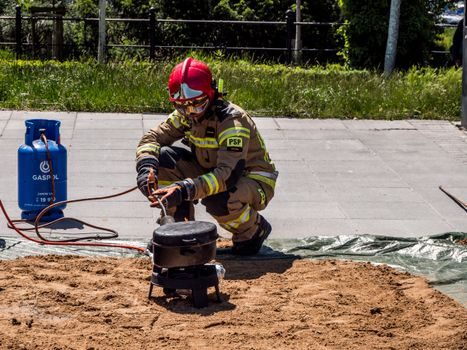
For a single worker doing a 2 h walking survey in a chemical plant: diffusion 4-gas (CO / H2S / O2 / LEL catalytic), USD 350-500, 200 g, no pump to fail [S1][S6]. For confined-space entry (vessels, manholes, tanks): pumped 4-gas with 10 m hose, USD 500-900, IP67, pre-entry test sequence [S1]. For hazardous-area VOC monitoring (refineries, paint shops, pharmaceutical): 5-gas with PID 10.6 eV, USD 700-1,200, lamp-replacement budget 6-monthly [S2].
A voided choice: a pumped instrument used for full-shift personal monitoring — the pump dies in 6-8 h and the worker ends up unprotected. Conversely, a diffusion clip carried into a permit-required confined space fails most site safety audits because the worker cannot pre-test the atmosphere remotely. Match the form factor to the task; the form factor is a safety decision, not a budget decision.
Limitations, Failure Modes and What the Datasheet Won't Tell You
Catalytic-bead LEL sensors give wrong (low) readings in oxygen-deficient atmospheres — exactly the condition an O2 sensor is supposed to alarm on; the two readings must be cross-checked. PID readings are humidity-sensitive (a 50% RH change can shift response 10-15%) and the lamp window fouls in dusty environments. EC H2S sensors cross-react with SO2 and NO2; spec the cross-sensitivity table, not just the headline range. Dräger's portable-detection product page calls out the four-hazard family (toxic / oxygen / combustible / vapour) as the scope of personal monitoring — everything else is a fixed-system or laboratory-analytical problem [S2].
Finally, no portable detector is a substitute for a calibrated fixed system on a tank farm or compressor station; the fixed gas detector reference describes the wall-mount infrared and catalytic units that protect the asset 24/7. Portable instruments are last-line-of-defence personal protection, and the next signal to track is the IEC 60079-29-1 revision cycle for combustible-gas detector performance — every IECEx-certified unit on the 2026 market is built to its current edition, and the 2026-06 product datasheets are the cleanest baseline for a 12-month fleet refresh plan.