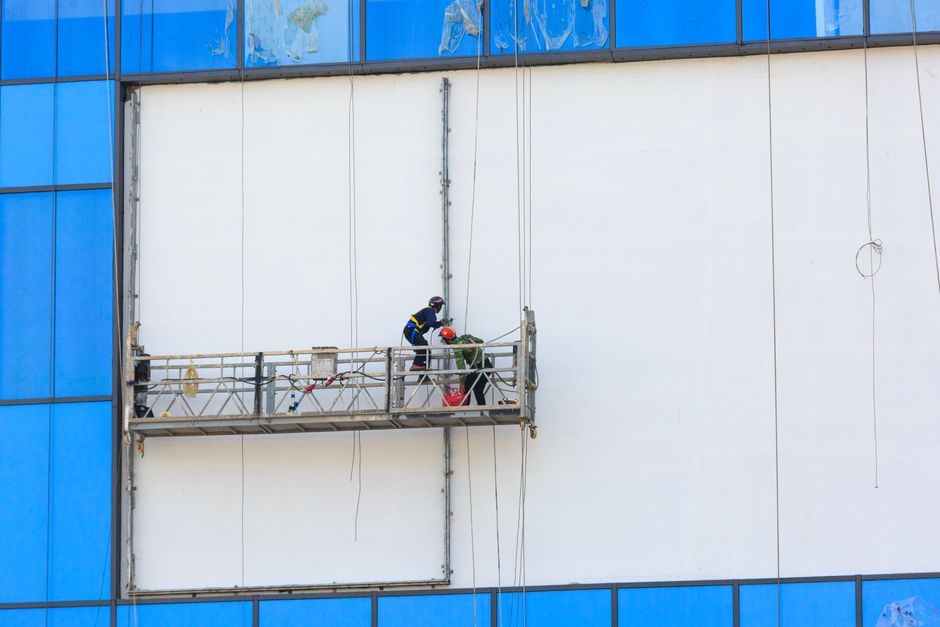
On elevated work platforms, scaffolding, tower, and boom-lift tasks, the portable gas detector functions as a personal protective device, not a survey instrument, and the selection criteria differ sharply from those for confined-space entry or food-processing lines [S1][S2].
For 2026 procurement, the practical baseline is a 4-gas LEL/O2/H2S/CO unit with an integrated sample pump, IP66 or higher ingress protection, drop-tested 7 m or more, and an ATEX/IECEx zone 1 rating so the unit can stay clipped to the harness during welding, grinding, and exhaust-rich hot work above ground [S1][S3]. Sensor stack, mounting method, and pre-entry bump-test workflow drive roughly 80% of the field failures seen by safety officers, far more than the brand of the LEL pellistor itself.
Sensor Stack: Why 4-Gas Is the Work-at-Height Default
A 4-gas simultaneous monitor covering LEL (combustible), O2, H2S, and CO is the dominant configuration for elevated industrial tasks because the four hazards coexist at construction, refinery-turnaround, and steel-structure sites where workers also operate from aerial work platforms and truck-mounted booms [S1]. Hanwei's BX616 and E6000 portable multi-gas families ship with this LEL/O2/H2S/CO combination, while single-gas siblings such as the HRLD600 cover LEL, O2, H2S, or CO only [S1].
Single-gas detectors still earn a place where the task is well-defined: a refrigerant-leak sweep on a roof only needs a calibrated NH3 monitor like the ATO GD800-NH3 (0–50/100 ppm range), at $433.99 retail, which is far cheaper than carrying a 4-gas unit that the worker will never pre-bump for chlorine or NH3 [S2]. The Nanjing Kelisaike K60-IV pump-equipped 4-gas portable is the other end of the spectrum, built for long-duration hot-work at elevation where pump draw is the only way to get a representative sample from a harness-mounted sensor [S3].
Mechanical Specs That Matter Off the Ground
Ingress protection, drop rating, weight, and audible alarm output matter more on a harness than the sensor resolution, because a worker 8 m up cannot hear a 75 dB sounder or see an obscured display [S1][S3].
Spec points to demand from any vendor quote in 2026: IP66 minimum (IP67 preferred for outdoor monsoonal sites), 7 m drop-test survival to concrete, audible alarm ≥95 dB at 30 cm, visual 360° LED alarm ring, and a stainless-steel or reinforced-alligator harness clip rather than a plastic belt loop [S1]. The K60B single-gas Bluetooth portable and the K60-IV pumped 4-gas are typical examples where the housing, not the sensor, is the headline engineering line [S3].
Active sampling with an electric pump is the right call whenever the sensor cannot sit at breathing-zone height, e.g. clipped to a chest D-ring while the worker leans over a pipe rack; a diffusion-only unit will read the stagnant pocket of air near the harness, not the air the worker actually inhales [S3]. Pump flow loss is also a self-diagnostic alarm, so a kinked sample line is caught immediately rather than at the next bump test.
Certification Map: ATEX, IECEx, and Ex d IIC T6

Any portable carried into a classified area at height, including work near refinery columns, gas terminals, or petrochemical flare structures, must carry an explicit zone 1 or zone 2 gas-group rating [S3].
Concrete markings to verify on the nameplate or datasheet: ATEX II 2G Ex d ia IIC T6 Gb, equivalent IECEx Ex d ia IIC T6 Gb, and a temperature class that does not exceed the surrounding process, e.g. T6 for ambient below 60 °C service [S3]. The Kelisaike K800 fixed detector line carries the Exd IIC T6 marking for hazardous-area fixed installation, and the portable siblings share the same sensor and certification genealogy, which simplifies document control across a mixed fleet [S3]. For Chinese-made units, the GB 3836 series (the Chinese national standard aligned with IEC 60079) is the domestic equivalent and is increasingly accepted by EPCs operating in mixed-jurisdiction projects [S1].
Mounting, Tethering, and Human Factors
A portable monitor that dangles from a lanyard is a drop hazard to anything below, and a swing hazard to the worker's own face when the harness arrest line goes taut, so the mounting decision is a safety decision, not an ergonomic one. [S1]
Best-practice options in 2026: a rigid alligator clip on the chest strap of the fall-arrest harness; a thigh-pocket holster with a retraction reel; or a dedicated aerial work truck basket-mount bracket when the worker is in an insulated boom and the instrument is at the operator's knee level. Each approach changes the sampling geometry: chest-mount is closest to the breathing zone, thigh-mount keeps the unit out of the worker's handline swing arc, and basket-mount protects the sensor from torch spatter at the cost of slower gas diffusion.
Failure Modes and Pre-Use Bump Test
The leading cause of portable-detector incidents at height is not sensor failure but a flat battery, a clogged sinter, or an un-bumped sensor, and these are administrative failures, not specification failures.
Operational rules to lock into the procedure: bump test every shift with a known-concentration gas (typically 25–50% LEL for combustible and 25 ppm H2S for toxic channels), confirm response within ±10% of the target, replace the sensor if it fails two consecutive bump tests, and verify the audible alarm at 95 dB+ before clipping the unit on [S1][S2]. For NH3-specific work such as refrigeration plant on a roof, a dedicated monitor like the GD800-NH3 is the right call because cross-sensitivity on a standard H2S electrochemical cell would mask the real hazard [S2]. A 4-gas LEL/O2/H2S/CO portable gas detector covers the majority of work-at-height tasks and is the unit most safety officers should standardise on, with single-gas and pumped variants held in reserve for refrigerant, VOC, and confined-space entry at the same elevation.
Where This Fits: Comparison to Other Tasks
Work-at-height selection overlaps with, but is not identical to, confined-space or welding selection; the differences are the harness interaction, the pump-vs-diffusion decision, and the battery-life demand.
For comparison, welding at elevation adds combustion-gas interference, so the LEL sensor head is the limiting component and the spec map for welding tasks is detailed in Portable Gas Detector Selection for Welding Operations. Confined-space work at the same elevation changes the priority to a forced pump, a 4-gas stack, and pre-entry calibration, mapped in Confined Space Portable Gas Detector Selection: 4-Gas Stack, Pump, and Certification Map. Food-processing work at height still demands a 4-gas LEL/O2/H2S/CO baseline, but the certification demands and cleanability rules shift toward IP67 and food-grade housings, as laid out in Portable Gas Detector Selection for Food Processing: Spec Map and Sensor Match. The combustible gas detector channel is the single most failure-prone element in all four scenarios and is the one to specify with a redundant pellistor or an IR-backup sensor on any elevated hot-work task.
Two trackable signals to watch through Q4 2026: the rollout of Bluetooth-enabled bump-test stations from the K60B generation, which removes the manual cylinder-and-wait step from pre-use checks [S3], and the broader adoption of IR (infrared) LEL sensors as a pellistor alternative, which removes the silicon-poisoning failure mode on silicone-rich construction sites and is a likely procurement talking point at the 2026 A+A trade programme in Düsseldorf.