Landscaping batch volumes rarely justify a towable or truck-mounted concrete mixer truck; most hardscape work, including paver bases, stepping-stone footings, small retaining-wall cores, and fence-post footings, runs through a portable drum or paddle power mixer in the 1.5–6.0 cu ft range, with a 120 V or 240 V electric motor for residential sites and a small gasoline engine when no mains is available [S3].
The decision tree starts with three variables: maximum single batch in cubic feet, maximum aggregate size, and whether the mix is concrete (tumbling action) or mortar / paver bedding / polymeric sand slurry (paddle action). The wrong pairing either leaves unmixed sand pockets in a mortar batch or grinds aggregate against drum walls in a stiff concrete mix, so the selection criteria mirror the broader construction-mixer taxonomy used across building sites [S3].
Drum-class power mixers (1.5–6.0 cu ft): the landscaping default
Drum mixers tumble aggregate, cement, and water to coat every particle, and are the right answer for any concrete batch in a landscape build, from a single fence-post footing up to a small patio slab [S3]. A 3.5 cu ft drum typically yields about 1.7 cu ft of finished concrete per batch, and 5–7 batches are a realistic working day for one operator on a residential paver-base job [S3].
Within the drum family, three subtypes appear in landscape rental fleets: tilting drum, which dumps by cranking the bowl forward (best for stiff low-slump mixes and for sites where a wheelbarrow can be parked close); non-tilting drum, which discharges through a chute and suits continuous repetitive pours such as post footings; and reversible drum, which spins the opposite way to discharge, useful when slump is kept above 4 in to avoid hanging up in the bowl [S3]. For an average 200 sq ft paver patio over 4 in of crushed-stone base, the concrete demand is zero (sand-set or open-graded base) but the mortar or polymeric-joint demand can still route through a small tilting drum for uniformity [S3].
Paddle and mortar mixers for paver bedding, stucco, and grout
Mortar mixers use stationary paddles inside a rotating drum, folding the mix rather than tumbling it, which is the correct mechanism for masonry mortar, stucco, and tile grout, where overworking or air entrapment weakens the bond [S3]. For landscape work, paddle mixers handle Type S mortar for retaining-wall block, veneer stone around fire pits, and the cement-based bedding slurry used under porcelain pavers, all at batch sizes of 2–4 cu ft that match a typical hardscape day [S3].
Pan mixers, a separate subtype with a stationary pan and rotating blades, deliver the most consistent mortar and are common in production masonry yards, but for field landscaping the paddle-drum hybrid is the practical compromise [S3]. Mud-mixer attachments on a half-inch chuck high-torque drill cover the smallest jobs, such as mixing thinset for a small flagstone repair, where a dedicated drum would sit idle ninety percent of the day [S3].
Power source: 120 V electric, 240 V electric, or gas
Electric drum mixers dominate residential landscaping because they start with a switch, produce no on-site exhaust, and meet most HOA noise rules; a 120 V 1.5–3.5 cu ft unit plugs into any outdoor GFCI receptacle and is the right answer for a backyard patio [S3]. When the batch climbs past about 3.5 cu ft the motor current climbs with it, and a 240 V 5–6 cu ft unit is the more efficient step, drawing roughly half the running amps of a 120 V motor of the same horsepower [S3].
Gasoline-powered mixers are specified when the site has no service entrance within cable reach, common on raw lots, rural acreages, and large commercial grounds where a 200 ft cord run would be a tripping hazard. For a remote segment of a landscape project the same power-class logic from road-maintenance power-mixer selection applies: match motor torque to the heaviest expected load, not to the average, because aggregate-stalled motors on contractor sites burn out within a single season [S3].
Selection matrix: drum vs paddle vs mud mixer on four decision axes
Four axes decide the unit: aggregate size, slump or stiffness, batch volume, and finish quality. Drum mixers handle aggregate up to about 1.5 in and slump above 2 in, paddle mixers handle sand-only or pea-gravel mortar batches and produce the smoothest finish, and drill-attach mud mixers handle thinset and drywall compounds at under 1 gal per batch [S3].
For a residential landscape crew running a paver base, a small retaining wall, and a fire-pita veneer in the same week, a 3.5 cu ft electric tilting drum covers the structural concrete, a 4 cu ft paddle mixer covers the wall mortar, and a half-inch mud mixer covers the thinset; that three-unit kit is the typical landscape-contractor baseline [S3]. For a single-weekend DIY patio, a 1.5–2.5 cu ft 120 V drum and a drill mud mixer will cover nearly every task, and the sibling selection logic for road-maintenance power mixers on motor class and drum capacity transfers almost unchanged to this lighter load profile [S3].
OSHA crystalline silica: the rule that decides enclosure and water
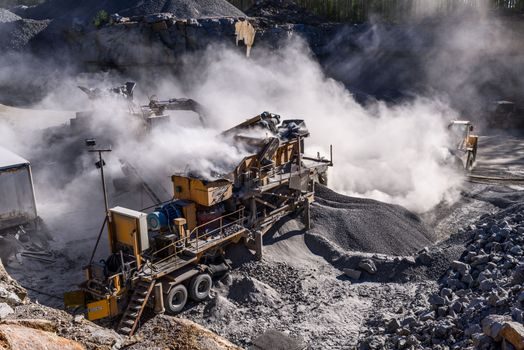
The OSHA construction silica Rule (29 CFR 1926.1153) covers about 600,000 construction workplaces and an estimated 840,000 workers exposed above the permissible exposure limit, and the mixing station is one of the highest-emission tasks on a landscape site [S2]. Powered mixers generate respirable crystalline silica dust whenever dry cement or sand is charged into the bowl, and the Rule’s Table 1 lists wet mixing, enclosed cabs, and local exhaust ventilation as the three principal controls [S2].
For a landscaping power mixer this translates into three concrete practices: pre-damp sand and cement before they enter the drum, fit the drum with the manufacturer’s dust shroud where one is offered, and use a continuous-feed or auger-fed system (such as the SPEC MIX PA1000 / PA4000 power auger class) on jobs that exceed a single pallet of preblended material per day [S2]. OSHA’s construction standard explicitly exempts low-exposure tasks such as mixing mortar, pouring concrete footings, and removing formwork, but a typical landscape patio or wall build with multiple bagged-mix lifts per hour sits well above that low-exposure threshold and the sourcing references on the SPEC MIX side are written against that Rule [S2].
Limits and failure modes specific to landscaping
Three failure modes show up repeatedly in landscape-mixer duty: drum wall wear from pea-gravel aggregate, paddle-shaft bending from overcharged stiff mortar batches, and motor brush or capacitor failure on 120 V units run on undersized extension cords [S3]. Specifying a drum thickness of at least 2 mm steel (entry-level rental fleet drums run 1.2–1.5 mm) and a paddle shaft of at least 20 mm round stock avoids the first two; a 12 AWG cord on a 120 V 1.5–3.5 cu ft drum at 50 ft keeps voltage drop under 5 percent and avoids the third [S3].
Landscape mixers are not rated for refractory or high-temperature work, and a drum mixer should not be used to mix refractory cement for a fire pit because the cement’s working time and aggregate grading differ from structural concrete; refractory suppliers specify paddle mixing by hand or a dedicated refractory mixer for that application. Likewise, a mortar mixer should not be used for structural concrete, since the paddles will not coat coarse aggregate and the result will be honeycombed and below any design strength [S3].
Specifications to capture before ordering or renting
Five specifications are non-negotiable on the rental or purchase order: drum or bowl capacity in cubic feet, motor voltage and horsepower (typical 0.5–1.5 HP electric for 1.5–3.5 cu ft, 2–3 HP for 5–6 cu ft and for gas units), drum type (tilting, non-tilting, reversible, or paddle), weight empty for trailer loading, and dust-control interface (shroud port diameter or auger-feed compatibility) [S2][S3].
Trackable signals worth watching into 2026: rental-fleet refresh announcements for 120 V brushless drum motors (longer life, less thermal cutout on hot afternoons), OSHA enforcement summaries on 29 CFR 1926.1153 Table 1 compliance at landscape scale, and any updates to SPEC MIX power-auger model lines, since the PA1000 and PA4000 are the most commonly specified continuous-feed platforms on mid-size landscape commercial jobs [S2].
For the relevant spec sheets and selection criteria, see sand mixer.