
A marble cutter is a compact handheld power tool, typically 1200 W class with 11000–13000 RPM no-load speed and 2.5–3.5 kg body weight, that spins a 4 to 4.5 inch (100–115 mm) diamond or abrasive disc [S4].
It runs on the same basic architecture as a small angle grinder: a mains or battery motor, a spindle-mounted blade, a top handle, and a base plate for stability, with dry and wet cutting both supported [S1][S4]. The marketing label "marble cutter" covers any small disc cutter shipped with a diamond rim; swap the disc and the same tool handles paper, plastic, metal, marble, wood, and concrete [S1][S3].
Why a "Marble Cutter" Shows Up on a Steel Job
Steel construction sites use marble cutters for trim work, slot cuts, and rebar nipping where a 7 inch (180 mm) cut-off saw is over-spec, too heavy, or trips the GFCI on a temporary 16 A board [S1][S3].
The tool's portability, sub-3.5 kg mass, and 4–4.5 inch blade footprint let an ironworker cut thin wall tube (under 3 mm), cold-rolled sheet, and up to about 12 mm rebar in tight corners where a chop saw cannot reach [S4]. In practice, crews buy one corded 1200 W unit as a multi-role cutter, then swap discs by material: diamond continuous-rim for stone, abrasive cutoff (Type 41) for mild steel, and segmented diamond for concrete [S2][S3]. For dedicated rebar production, a real rebar cutter with hydraulic or electric shear action is the safer, faster, and code-compliant choice for anything above 12 mm.
Core Specs that Drive Selection
Four spec gates decide whether a marble cutter earns a slot on a steel site: motor input, no-load speed, blade diameter and bore, and net weight [S2][S4].
Motor input (W) is the headline number; 1200 W is the practical floor for steel trim work, anything under 1000 W stalls on 6 mm plate and burns out fast [S2][S4]. No-load speed for a usable steel-cutting disc should be 12000 RPM or above; below that the peripheral blade speed drops below the roughly 80 m/s most 4 inch abrasive discs are rated for, and cut quality collapses [S4]. Blade diameter sets the maximum cut depth: a 4 inch (105–110 mm) disc delivers roughly 25–30 mm depth, while a 4.5 inch (115 mm) disc reaches about 30–35 mm, enough to bisect a 25 mm rebar in one pass [S2][S4]. Blade bore is the often-forgotten spec; the common values are 20 mm and 22.23 mm, and a mismatch forces an unsafe spacer ring that ruins concentricity [S4]. Net weight between 2.5 kg and 3.5 kg is the sweet spot per OEM guidance: light enough for overhead one-hand work, heavy enough to damp vibration through a steel plate [S4].
Blade Match-up: Steel, Stone, Concrete, Tile
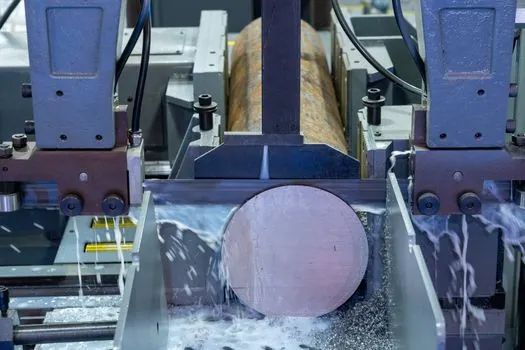
Choosing a marble cutter is really choosing the right disc for the substrate, because the tool body is the constant [S2][S3].
For mild steel trim and rebar nipping, fit a Type 41 (flat) abrasive cutoff disc rated at least 80 m/s peripheral speed; segmented diamond discs glaze over on ferrous metal and shed abrasive [S1][S2]. For marble, granite, porcelain, and engineered stone, use a continuous-rim diamond blade for chip-free edges, or a turbo-rim blade when a faster, slightly rougher cut is acceptable [S2][S3]. For concrete, brick, and masonry, fit a segmented diamond blade with deep gullets for dust and slurry evacuation; running a continuous-rim blade on concrete overheats the bond and shortens blade life by roughly half [S2]. For tile, a thin (under 2 mm) continuous-rim or porcelain-specific blade is mandatory to keep chipping under 1 mm on glazed edges [S3]. CMP Stone, a Melbourne stone-tool supplier, stocks blades in this exact segmentation, and their wet-cutting thin turbo and continuous-rim ranges are typically used for porcelain and marble, while thicker segmented blades go to concrete and sandstone [S3].
Limits and Failure Modes on Steel
A marble cutter, despite the name, is not a production steel saw, and three failure modes show up fast when crews push it past design intent [S1][S2].
First, thermal overload: continuous steel cutting on a 1200 W motor without 60 second cool-downs trips the overload clutch or burns the armature windings; the OEM cure is a cutter with electronic overload protection, not a heavier spring [S2]. Second, disc shatter: abrasive cutoff discs for steel run at 80 m/s peripheral speed at 12000 RPM, and undersized bore, cracked discs, or missing guards raise the shatter risk to unacceptable levels on a vibrating steel plate [S1][S4]. Third, kickback and bind: a 4.5 inch blade has only about 30 mm cut depth, so trying to bisect a 40 mm rebar in one pass wedges the disc, stalls the motor, and snaps the spindle; the safe practice is to score and rotate, or to step up to a rebar cutter for anything over 12 mm diameter [S2]. A wet-cutting feed is recommended even for steel trim to keep dust below respirable thresholds and extend abrasive life, mirroring the OEM note that a parallel water jet reduces wear on the disc and housing [S4].
Selection Criteria Comparison: Corded 4.5 in vs Cordless 4 in vs Pneumatic

The three common power variants trade off duty cycle, mobility, and steel-cutting torque differently, so the right pick depends on site power, runtime, and steel thickness [S2][S4].
Corded 4.5 inch (115 mm), 1200 W class: highest continuous torque, no battery fade, and the standard 22.23 mm bore accepts mainstream steel cutoff discs; weight 2.7–3.5 kg, and a 16 A site supply handles it without nuisance trips. Best for fixed-bench trim stations and any work over 4 mm steel plate. Cordless 4 inch (100–105 mm), 18 V or 20 V brushless: roughly 800–1000 W equivalent, 18–25 mm bore via reducer, weight 1.8–2.5 kg, and runtime of about 8–12 minutes of cut per 5 Ah battery on rebar; ideal for overhead steel trim where a cord is a snag hazard, but limited to thin sheet and small rebar. Pneumatic 4 inch, 6–8 bar (90–120 cfm): no electronics, intrinsically safe near flammable atmospheres, and consistent torque under load, but needs an air hose and lubricator and is rare outside shipyard and shutdown work [S2][S4]. For a steel-construction site crew the practical default is one corded 4.5 inch 1200 W unit per two ironworkers plus one cordless 4 inch for overhead, sized against an impact drill budget for hole-making on the same kit.
Sourcing, Standards, and Site Hygiene
Specifying a marble cutter for steel work means matching the tool to EN 60745-1 hand-held motor tool safety, the disc to EN 12413 for bonded abrasive products, and the operator PPE to EN 166 eye plus EN 149 respiratory class [S1][S2].
OEM build guidance keeps the unit under 3.5 kg with a robust metal or reinforced-plastic frame, a fixed top handle, a spindle lock for blade change, and a dust- or waterproof housing rated to IP5X or better; cordless SKUs add a brushless motor and electronic overload cut-out as standard [S2][S4]. For wet-cutting steel trim, mount a parallel water feed; the simple jet of water reduces disc wear and respirable dust, extending blade life on a 4.5 inch abrasive from roughly 30 cuts to 50 cuts per disc on 6 mm plate [S4]. On the purchasing side, mainstream industrial lines from Endico, Kynko, and similar OEM catalogs list motor wattage, no-load RPM, blade diameter, bore, and net weight on the nameplate, and most publish a 12 month warranty conditional on a 60 second on / 30 second off duty cycle for steel cutting [S2][S4]. Two trackable signals to watch for: cordless 4 inch brushless platforms crossing 1000 W equivalent at sub-2.5 kg weight, and bonded-abrasive disc prices per cut trending as a leading indicator of steel-fabrication backlog.
The underlying component specifications are covered under marble cutter, and construction tools.