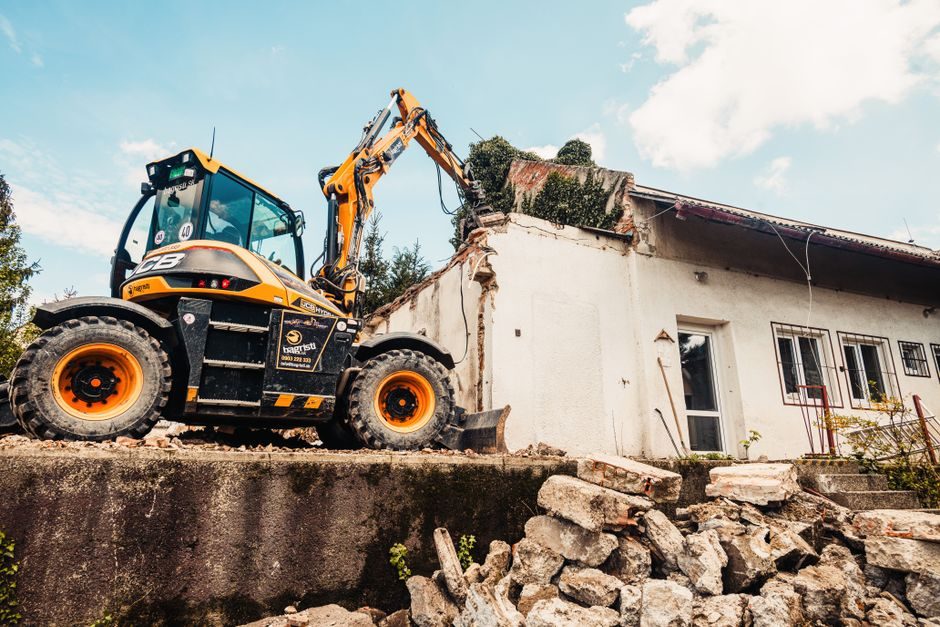
Excavator-mounted power mixers for demolition stabilisation are spec'd against the carrier's hydraulic envelope, not the engine: ALLU Processor Power Mixers run up to 350 bar (5,000 psi) and 300 l/min (79 US gal/min), with a peak 160 kW hydraulic input and 18,000 Nm of drum torque at 350 bar on a 25-40 tonne base machine [S3].
Standalone power mixers used at the demolition site — material blending, mortar for repointing, slurry for dust suppression — are sized by drum volume, motor power, and footprint. SPEC MIX's PA4000 power auger ships at 2,000 lb (907 kg) dry / 14,000 lb (6,350 kg) wet, with a 6 ft 1 in × 7 ft 9 in (1.9 m × 2.4 m) footprint and the option of a 13 hp gas engine with electric start or a 7 hp (220 V, 30 A, single-phase) electric motor [S2]. For demolition crews who need to grind rubble, separate slurry, or blend stabilising binders, that 7,000 lb batch swing is the operating window that decides how many lifts per hour you can sustain.
Excavator-Mounted vs Standalone Power Mixers: Decision Matrix
Excavator-mounted processor power mixers such as the ALLU series are designed to live on the demolition machine itself, using on-board hydraulics rather than a separate engine: working depth 3 m (10 ft) or 5 m (16 ft), max pressure 350 bar, max flow 200-300 l/min depending on model, and a 2,400 kg attachment mass that fits a 25-40 t carrier [S3]. The 18,000 Nm drum torque is what allows the mixer to churn contaminated demolition spoil in situ without burning the carrier's hydraulic pump — a real failure mode when contractors oversize an attachment to a smaller excavator.
Standalone power mixers, by contrast, are stationary or towable: the SPEC MIX PA4000 holds a 13 hp gas or 7 hp (220 V, 30 A, 1-phase) electric drive, while Bartell mortar mixers like the MM6H160 (Honda GX160, 6 cu ft / 0.17 m³, 737 lb / 335 kg) and MM8H240 (Honda GX240, 8 cu ft / 0.23 m³, 860 lb / 395 kg) cover the 1.5-2.5 bag batch range for repointing and patch work [S2][S6]. For demolition contractors the matrix reads: in-situ soil/stabilisation mixing → excavator-mounted (350 bar, 18,000 Nm, 25-40 t carrier); site-blended mortar or slurry → standalone power auger or forced-action mixer (7-13 hp, 6-8 cu ft, 220 V single-phase). Mixing-system selection criteria for adjacent finishes are covered in the Power Mixer Selection for Interior Finishing: Spec Map reference, and the carrier-sizing logic parallels the Power Mixer Selection for Road Maintenance: Spec Map carrier-pairing discussion.
Dust, Silica, and Demolition-Site Compliance Thresholds
OSHA's crystalline silica construction standard (29 CFR 1926.1153) sets a PEL of 50 µg/m³ as an 8-hour TWA and an action level of 25 µg/m³; OSHA estimates more than 840,000 construction workers are exposed above the new PEL across over 600,000 workplaces, with about two million exposed overall [S2]. Mixing mortar and pouring footers are explicitly carved out of the rule when exposures stay low, but cutting, crushing, and drilling concrete during demolition are not — the dust load around any power-mixer station on a demolition site is the binding design constraint, not a marketing line.
SPEC MIX pairs its mixing systems with upper-shroud and mixer-shroud accessories and a continuous dust-control mitigation line to keep the mixing station inside the action level [S2]. City-level demolition specs reinforce the same pressure: the City of Green, OH requires contractors to "keep dust at a minimum" and prepare the work in such a manner as to keep dust controlled, with prohibited use of explosives and mandatory pre-demolition pest inspection by a licensed exterminator [S7]. For a 13 hp gas power mixer, that means either wet-blend suppression or a shroud + extraction hood; for a 7 hp 220 V electric unit, dry extraction is the cleaner option because there is no engine exhaust to add to the airborne load.
Forced-Action Mixers: When Drums and Pans Are Not Enough
Forced-action (pan) mixers are the workhorse for stiff, low-water mortars, epoxy screeds, and cement-based patching compounds that a gravity drum mixer cannot break down — drum-style mortar mixers top out at 105 dB(A) sound power (Bartell MM6H160) and rely on free-fall tumbling, which leaves unmixed pockets in anything drier than a plastic mortar [S6]. Makinex's demolition product line groups the FAM-120 forced-action mixer with concrete/tile/screed cutting tools, positioning forced-action as the default for "outdated gear" replacement on regulated, fast-cycle sites [S5]. The unit's value to a demolition contractor is shear: paddles counter-rotate inside a stationary pan, so the mix is mechanically forced rather than tumbled — relevant when a spec calls for a homogeneous, low-water patch mortar to fill demolition-induced voids.
Selection between drum, power-auger, and forced-action follows three criteria: (1) batch stiffness (plastic → drum, stiff → power auger, very stiff/epoxy → forced action); (2) power source available on site (no 220 V → gas, urban noise/silica cap → 7 hp electric); (3) mobility/footprint, where the PA4000's 1.9 m × 2.4 m footprint and 2,000 lb empty weight set the upper limit for trailer-mounting on a demolition site [S2]. Spec maps for adjacent carrier-pairing decisions follow the same pattern as the Backhoe Loader Selection for Mining Operations: Spec Map — match the implement envelope to the prime mover, not the other way around.
Submittals, Mix Designs, and Code Anchors That Bind the Spec
Demolition specs increasingly require the contractor to submit mix designs, sieve analyses, and proof of compliance with state-DOT standard specifications before any backfill or flowable fill is placed. The Westland, MI selective demolition spec (Section 260505) requires submittal of construction methods, design mixes, sieve analysis, and certification of compliance with the 2012 MDOT Standard Specifications for Construction [S4]. That submittal gate is where the power-mixer choice gets locked in: a 6 cu ft drum mixer at 1.5-2 bag capacity per batch simply cannot hit the production rate a 50 yd³ flowable-fill pour demands, which is why contractors default to either a stationary power auger at the batch plant or an excavator-mounted processor mixing in situ [S6][S3].
On the disposal side, demolition scope-of-work specs (ORNL CRSF example) require segregation and packaging of slab debris, building contents, and other waste per the approved work plan, with disposal of "demolition debris, building contents, remaining site contents, slab debris, and other waste in accordance with the specifications and approved work plans" [S1]. The contractor-side read: a power mixer that cannot deliver a documented mix ratio (water:cement:aggregate by mass, with batch tickets) is a contractual liability on these jobs, regardless of how well it churns. The same constraint shows up in adjacent specs — see Concrete Release Agent Selection for Residential Construction for the form-side parallel where mix documentation drives the submittal package.
Carrier Pairing and Hydraulic Envelope: 25-40 t, 350 bar, 160 kW
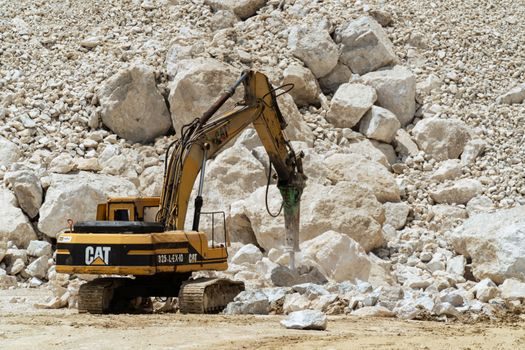
Excavator-mounted processor power mixers are a hydraulic-implement purchase, and the binding numbers are pressure, flow, and torque, not engine horsepower. The ALLU PM-series runs 350 bar (5,000 psi) max pressure across the range, 200-300 l/min max flow, 160 kW max hydraulic power, 18,000 Nm of drum torque at the drum at 350 bar, on a 25-40 tonne base machine, with a 2,400 kg attachment mass [S3]. A 20-tonne excavator with a 250 l/min main pump is in the working envelope; a 15-tonne with 180 l/min is below it and will stall the drum in dense demolition spoil — the failure presents as hydraulic relief chattering and slow drum recovery, not a tripped breaker.
For standalone power mixers, the binding numbers are motor power, voltage/phase, and footprint: 7 hp at 220 V / 30 A / single phase for the PA4000 electric option, 13 hp gas with electric start for the gas option, on a 1.9 m × 2.4 m / 907 kg dry frame [S2]. Noise is the soft constraint — Bartell's drum mixers register 105 dB(A) sound power, so any urban or night-work demolition site will need the electric variant plus a shroud [S6]. For the 5 m (16 ft) working-depth version of the excavator-mounted unit, the flow demand drops to 200 l/min (53 US gal/min) while pressure stays at 350 bar, so a 30-tonne carrier with 200-220 l/min is a viable match [S3].
Failure Modes and What Spec Auditors Flag First
The first thing a spec auditor or building department inspector flags on a demolition power-mixer setup is dust control documentation, not machine model. OSHA's silica rule applies whenever foreseeable conditions put workers above the 25 µg/m³ action level, and grinding/cutting/demolition tasks are named in the standard as covered tasks [S2]. A 13 hp gas mixer without a shroud is the easiest citation on the site; a 7 hp electric mixer with a shroud and wet-feed is the cleanest compliance posture.
The second flag is mix-design traceability: the Westland MI spec demands submittal of design mixes, sieve analysis, and MDOT 2012-spec compliance before placement [S4]. A power mixer that batches by visual consistency rather than mass measurement will not pass that submittal. The third flag is carrier-attachment mismatch: an 18,000 Nm drum on a 20-tonne excavator with insufficient hydraulic flow will produce slow drum recovery and overheating — a mechanical failure mode the OEM datasheet flags by max-flow and max-power numbers, not by carrier class alone [S3]. A related read on attachment envelope logic is captured in the Landscaping Demolition Hammer Spec Map: Class, Chuck, Impact Energy reference, where the same hydraulic-implement matching pattern applies.
Procurement Shortlist by Demolition Sub-Task
For in-situ soil/stabilisation mixing on contaminated or re-engineered demolition sites, specify the excavator-mounted processor power mixer with the working depth that matches the dig (3 m / 10 ft or 5 m / 16 ft), 350 bar / 200-300 l/min hydraulic envelope, 18,000 Nm drum torque, and a 25-40 t carrier class [S3]. For site-blended mortar, repointing, and patch work, specify a power-auger or forced-action mixer with a 6-8 cu ft (0.17-0.23 m³) drum, 7 hp 220 V single-phase electric or 13 hp gas drive, and an upper/mixer shroud for silica dust control [S2][S5][S6]. For flowable fill or large-volume backfill batching, default to a stationary power auger at the batch plant with submittal-grade mass batching, not a jobsite drum mixer [S2][S4].
Trackable signals to watch in the next sourcing cycle: (1) any municipality tightening its silica-dust language in demolition permits beyond the OSHA 50 µg/m³ PEL, which would push more buyers toward the 7 hp 220 V electric + shroud configuration [S2][S7]; (2) OEM datasheet revisions for the 5 m / 16 ft working-depth excavator-mounted mixer, where flow drops to 200 l/min and the carrier envelope widens to include 30-tonne class machines [S3]; (3) state-DOT spec updates beyond MDOT 2012, which would force re-submittal of design mixes on any demolition job that produces flowable fill or stabilised base [S4].
For component-level specifications, see power mixer, demolition hammer, and aerial work platform.