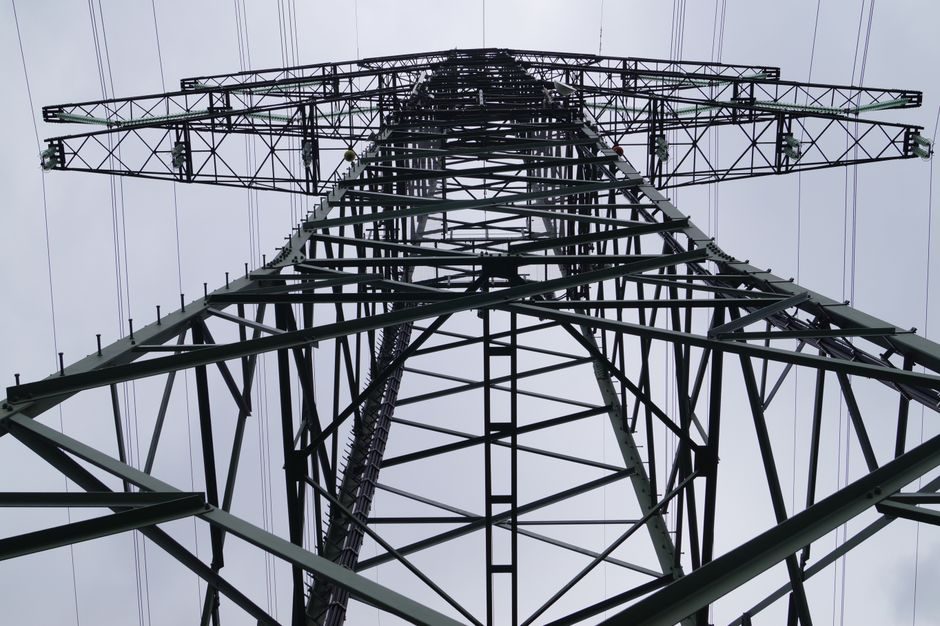
A 260-800 L manual-discharge tilting-drum mixer running 18-25 RPM with 3 mm upper / 4 mm lower drum plate is the baseline power-mixer package for structural concrete on steel-construction job sites, with engine sizing scaling from ¾ HP portable units up to 9 HP / 3 kW heavy-lift drums per published 2024-2026 mixer product data [S2][S3].
The choice pivots on three numbers: drum capacity, drum RPM, and engine power source. MDOT 2020 Standard Specifications for Construction requires that mixers combine aggregate, cementitious material, water, and admixtures without segregation, that central batch mixers carry a timing device locking the discharge during mixing, and that revolving-drum truck mixers remain in good condition [S1]. For steel-construction applications - footings, piers, deck pours, grout pads - the same MDOT discharge-locking logic applies, but the field unit is almost always a tilting-drum or paddle power mixer, not a central batch plant.
Duty Tier by Structural Element: Which Mixer Goes Where
Foundation pads and small pier bases (typical 0.5-2 m³ per pour) match 260-350 L drums with a 3.0 cu ft (≈85 L) rated mix volume; the Multiquip Mix-N-Go MC3SEA / MC3PEA series hits this tier at 3.0 cu ft maximum mixing capacity with a ¾ HP 115 V single-phase motor or a Briggs & Stratton 148 cc gasoline engine, weighing 132-138 lb dry with stand [S3].
Floor slabs, mat foundations, and composite deck pours land in the 400-500 L range, the manufacturer's stated "sweet spot" for general contractors balancing capacity and portability on the pour line [S2]. Large-diameter columns, pier caps, and continuous deck pours on multi-storey steel frames step up to 600-800 L drums driven by 9 HP gasoline or 3 kW electric motors, with the heavier drum geometry (3 mm upper shell / 4 mm lower shell plate) needed to survive aggregate impact through 8-hour shifts [S2].
Drum RPM, Geometry, and the Segregation Question
Drum speed in the 260-800 L manual-discharge class is held in an 18-25 RPM window to mix without segregating the coarse aggregate - a tighter band than the 14-20 RPM sometimes seen on ready-mix truck drums, because stationary site mixers lack the agitator dwell time of a transit drum [S2].
Shell thickness separates consumer-grade units from site-grade units: 3 mm upper / 4 mm lower plate is the working minimum for daily structural-concrete service, and cast-iron gear rings on the drive end are the standard wear part for the 260-800 L class [S2]. For batched material up to 3.0 cu ft, the Mix-N-Go frame uses replaceable bolt-in blades on a steel or polyethylene drum with an oil-immersed gearbox, the same lower-cost geometry adopted for lighter commercial work [S3]. For grout, mortar, and structural patching around base plates, a sand mixer with a paddle shaft and high-strength cast-iron paddle arms is the correct tool, not a drum mixer - paddle action breaks up dry cement-sand pockets that a rotating drum smears.
Engine Selection: Gasoline, Diesel, Electric
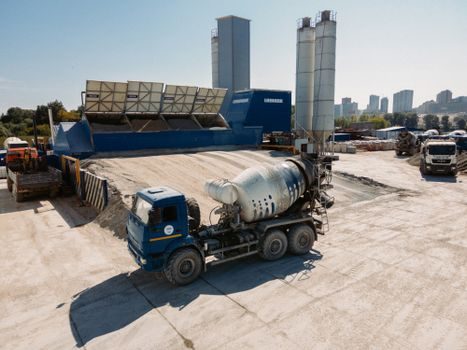
Gasoline power (Honda, Lifan, or B&S 148 cc class) fits remote steel-erection sites with no grid and intermittent cold-start risk; diesel fits heavy continuous pours with high torque demand on stiff low-slump mixes; electric 220 V / 380 V fits indoor and urban sites where engine exhaust is unacceptable [S2]. The Multiquip MC3SBA / MC3PBA models run the gasoline 148 cc B&S engine at 132 lb dry, and the electric MC3SEA / MC3PEA run the ¾ HP brushless 115 V single-phase unit at 138 lb dry - effectively the same frame, same 3.0 cu ft drum, with the engine swap being the only meaningful spec delta [S3]. For structural concrete sites in steel-construction that are tied to tower-crane power distribution, electric tilt-drums (3 kW class on the 600-800 L models) eliminate on-site diesel particulate and reduce fire-load near hot-work [S2].
Drum Material: Steel vs Polyethylene Trade-off
Steel drums tolerate coarse aggregate, structural concrete with rebar-chunk spillage, and prolonged abrasive wear; polyethylene drums are lighter, do not dent on impact, and release sticky mix cleanly, but they have lower upper-temperature tolerance and are typically specified for plaster, mortar, and small-batch concrete rather than daily structural pours [S3][S5].
For steel-construction work the steel drum is the default. The Multiquip product line offers both materials on the same frame to let rental fleets move units between structural and finishing duties, with the same oil-immersed gearbox behind either drum [S3][S5]. Polyethylene units are also less noisy on the pour line - relevant on occupied-building retrofit work where steel erection is happening next to live tenant space.
MDOT Discharge-Locking Logic Applied to Site Mixers
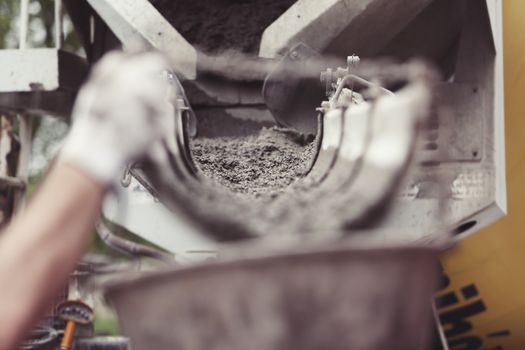
MDOT 2020 § on mixing equipment requires that central batch mixers lock the discharge mechanism during the full mixing period and release only at the end - a timing requirement that maps directly onto how a concrete mixer truck or site tilting-drum is accepted on a state-funded job [S1].
For non-state-funded steel-construction work, the same lock-during-mix principle is enforced by the manual-discharge drum's tilt-lever detent: the operator physically cannot tilt and pour until the drum has turned through the rated mix cycle. MDOT also requires mixers to combine the entire batched volume in one operation, which on a 600-800 L site mixer means a single 9 HP / 3 kW drive package sized to swing a fully loaded drum at 18-25 RPM without stalling [S1][S2]. Practical site check: a 500 L unit with a 5-6 HP engine can churn a full load; dropping to 3 HP on the same drum produces slow turns, poor aggregate coating, and segregation at discharge.
Power, Cabling, and Site Distribution
Electric mixers in the 3 kW class draw roughly 14 A at 220 V single-phase, which is well within a 16 A site distribution circuit but means the supply cable run and breaker sizing matter more than the mixer spec itself. For tower-crane-fed pours the same 3 kW motor can be fed from a 380 V three-phase site transformer with a phase-to-neutral drop to 220 V for the mixer. [S3]
Cable selection for movable mixers is governed by the same mechanical-duty rules as any site power cable: heavy-duty rubber-sheathed (e.g. H07RN-F) flex, not PVC indoor flex, and a length budget that does not exceed the voltage-drop limit at full load. On the metering side, kWh consumption for a 3 kW mixer running a 6-hour pour day is roughly 18 kWh - small enough that a site power meter on the mixer feed is useful for cost allocation between sub-trades on a multi-contractor steel frame.
Static Mixers in Plant-Batched Grout for Steel Base Plates
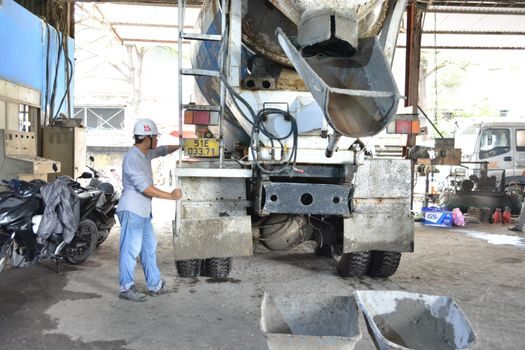
For plant-batched grout delivered to base-plate voids, an inline static mixer handles the final homogenisation step without moving parts; Komax publishes a static-mixer material menu spanning PVC, CPVC, clear PVC, FRP, stainless steel, carbon steel, and ductile iron bodies for chemical, food, and structural-grout service [S6].
For steel-construction base-plate grout, the relevant spec is a stainless or carbon-steel static mixer body rated for the grout's aggregate size and pump pressure, sized so the residence time matches the cement's working time. Inline static mixers have no RPM control (no moving parts), so the "selection" is body material, element count, and pressure drop - not engine sizing. Where a static mixer feeds a power transformer cooling loop or a chemical service, the material menu above also applies, but the structural-grout duty is the typical entry point on a steel-construction site.
Selection Rules of Thumb for Site Engineers
Match drum capacity to the largest single pour element: ≤2 m³ use 260-350 L, 2-4 m³ use 400-500 L, >4 m³ use 600-800 L. Hold drum RPM in the 18-25 RPM band. Specify 3 mm upper / 4 mm lower shell plate minimum for daily service. Choose engine by site conditions: diesel for heavy continuous off-grid, gasoline for portable cold-start, electric 3 kW class for indoor and urban sites with reliable supply. Verify the discharge-locking mechanism physically prevents early tilt, mirroring the MDOT 2020 central-mixer timing logic for state-funded work [S1][S2][S3].
Track these next signals: revision of MDOT 2020 Standard Specifications (the 2020 edition is the current public reference as of the source date) for any change to the mixing-equipment timing clause; rental-fleet refresh notices from Multiquip on the Mix-N-Go MC3 series; and any new 9 HP / 3 kW electric-drive offerings in the 600-800 L manual-discharge class that would let a steel-construction site run diesel-free without dropping drum size. Two adjacent spec domains worth cross-checking for related steel-construction equipment decisions are the Carbon Steel for Aerospace grade map for structural-plate material sourcing, and the Backhoe Loader 70+ HP class spec map for the support fleet that feeds aggregate to the mixer on site.