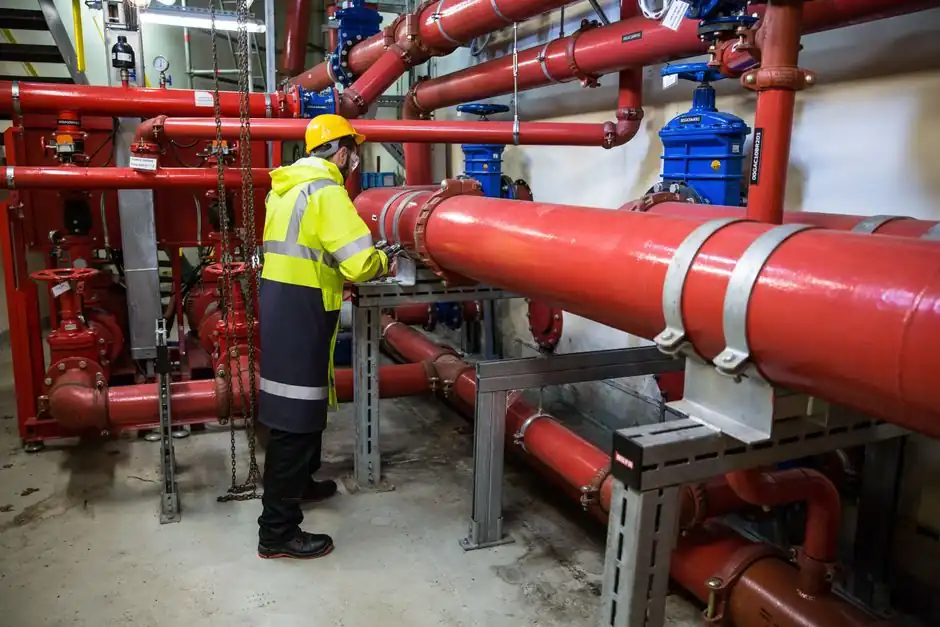
School campus plumbing covers drinking fountains, dormitory risers, cafeteria hot water, and HVAC branch lines, all of which a properly specified PPR pipe system can serve from 20 mm to 160 mm in PN10, PN16, and PN20 pressure classes [S1][S3].
A campus is rarely one uniform duty cycle: cold supply runs at 1.0–1.6 MPa class, hot recirculation at 70°C continuous with short peaks to 95°C, and HVAC risers demand lower thermal expansion [S1][S5]. Picking the wrong pressure class is the most common cause of premature joint creep in school retrofits.
Pressure class and SDR mapping for each school zone
Standard PPR is classified into PN10 (SDR 11 / S5), PN16 (SDR 7.4 / S3.2), and PN20 (SDR 6 / S2.5) pressure grades that map directly to allowable operating pressure at 20°C reference conditions [S3]. Cold-water distribution to drinking fountains and restrooms is normally PN16 in sizes 20–63 mm, while general hot water in dormitories and cafeterias is PN20 in the same range [S1][S3].
PP-RCT (PP-R Crystallite Temperature resistance) raises the pressure capability by about 25% over standard PPR at the same SDR and is the preferred pick for centralized hot-water circulation above 70°C [S1].
The table below is a decision matrix engineers can use as a starting point, not a substitute for hydraulic calculation against local code.
Material options: standard PPR, PP-RCT, F-PPR, and when each is wrong
Standard PPR (homopolymer random copolymer, ISO 15874 Type 3) is the default and is rated for continuous 70°C service with short-term peaks to 95°C and up to PN25 in cold service [S5]. For most school cold-water branch work it is the cost-effective choice and the simplest to heat-fuse on site [S1][S5].
PP-RCT is the upgraded crystalline-structure variant; its higher crystallinity allows about 25% higher pressure rating at the same SDR, or a thinner wall for the same duty, which is useful on long recirculation loops and high-rise dormitory risers [S1]. It is the right pick for hot-water plants sized above 70°C continuous, and it is the wrong pick if the specifier is buying purely on price for unheated cold lines.
F-PPR (glass-fibre reinforced, typically 20% glass by mass in a three-layer coextrusion) is designed to cut linear thermal expansion from roughly 0.15 mm/m·K down to 0.05 mm/m·K, which removes most expansion-loop hardware on long horizontal runs in ceiling voids and mechanical rooms [S1]. It is the wrong pick for schools with very tight ceiling plenums that demand small-bore bending radius; standard PPR with formed loops is still more forgiving in confined spaces.
Sizing rules of thumb: 32 mm is the school backbone

The 32 mm PPR size is the workhorse for branch distribution to a floor of restrooms, drinking fountains, and a small cafeteria point, while 40–63 mm covers dormitory stack risers and 75–110 mm feeds the building manifold from the plant room [S1][S6]. A single primary backbone up to 160 mm is used on larger school distribution mains where flow and pressure uniformity matter [S1].
Sizing should still be calculated against simultaneous demand factors (dormitory peak draw at morning and evening shower windows, cafeteria lunch peak) rather than fixture-unit summation alone, because PPR's smoother bore (roughness ≈ 0.007 mm) gives a lower head loss than steel or copper but does not change peak simultaneous flow [S1]. Comparing PPR to copper and steel at the same internal diameter, the operating cost of pumping is lower for PPR, but the operating cost advantage is not a substitute for sizing the pipe to the actual peak flow.
Certification and standards that actually matter on a school tender
For potable water inside a school the pipe must be certified to ISO 15874 (the governing product standard for PPR systems), with regional drinking-water approvals such as WRAS (UK), DVGW (Germany), or NSF/ANSI 61 (US) carried on the certificate, not claimed on the marketing page [S1][S5]. Heat-fusion joints must be performed by certified installers using temperature-controlled socket tools in the 250–270°C range, because a cold or overheated joint is the single most common leak path in PPR school systems [S5].
For hot-water recirculation above 70°C continuous, the specifier should require the manufacturer to publish a 50-year creep-rupture curve at the design temperature and to confirm the pipe has been tested to the relevant clause of ISO 15874, not just to a generic "PPR" label [S5]. For HVAC and heating, the same ISO 15874 framework applies, but the design must additionally account for the system's closed-loop water chemistry, since glycol-charged heating circuits reduce the pipe's effective pressure rating compared with plain water at the same temperature.
Installation and jointing: where schools leak
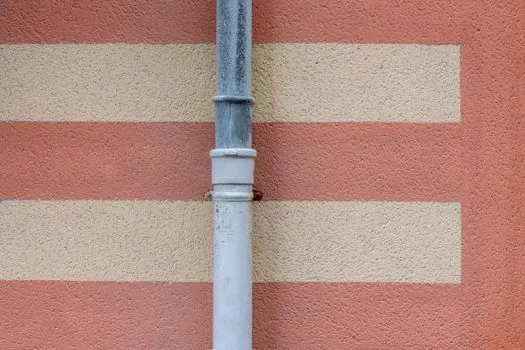
Heat-fusion socket welding is the dominant jointing method because the resulting bond is molecular and stronger than the pipe body, eliminating the threaded-joint leak path that plagues metal systems in school service [S1][S5]. The trade-off is that fusion joints are not demountable: any rework after pressure test means cutting out the fitting and re-fusing, which is why school projects stage the test before wall closure.
Transition fittings (brass-plated PPR or stainless-steel-lined PPR) are required at every point of contact with metal equipment, including boilers, booster pumps, and backflow preventers, because direct fusion to dissimilar metals is not allowed. Pipe support spacing on horizontal runs at 20°C is roughly 10–12× the diameter in mm (e.g. 32 mm pipe supported every 320–380 mm); on hot runs above 60°C the spacing must be halved, and expansion loops or offsets must be engineered every 6 m on unconstrained hot risers [S1][S5].
Who PPR is for, and where it should not be specified
PPR is the right material for new-build school potable water, hot recirculation, and HVAC water circuits where the design temperature stays inside ISO 15874 limits and the system is closed-loop or clean cold potable [S1][S5]. It is widely used in hotels, hospitals, schools, and apartment buildings for the same reason: long service life, no internal corrosion, and welded joints [S1][S5].
PPR should not be specified for outdoor UV-exposed runs without protective sleeving, for compressed-air or medical-gas service, or for any line that must remain open-loop with untreated water, and it should not replace a dedicated fire-sprinkler system, which is governed by a different standard family. For prefabricated building services modules that ship to site, a coordinated system spec like the specifying architectural hardware for prefabricated construction approach helps the MEP package arrive on site ready to terminate, because heat-fused PPR needs site power and trained installers on day one. Larger schools with on-site water treatment should also revisit the IBC tank selection criteria for any bulk storage tied into the same potable network.
2026 specification signals worth tracking
Two procurement-side signals are worth monitoring over the next two quarters: WRAS and DVGW certificate renewals for PP-RCT grades (because not every PP-RCT line on the market has both approvals), and published creep-rupture curves at 70°C and 80°C from the actual mill making the pipe being quoted, rather than generic brochure data. Either signal is auditable on the manufacturer's certificate portal and will determine whether a PN20 quotation on a school tender is really PN20 for the design life, or only PN20 at 20°C reference. [S1]
For component-level specifications, see pe pipe, and pipe clamp.