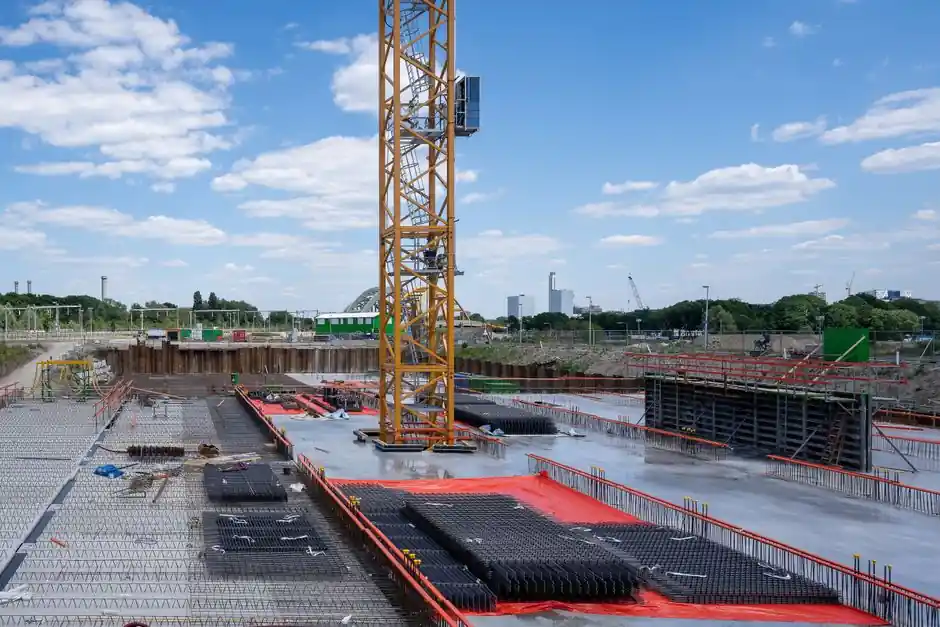
A precast concrete weighbridge deck arrives factory-poured and ready to set, but its handling weight and transport cracking risk separate it sharply from a site-poured deck that cures for about 30 days on the foundation [S1][S2].
Both forms use the same steel weighbridge framing and load cells, so weighing performance is identical when the scale is built to the same NTEP design specification. The choice between precast and pour-in-place sits on five decision axes: install time, deck mass, traction, relocatability, and long-term deck service life [S1][S5].
How the Two Concrete Deck Types Differ at the Spec Level
A site-poured concrete deck is a steel-framed weighbridge with an open top that the supplier ships to site; a third-party contractor then pours concrete to the supplier's spec and the deck cures for up to 30 days before trucks can run on it [S1]. The finished deck thickness on most concrete truck scales runs 6 to 10 inches, with anything below that typically indicating a precast weighbridge poured at the factory rather than on site [S2].
A precast concrete deck is a factory-cast module that the scale manufacturer delivers already filled and finished. The deck mass is roughly four times that of an equivalent steel deck, which is what gives concrete its drive-wheel resistance but is also what makes precast modules heavy enough to require a larger crane and, in many cases, two transport trucks instead of one [S1][S4].
Mass, Longitudinal Loading, and Deck Service Life
Concrete decks owe their durability to mass: with roughly four times the dead weight of a steel deck, the concrete surface absorbs and distributes the longitudinal kick from a truck's drive wheels during acceleration, instead of passing that shear into the load cells and bearings [S1]. The same mass also lowers the deck's center of gravity, which improves load distribution across the weighbridge module [S5].
Multiple OEM and dealer sources place the deck service-life advantage of concrete at about 5 to 7 years longer than a comparable steel deck, and the maintenance burden is rated "low" because the driving surface is not subject to the same corrosion mechanism as exposed steel tread plate [S5][S6]. For aggregate, quarry, and port operations where the truck mix skews heavy, this is the headline spec number that drives the choice toward pour-in-place concrete [S2][S5].
Install Time, Cure Time, and Relocatability
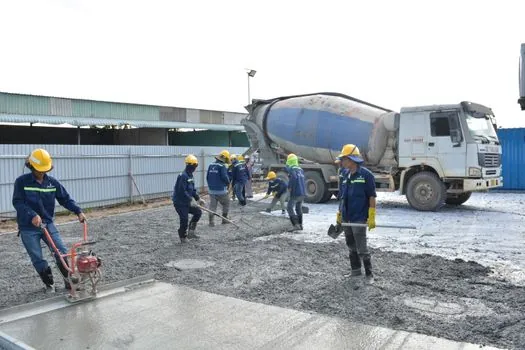
A steel deck truck scale is typically installed and weighing trucks within one business day, because the deck is welded at the factory and the only field work is setting modules on the foundation and calibrating [S1][S2]. A pour-in-place concrete deck trades that speed for about 30 days of cure time before live weighing; a precast concrete deck is the middle path, since the factory has already cured the concrete, but transport and craning the heavier module push install time and freight cost above a steel deck's [S1][S3].
For a temporary site, a lease yard, or a quarry where the scale is expected to move in 5 to 10 years, relocatability matters more than deck mass. A precast concrete deck can be lifted and moved, but its weight typically rules out a single standard crane; a steel deck is the lightest to relocate and also commands higher resale value in the used-scale market [S1][S4].
Traction, Corrosion, and Pedestrian Safety in Wet or Icy Conditions
Concrete decks rate better than steel in wet, snowy, or icy conditions because the broom-finished or cast surface holds tire grip even when the deck is saturated; steel tread plate, including diamond pattern, can become slick when wet, and pedestrian footing is noticeably worse on steel than on concrete in those conditions [S1][S4][S6]. Concrete also resists the chloride and de-icing salt exposure that pits steel tread plate over time, which is the second mechanism (besides mass) behind the longer deck life rating [S5][S6].
The trade-off is repair: a damaged steel section is cut out and welded back in, while a damaged concrete section has to be chopped out and re-poured, and the cure clock restarts for that panel [S2]. For a site that takes heavy impact from off-road or steel-tracked equipment, this repair asymmetry is a real spec line, not a footnote.
Decision Matrix: When Each Deck Type Fits
Use pour-in-place concrete when the site is permanent, traffic is heavy (aggregate, scrap, port, transfer station), wet-weather traction matters, and the owner can absorb 30 days of cure. Use precast concrete when the site is semi-permanent, the owner wants concrete traction and mass but cannot accept a 30-day cure, and the install crew can handle a heavier crane lift and likely a multi-truck delivery [S1][S5]. Use steel when relocatability, fast install, and lower upfront cost dominate the decision, and when the deck will not see concentrated off-road loading [S2][S3][S4].
A common rule of thumb from dealers: if the truck mix is dominated by Class 8 on-highway tractors, both precast and pour-in-place are defensible, and steel remains competitive; if the mix includes loaded dump trucks, scrap haulers, or off-road rigs, concrete is the safer spec, and a pour-in-place deck generally outlasts precast on the same site because the field-poured bond to the steel framing is mechanically tighter than a factory-cured module's [S2][S4][S5].
What a Buyer Should Confirm Before Signing the PO
Pin three numbers on the spec sheet before the order is released: deck plate or slab thickness in inches, expected cure or install-to-weighing time in days, and the static deck weight in pounds or kilograms, because that number drives foundation design, crane size, and freight class [S1][S2]. For a concrete deck, also confirm whether the pour is site-poured or factory-poured precast, who is responsible for the concrete (supplier or third-party contractor), and whether the foundation has been sized for the higher static load a concrete deck imposes [S1][S4].
Two trackable signals to watch in 2026 are worth noting for any fleet or site engineer evaluating a future purchase. First, multiple OEM product lines now list a 5 to 7 year deck-life advantage for concrete over steel as a published spec, a number that was not consistently stated in pre-2022 dealer literature [S5]. Second, factory-poured precast deck options are being quoted more often for temporary and lease applications, which suggests the precast form factor is being repositioned away from the permanent-scale market and toward the relocatable-scale market, where its higher transport cost is offset by the absence of on-site cure time [S1][S3][S5].
The underlying component specifications are covered under concrete mixer truck, concrete pump truck, and truck mounted concrete pump.
Related analysis: Choosing a Concrete Vibrator by Structural Member: Internal vs Form vs Surface.