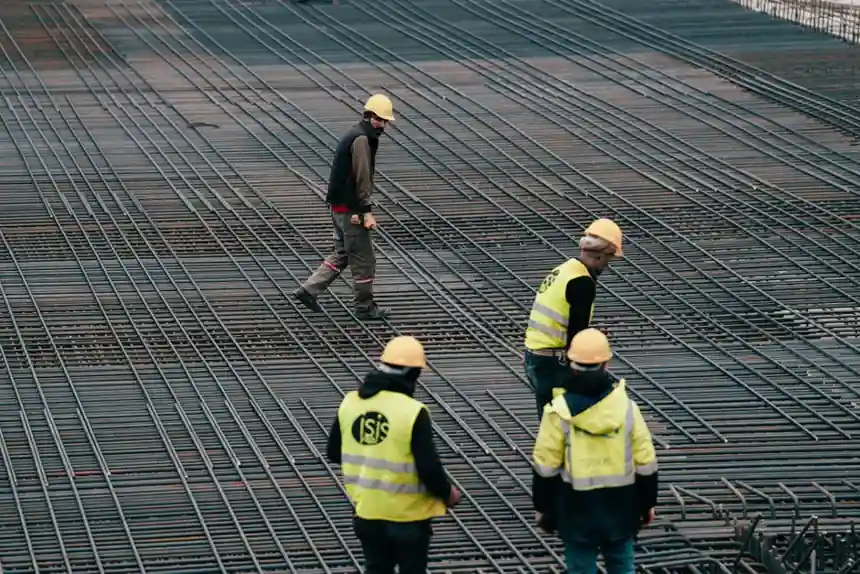
Selecting a vibrator by member geometry is a specification decision: a 200 mm slab screed, a 1.2 m thick foundation pour, and a heavily-reinforced precast column require three different machines, and matching the wrong one costs density, finish, or both. Air content in fresh concrete can run up to 20% by volume before vibration, and for every percent of trapped air, the compressive strength of a poured concrete product is reduced by 6% [S1][S4].
American Concrete Institute guidance treats vibration as the controlled input of mechanical energy to collapse those voids [S1][S2]. The same goal, dense, homogeneous concrete around rebar, is met by three mechanically different tools: an immersion head (internal), a clamped bracket on the form face (form/external), or a vibrating screed riding on the top surface (surface) [S2].
Three Vibrator Families and the Mechanics Behind Them
Internal (immersion) vibrators place a rotating eccentric-weight head directly into the concrete; the effective radius of influence around that head runs 300-600 mm (1-2 ft), so insertion spacing must overlap or the lift will be under-consolidated [S2][S4]. Most site units are external-motor stick vibrators with 120/240V single-phase drives and shaft lengths from 1 ft to 8 ft; head diameters span roughly 25-75 mm and the larger heads go with low-slump mixes [S2].
Form vibrators, also called external vibrators, are clamped to the outside of the formwork and drive energy inward through the form face; they are the go-to for precast, heavily congested rebar cages, and closed or complex forms where an immersion head cannot reach [S1][S2]. Surface vibrators (screeds) sit on top of the slab and consolidate only the upper lift, typically limited to slab depths under about 150 mm before the energy decays past useful amplitude [S3].
Matching the Tool to the Structural Member
For thick slabs, walls, and columns, internal vibrators remain the most common selection because of head reach, maneuverability, and unit price; back-pack and flex-shaft electric or gas units cover the 150-600 mm member range typical of cast-in-place frames [S3]. A concrete vibrator selected for this class is sized by head diameter relative to the smallest rebar clear spacing, with the head passing freely between bars without snagging.
For precast columns, dense rebar mats, and architectural members where surface finish is critical, form (external) vibrators are specified because the head cannot be immersed in the cage; bracket force, frequency, and form stiffness then govern the result, with the bracket typically tuned to the form's mass to avoid form blow-out [S1][S2]. The two-stage process described for internal rods (leveling, then de-aeration) still applies, but energy is injected from the form face rather than from the centerline [S4].
For thin slabs, toppings, and pavements under about 150 mm, surface vibrators (vibrating screeds) consolidate the lift in a single pass and lay the surface profile in the same operation; the trade-off is depth, anything thicker than roughly 150-200 mm starts to fall outside the effective amplitude band and needs an internal pass below the screed [S3]. A common field rule is to size the screed length to exceed the slab width by at least 150 mm at each edge to keep the working face straight.
Selection Criteria That Actually Move the Decision
Five criteria drive the choice more than brand or power source: member depth, rebar congestion, slump, surface-finish class, and access for an immersion head. Lifting the head from a 2 m column pour while staying inside the form is straightforward; the same head cannot be inserted into a closed-end precast box girder, so the form vibrator takes over. If the surface must be architectural (class A finish) with no bug-holes or lift lines, the form vibrator is preferred because it does not leave immersion marks [S1][S2].
For self-consolidating concrete (SCC) and other high-flow mixes, a small-diameter head (or only a brief touch with a form vibrator) is enough; over-vibrating SCC segregates the mix and pushes paste to the surface, which is the opposite of what the spec demands [S2]. The pitch cue still applies: a freshly-inserted head drops in tone, then climbs and steadies when entrapped air has escaped, and operators who stop at the leveling stage leave bug-holes and lift lines behind [S4].
Limits, Failure Modes, and the Over-Vibration Question
Form vibrators are not universal: thin, flexible, or poorly-braced forms will deform or split under the same energy that consolidates a stiff precast mould, so the rule of thumb is to size bracket force to form stiffness rather than to concrete volume alone [S1]. Internal heads pulled too fast leave an air-filled cavity in their wake; left in one spot too long, they segregate the mix and drive paste to the top, which is the failure mode the surface screed is least able to recover [S2][S4].
Operators commonly stop after stage one (leveling) and never reach stage two (de-aeration), which is the documented root cause of most surface blemishes on formed walls [S4]. Over-vibration is rarely a problem in ordinary mixes because the paste viscosity throttles particle motion; in SCC, however, the same physics produces segregation, so vibrator energy for SCC is set deliberately low, sometimes with just a brief form-vibrator tickle [S2][S4].
Side-by-Side Comparison by Member Type
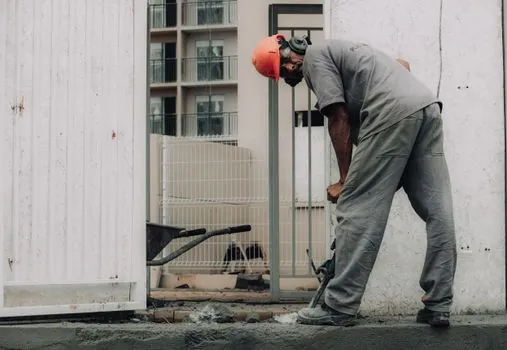
Comparing the three families against the four decision criteria most often used on site: thick slabs, walls, and columns favor internal vibrators for head reach and per-unit cost; precast members, congested rebar, and architectural finish favor form vibrators because no immersion access is needed; thin slabs and toppings under 150 mm favor surface screeds for single-pass profile and consolidation. On rebar congestion, internal units lose to form units because the head must pass between bars; on finish class, form units win because they leave no immersion marks; on unit cost, surface screeds are the lowest per square metre, internal stick units the lowest per cubic metre, and form vibrator systems the highest because the brackets and formwork are engineered as a pair [S1][S2][S3].
For a 300 mm cast-in-place wall with standard rebar spacing, a 35-50 mm internal head on a 7 ft flex shaft covers the lift in 400-500 mm insertion spacings; for the same member cast in a precast yard with architectural finish, a form-mounted high-frequency bracket replaces the head and a finishing pass handles the surface. For a 100 mm bonded topping on a precast plank, only a vibrating screed is specified; the head is too large to consolidate 100 mm without punching through, and the form vibrator is irrelevant because there is no form face to clamp to [S1][S3].
Standards, Sourcing, and Trackable Signals
Consolidation practice is governed by ACI 309 (Guide for Consolidation of Concrete) and the project's specified finish class, with form-vibrator sizing typically cross-referenced to the formwork supplier's bracket-force tables; energy and amplitude targets come from ACI 211 mix-design inputs rather than from the vibrator OEM [S1][S2]. Head-size selection against rebar clearance is project-specific and should be confirmed against the placing drawings before the pour, not during it.
Trackable signals for spec drift over the next planning cycle: tighter architectural-finish specifications pushing more precast work to form-vibrator systems; wider SCC adoption trimming internal-vibrator run-time on cast-in-place frames; and slab-thickness ceilings on surface screeds staying near the 150-200 mm mark unless the screed is paired with a follow-up internal pass. The decision matrix in the section above is the working tool; the member geometry dictates the family, and the family dictates the head, the shaft, the bracket, or the screed. For an adjacent decision on the equipment side of a pour train, see the hammerhead vs luffing jib tower crane spec and site decision matrix, which covers the lifting side of the same pour operation.
For the relevant spec sheets and selection criteria, see surface roughness tester, and pressure transmitter.