
Precision air conditioning (PAC) — sometimes called close-control air conditioning — held a structural share of the data-center HVAC spend through 2025-2026, with the 20-vendor competitive set led by Vertiv, Envicool, Canatal, Airsys, YMK, Gree, Guangdong Shenling, Stulz, Renovoair, Hisense, Guangdong Jirong, iTeaQ, Blackshields, Uniflair, Euroklimat, Mitsubishi Electric, EATON, HAIRF, Haier and Dantherm [S1].
Application segmentation in the 2024-vintage GIR baseline still maps the 2026 buy: computer rooms and data centers, telecom equipment rooms and shelters, hospitals and health areas, industrial cleanrooms, and a residual "other" bucket — with the data-center and telecom lines absorbing the bulk of new unit shipments [S1]. The two product tracks remain indoor PAC (downflow/upflow CRAC inside the white space) and outdoor PAC (roof- or skid-mount condenser-side equipment for harsh or space-constrained sites) [S1].
What "precision" actually delivers above comfort cooling
PAC holds temperature, relative humidity and particle counts inside tight, server-grade tolerances 24/7 and pushes alerts when the room drifts out of band, something a comfort unit is not designed to do [S1]. Ganpati's engineering definition converges: PAC targets sensitive electronic loads, not human comfort, and trades off part-load efficiency for tight dew-point and temperature control [S4].
Sensible heat ratio (SHR) is the second axis: data-center PAC units are normally sized at 0.9-1.0 SHR because wall moisture loads are small, whereas hospital OR and cleanroom PAC drops toward 0.7-0.85 SHR to handle fresh-air and latent gains [S4].
2026 trend stack: AI heat density, EC fans, low-GWP refrigerants
Three movements show up across the 2026 product lines. First, AI training racks above 50-100 kW per cabinet push PAC manufacturers toward higher delta-T and chilled-water or rear-door heat-exchanger variants alongside traditional DX. Second, EC (electronically commutated) fan retrofits — for example ebm-papst's next-generation RadiCal and the new iQx motor platform — replace AC backward-curved fans and cut fan-stage power materially, a 2026-dated product push ebm-papst lists under its precision air-conditioning and CRAC segment [S2]. Third, low-GWP refrigerant transitions (R-454B, R-32 and R-290 in sub-150 g charges) show up in 2026 product briefs as the response to the EU F-Gas revision and similar rules.
The RadiCal line ebm-papst markets for PAC and CRAC applications sits in a compact-fan package that handles the pressure rises of dense coil and filter sections, and the iQx EC motor family (up to 24 kW in the DV280 frame) lets integrators spec the same motor across indoor PAC, AHU and condenser stages [S2]. For buyers tracking the fan side specifically, ebm-papst also publishes a "Data center cooling for the AI age" campaign covering in-row units, RDHx (rear-door heat exchangers) and server cooling — directly relevant to PAC spec sheets on the heat-rejection side [S2].
Indoor vs outdoor PAC: a four-criteria comparison
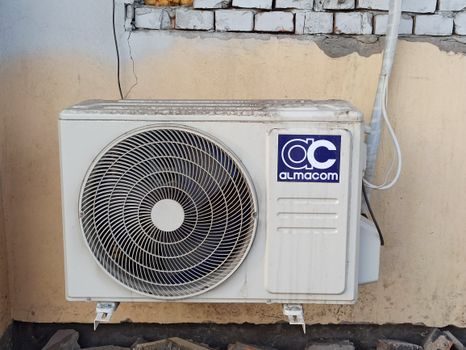
The two architectures [S1] line up differently for the 2026 buyer:
1) Footprint: indoor PAC sits inside the white space and uses floor or ceiling returns; outdoor PAC removes the heat-rejection stage to a roof or yard, freeing IT floor area but adding refrigerant-line length and a separate power feed. 2) Heat-rejection: indoor units reject to ducted condenser air or a chilled-water loop; outdoor units reject to ambient air, so performance is seasonal. 3) Maintenance: indoor PAC keeps service in the data hall, which is fine for trained techs but raises change-management friction; outdoor PAC moves compressor and condenser work to a non-IT zone. 4) Use case: indoor PAC is the default for greenfield greenfield 5-20 MW halls with good duct risers; outdoor PAC fits retrofit telecom shelters, containerised micro-data-centers and edge sites where floor area is the bottleneck. Made-in-China sourcing pages show PAC container and e-house units from NINGBO HICON INDUSTRY CO., LTD. quoted in a US$ 950.00-9,500.00 per-set range for floor-standing / top-mounted microcomputer-controlled units with galvanized-sheet cabinets [S3].
Selection criteria engineers actually use in 2026
Five filters consistently separate a 2026 PAC shortlist. [S1]
For buyers with hot-aisle containment, the EC fan stage typically oversizes the return path; ebm-papst's RadiCal and AxiEco (300-910 mm) families are the visible supplier choices in 2026 catalogues and the same fans show up across both indoor CRAC and in-row coolers [S2]. Buyers who want to cross-link sensor-side decisions can review the precision filter reference for filter class and pressure-drop math, and the air quality monitor reference for the particulate/RH sensing stack that pairs with PAC BMS points.
Who PAC is for — and where it is the wrong tool
PAC is the right call for: (i) data halls and telecom equipment rooms where server-room-grade tolerances matter more than $/kW cooling; (ii) hospital operating theatres, MRI suites and pharmaceutical cleanrooms with codified T/RH limits; (iii) industrial cleanrooms (ISO 14644-1 Class 5-8) where particle and humidity control are coupled; (iv) battery energy-storage rooms and switchgear rooms with thermal-runaway thresholds. [S1]
PAC is the wrong tool for: (a) general office comfort loads — a VRF or chilled-beam plant is cheaper per kW; (b) high-density AI training pods above 50-100 kW/rack where the right answer is chilled water + RDHx or direct-liquid cooling rather than perimeter CRAC — buyers weighing that transition can compare lifecycle cost against the immersion cooling 2026 spec map and the industrial UPS system leaders spec map (UPS hold-up time is the buffer that lets you ride a PAC restart). For semiconductor-fab PAC behind the tool, review the semiconductor manufacturing quality standards spec map — the contamination envelope is tighter than a generic cleanroom.
Standards, failure modes, and what to write into the RFQ
Reference frameworks a PAC spec should call out by name: ASHRAE TC 9.9 (thermal guidelines for data processing environments), EN 16798-3 (ventilation and indoor-air quality for non-residential buildings), ISO 14644-1 (cleanrooms), EU Regulation 2024/573 (F-Gas, the revision in force), and EU Ecodesign 2025 tiers for air-conditioning products. ASHRAE 135 / BACnet and ISO 16484-5 (BACnet) are the usual BMS hooks; for industrial sites, IEC 62443 applies when the BMS is on the same network as process control. [S2]
Common failure modes to test in commissioning: (1) condensate pan overflow under partial latent load (a defect of undersized drip trays), (2) hot-aisle bypass when the supply diffusers are not balanced, (3) fan-stage tripping on clogged ePM10/ePM2.5 filters (confirm a magnehelic or differential-pressure switch is wired into the alarm stack), (4) refrigerant migration in long line-sets on outdoor PAC installs — a vacuum/pressure-decay test is mandatory after brazing, (5) humidity overshoot on humidification electrode-boiler service where supply-water hardness climbs. The procurement line items a 2026 RFQ should force: sensible kW at ASHRAE entering conditions, EER/ESEER numbers at A, B and C load points, filter class per ISO 16890, dB(A) at 1 m, BMS protocol and points list, and refrigerant type with GWP stated on the nameplate.
Lead-time, regional supply, and what changed in 2025-2026

Lead times for close-control PAC in 2024-2025 stretched on EC fan motors and inverter compressor allocations, and the same constraint carried into 2026 builds — Vertiv, Stulz and Envicool all lengthened quoted lead times on custom SKUs in 2025. Regional supply stays concentrated: GIR's regional analysis places North America, Europe and Asia-Pacific (China, Japan, Korea, India, Southeast Asia) as the three core regions, with South America and MEA as secondary growth zones [S1]. Made-in-China category pages show 1,000+ PAC and industrial air-conditioning SKUs across 1-10+ set MOQ tiers from ISO 9001:2015 / ISO 14001 / ISO 45001:2018 audited factories, with NINGBO HICON INDUSTRY CO., LTD. among the suppliers quoting in the US$ 950-9,500 per-set band for floor-standing or top-mounted galvanized-cabinet units [S3].
For 2026 watch-lists a buyer can monitor: (1) EU F-Gas quota movements and the resulting R-454B/R-32/R-290 retrofit pipeline; (2) ASHRAE TC 9.9 updates on the upper end of the recommended envelope as AI racks push inlet temperatures above 27 °C in liquid-assisted designs; (3) EC motor and RadiCal-class fan price points, since EC stages are the most exposed component to neodymium and copper swings; (4) container/edge PAC pricing where Made-in-China factory quotes cluster. For the actuation side of a PAC control loop, the air solenoid valve and pressure transmitter references cover the components that sit on the BMS panel; for the pneumatic service that occasionally backs up PAC actuators, the air impact wrench reference is the closest spec-page in the catalogue.