
MarketsandMarkets pegs the global immersion cooling market at USD 2.61 billion by 2032, expanding at a 24.2% CAGR from a 2025 base, with segmentation by single-phase vs two-phase architecture, application (HPC, edge, cryptocurrency mining), cooling fluid, and component [S6]. That trajectory sits inside a much larger data center cooling envelope that Grand View Research values at USD 26.3 billion in 2025 and USD 31.4 billion in 2026, compounding at 22.3% to USD 128.3 billion by 2033 [S7].
The technology itself is mature enough to specify, not just forecast: a tank of dielectric fluid replaces air as the heat-transfer medium, so IT hardware sits in direct liquid contact. Two-Phase immersion cooling relies on a dielectric fluid boiling on component surfaces, and the latent-heat of vaporization carries the heat away. Single-phase uses a single-phase dielectric fluid that stays liquid and is circulated through a heat exchanger; both approaches are now standard procurement options for HPC and AI cluster builds [S6]. The 2021 MarketsandMarkets release set a 2026 mark of USD 700 million [S1], a figure that is now dwarfed by the 2032 USD 2.61 billion projection as AI training workloads scale [S6].
Market Size, CAGR, and the Hyperscale Driver
Immersion cooling is the fastest-growing slice of a fast-growing pie. The data center cooling market grew from USD 26.3 billion in 2025 to a projected USD 31.4 billion in 2026, then to USD 128.3 billion by 2033 at a 22.3% CAGR, with Asia Pacific holding the largest revenue share at 36.9% in 2025 [S7]. Immersion cooling's own 24.2% CAGR is on top of that envelope, because it converts to liquid cooling, the segment that captures the most heat flux from densely packed GPU racks [S6].
Hyperscale data centers in Asia Pacific, North America, and parts of Europe are the buying signal behind those numbers. District cooling, a separate but adjacent infrastructure category, was valued at USD 29.1 billion in 2025 and is projected to reach USD 62.4 billion by 2036 at 7.2% CAGR, driven by global-warming-linked urban cooling demand [S5]. The contrast matters: district cooling is a utility-scale play; immersion cooling is a server-room-scale play. Procurement teams should not conflate the two; they share a cooling-fluid supply chain but not a customer base.
Single-Phase vs Two-Phase: Selection Criteria
Single-phase and two-phase immersion are not interchangeable, and the 2025 MarketsandMarkets taxonomy treats them as separate market segments [S6]. Two-phase systems deliver higher heat-transfer coefficients because the phase change from liquid to vapor at the component surface absorbs latent heat; single-phase systems avoid the vapor-handling complexity and keep the dielectric in liquid form throughout, simplifying the tank and condensation loop. Procurement guidance in 2025 and 2026 reports maps two-phase to the densest GPU/TPU racks and single-phase to edge and mid-density HPC deployments, where the simpler fluid handling outweighs the lower heat flux per square centimeter [S6].
A practical comparison for buyers, drawn from the published segmentation logic in [S6]:
- Heat flux ceiling: two-phase > single-phase, due to latent-heat transport; two-phase is favored for AI training racks in the 50-100 kW-per-rack class.<br>- Fluid handling complexity: single-phase < two-phase, because two-phase requires vapor capture, condensation, and careful management of non-condensable gases; single-phase is closer to a pumped-loop design and fits retrofits.<br>- Dielectric fluid choice: both approaches depend on engineered fluorinated or hydrocarbon-based dielectric fluids; the single-phase pool is broader, including some legacy mineral-oil-based options, whereas two-phase tends to rely on lower-boiling-point engineered fluids.<br>- Maintenance access: single-phase tanks are easier to lift and service with standard lifting fixtures; two-phase installations need sealed vapor management and specific service procedures.
Cooling Fluid, Components, and Where They Sit in the Bill of Materials

MarketsandMarkets breaks the immersion cooling stack into two components: Solutions (the fluids, tanks, heat exchangers, CDUs) and Services (installation, monitoring, fluid management), and it tracks cooling fluid as its own axis [S6]. The dielectric fluid is the consumable; it degrades over time, picks up moisture, and must be filtered or replaced on a service interval, so the fluid line is a recurring opex item, not a one-time capex line. The tank, the heat exchanger, and the coolant distribution unit are the capex items, and they show up under Solutions in the same segmentation [S6].
Services revenue scales with the installed base: every tank needs commissioning, fluid top-up, and periodic dielectric testing. The breakdown between Solutions and Services matters to procurement because the gross margin profile is different: hardware margins are tighter and competitive; services margins, especially fluid-change contracts, are higher and stickier.
Application Map: HPC, Edge, and Crypto Mining
MarketsandMarkets names three end applications: high-performance computing, edge computing, and cryptocurrency mining [S6]. HPC, which now includes AI training and inference clusters, is the largest pull in 2025-2026 because the rack densities in those facilities exceed what air cooling can handle economically. Edge computing sites are smaller and more distributed, so immersion is selectively specified where the edge node is large enough to justify a tank; otherwise, the deployment stays on air or rear-door heat exchangers.
Cryptocurrency mining remains a third slice, but the 2025-2026 reporting cycle treats it as a smaller and more price-sensitive segment than HPC; mining operators are willing to retrofit, but the high-fluidity dielectric fluids and the higher-grade tanks still cost more than the open-air mining containers that dominated the 2017-2021 cycle [S6]. Buyers sourcing for HPC and AI workloads should not anchor on crypto-mining pricing, because the build quality and uptime expectations differ.
Adjacent Liquid-Cooling Stack and Where Immersion Fits
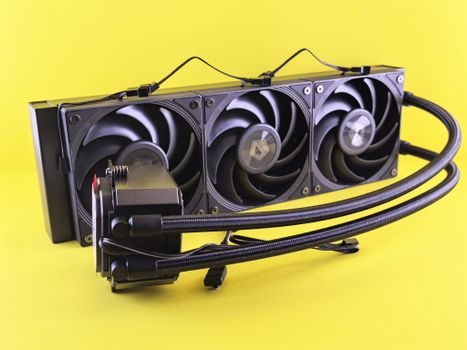
Immersion cooling is one of three principal liquid-cooling architectures, and it is the most aggressive on heat flux. For engineers comparing options, the relevant contrast is direct-to-chip (DLC) cold plates, rear-door heat exchangers, and full immersion tanks, all of which now sit in the 2026 procurement menu for AI clusters. The wider data center cooling market, USD 31.4 billion in 2026 [S7], is the parent category, and immersion is the highest-density child within it.
For plant-side and process engineers cross-mapping cooling strategies into industrial control, two adjacent reads are useful: the Liquid Cooling 2026 spec shifts for DLC and LFP ESS racks piece, and the broader platform-scale cost and sourcing map for non-thermal balance-of-plant hardware. The tank-side fluid-handling hardware also overlaps with industrial valve selection on the secondary loop, and the flow meter spec on the dielectric circulation line is a non-trivial decision because dielectric fluids have different viscosity and temperature curves than water-glycol mixtures.
Limitations, Failure Modes, and Standards Watch
Immersion cooling is not a free upgrade. The dielectric fluid is a chemical-handling responsibility: spills, disposal, and operator exposure are regulated under the same hazardous-fluid frameworks that govern other engineered fluids, and the dielectric strength of the chosen fluid must be re-tested on a service interval. Material compatibility with seals, gaskets, and cable jackets is a documented risk; some elastomers swell in hydrocarbon-based dielectrics, so the bill of materials must be vetted against the specific fluid, not just "dielectric oil" as a category. [S6]
Standards to watch for any 2026 spec are the ASHRAE TC 9.9 liquid-cooling guidance, the OCP (Open Compute Project) liquid-cooling specifications, and the IEC/UL safety work on immersion equipment. Specific revision dates and effective dates for those documents should be confirmed with the issuing body before they are cited in a procurement specification, because liquid-cooling standards are still being updated for higher-density AI workloads. Maintenance crews also need training to work around energized equipment submerged in dielectric fluid, and the lift fixtures, drip trays, and grounding paths are part of the install, not an afterthought.
Sourcing Signals to Track Through 2026

Three numbers are worth pinning to a buyer's wall: the 24.2% CAGR on immersion cooling through 2032 [S6], the 22.3% CAGR on the parent data center cooling market through 2033 [S7], and the 36.9% Asia Pacific revenue share in 2025 [S7] that tells you where the bulk of new build will land. The coatings additives market (USD 12.2 billion in 2025, USD 12.8 billion in 2026, 4.6% CAGR through 2036) [S2] is a useful reference for "slow chemical" growth, against which immersion cooling's 24.2% looks less like a forecast and more like a step-change in capex allocation. The district cooling market at USD 29.1 billion 2025 / USD 62.4 billion 2036 [S5] is the macro-scale cooling benchmark. The next node to watch is the publication of 2025 full-year installed-base numbers from the major immersion tank OEMs, which will set the 2026 baseline against the 24.2% CAGR curve.
Spec-level background on the components involved: pressure transmitter.