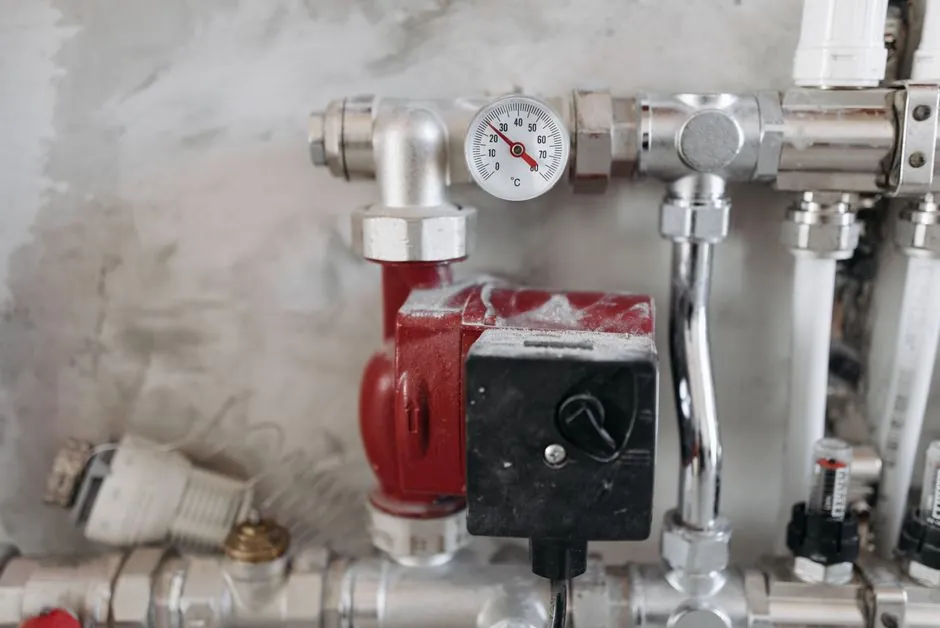
A pressure switch that opens or closes a contact at the wrong threshold is a false-trip or a missed-trip, and both failure modes live or die on whether the switch's accuracy class matches the application's actual demand. Across industrial datasheets published in 2026, the operating pressure should sit in the middle 30-70% of the switch's rated range, while a mechanical unit typically delivers 2-5% full-scale switching accuracy versus 0.5% full-scale for an electronic unit [S1][S2][S4].
Accuracy in this product class is not a single number. It bundles setpoint repeatability, deadband stability, temperature drift, and the long-term drift of the sensing element, and each of these is set by a different part inside the switch. The job of the specifying engineer is to map those four numbers onto the actual process tolerances, not onto the headline FS accuracy printed on the front of the datasheet.
Setpoint placement and the 30-70% rule
Setpoint placement inside the rated range is the single highest-leverage decision in pressure switch selection. Industrial guidance updated in April 2026 states that pressure switches are most accurate and most repeatable in the middle 30-70% of their rated range, and gives the canonical example: specifying a 0-500 psi switch to control at 50 psi puts the working point at 10% of full scale, where repeatability, deadband, and temperature coefficient all degrade together [S4]. The same 30-70% rule shows up in differential-pressure selection: the operating differential should fall between 25-75% of the switch's maximum range for both accuracy and reliability [S2].
Two mechanical effects drive the rule. First, springs are near-linear only in their mid-stroke; near the bottom of travel, small force changes produce large displacement, and near the top the windings bottom out. Second, the snap-action microswitch inside a mechanical pressure switch trips after only a few tenths of a millimetre of overtravel (under 0.5 mm on a Honeywell V3 or Crouzet 83 series), so the working point of the spring is effectively fixed at trip, not across the range [S4]. Oversizing the range "for safety" therefore trades away accuracy, a point also made in the 2026 hydrogen sensor literature: a 1,000 bar sensor at the same 0.5% FS accuracy delivers ±5 bar at full scale, versus ±2 bar for a 400 bar sensor at the same process point [S5].
Mechanical versus electronic: which accuracy class fits
The mechanical-vs-electronic decision is really a decision about which combination of accuracy, hysteresis, and switching load the application can tolerate. Mechanical pressure switches built around a diaphragm, piston, or Bourdon tube typically achieve 2-5% FS switching accuracy with hysteresis that can reach 10-15% of setpoint, and they switch higher electrical loads directly because the snap-action microswitch is rated in amps, not milliamps [S2][S3][S4]. Electronic pressure switches use a pressure sensor front end, signal conditioning, and a relay or solid-state output, and routinely deliver 0.5% FS accuracy with negligible hysteresis plus programmable setpoints, adjustable switching delays, and digital communication [S2][S3].
What the datasheet does not say out loud is that mechanical switches drift over time in ways the spec sheet does not list as a single number. A Buna-N diaphragm, for instance, will creep and the cut-in pressure will climb 5-10 psi over a year of service as the elastomer takes a compression set [S4]. A piston switch holds higher pressure (Barksdale CSP series up to 6,000 psi) but needs clean fluid, because particulates above 25 µm score the bore and produce sticky trips [S4]. Electronic switches avoid the elastomer creep but add a different drift term: long-term stability on the order of 0.1% FS per year under reference conditions, which a 400 bar hydrogen sensor translates into roughly 0.4 bar/year [S5].
For applications where setpoint precision is part of the safety case (SIL-rated trips, hydrogen service, high-pressure compressor stages), the 0.5% FS electronic class is the only credible option. For nuisance-trip-tolerant applications like a compressor cut-out or a well-pump guard, a mechanical switch is usually the better trade because it needs no power, survives EMI, and tolerates radiation and temperature extremes that an electronic front end would not [S2].
Interface layers that decide fit: port, media, electrical, deadband
Even a perfectly accurate switch fails on the wrong interface. Four compatibility layers have to be checked independently, and each carries a concrete pass/fail value. First, the pressure port and process connection: thread form (NPT, BSP, SAE), seat type, and proof-versus-burst ratings must be matched, and the same nominal/maximum/burst distinction that hydrogen datasheets spell out (400 bar nominal, 800 bar overpressure, 1,400 bar burst for the 400 bar EPT92H2) applies to every pressure-bearing interface [S5]. Second, wetted materials have to be checked against the process fluid. A pressure switch that requires setpoint correction every 90 days in a low-cycle application is usually a media-compatibility symptom, not a calibration problem [S6].
Third, the electrical interface. Mechanical switches using a snap-action microswitch (Honeywell V3, Crouzet 83 series, or the equivalent built into a Square D 9013) can switch line-voltage loads directly, which is why they still dominate well-pump and compressor controls. Electronic switches usually need a relay between the output and the load, and the relay's coil and contact ratings become a new spec line. Fourth, the deadband: deadband = cut-out minus cut-in pressure, and on a Square D 9013 with cut-in at 30 psi and cut-out at 50 psi the deadband is 20 psi (60% reset ratio, 50% pressure swing) [S4]. If deadband is sized too small, the pump short-cycles and smokes the start capacitor; if it is sized too large, downstream pressure swings become unacceptable.
Selection criteria mapped to accuracy demand
The right way to read the question "what accuracy do I need" is to start from the process tolerance, not from the switch catalogue. If the process allows a ±5% setpoint band, a mechanical switch with its 2-5% FS accuracy and 10-15% hysteresis can usually meet it, provided the setpoint sits between 30-70% of range and the deadband is sized for the connected load [S2][S4]. If the process needs ±1% or tighter, the answer is an electronic switch with 0.5% FS accuracy, programmable setpoints, and a documented long-term stability figure (0.1% FS/year is a common baseline, as published for the 400 bar EPT92H2) [S5].
Hazardous-area and SIL applications add a separate compatibility gate: the switch has to carry the right approval for the zone and the right safety integrity level for the trip function, and the proof-versus-burst pressure margin has to be calculated against fault conditions, not just nominal operating pressure [S1][S3]. For an engineering summary, the decision matrix is: range sizing (setpoint inside 30-70% of FS), architecture (mechanical for simplicity and direct load switching, electronic for precision and diagnostics), wetted material matched to fluid, deadband matched to load, and electrical interface matched to contact rating.
Common failure modes that masquerade as accuracy problems

Field returns labelled "inaccurate" are usually one of four things, and only one of them is a real accuracy issue. (1) Range mis-sizing: the working point is below 30% of FS, so repeatability and deadband look terrible even on a healthy switch [S4]. (2) Elastomer creep: a Buna-N or similar diaphragm takes a compression set, the cut-in pressure climbs 5-10 psi over a year, and the operator concludes the switch is "drifting" when in fact the part is doing exactly what elastomers do [S4]. (3) Sticky piston from particulate above 25 µm in the process fluid, producing erratic trip points that look like accuracy loss but are mechanical binding [S4]. (4) Media incompatibility producing 90-day setpoint correction cycles, which the OEM service literature flags as an investigation trigger rather than a normal maintenance item [S6].
Each of these has a different fix: range resizing, diaphragm material upgrade, filtration upstream of the switch, and wetted-material substitution respectively. None of them is solved by tightening the accuracy spec on the purchase order. The 2026 service guidance from SOR Inc. is explicit on this point: a switch that needs setpoint correction every 90 days in a low-cycle service is a media-compatibility symptom, not a calibration issue [S6].
Verification checklist before sign-off
Before a pressure switch goes onto a P&ID and into a procurement RFQ, five checks should pass. (a) Setpoint falls between 30-70% of the rated range, or 25-75% for differential units [S2][S4]. (b) MAWP, proof pressure, and burst pressure are all explicitly listed on the datasheet, with a 2x or higher proof-to-operating margin for compressible fluids [S3][S5]. (c) Wetted materials are named against the actual process fluid, not just a generic "stainless" entry, and the supplier has confirmed compatibility in writing. (d) Deadband is calculated from the load's cycle-life and the system's allowable pressure swing, and is not left to the factory default [S4]. (e) For electronic switches, the accuracy statement includes temperature band and long-term drift, not just a 25°C reference number; a ±0.5% FS at 25°C figure can degrade to a 1.5% overall accuracy across -5°C to +85°C, as published for the EPT92H2 [S5].
Run those five checks and the pressure switch accuracy question reduces to: does the chosen architecture's accuracy class actually beat the process tolerance band, with margin for the worst-case temperature, media, and long-term drift. The trends worth tracking into late 2026 are the migration of electronic switches into the 100-6,000 psi piston-switch territory as their pressure ratings climb, and the parallel spread of programmable deadband and digital diagnostics into the lower-cost mechanical tier.
For the relevant spec sheets and selection criteria, see pressure switch, and pressure calibrator.
For related coverage, see Basket Strainer Selection: Mesh, Body, and Duty Class.