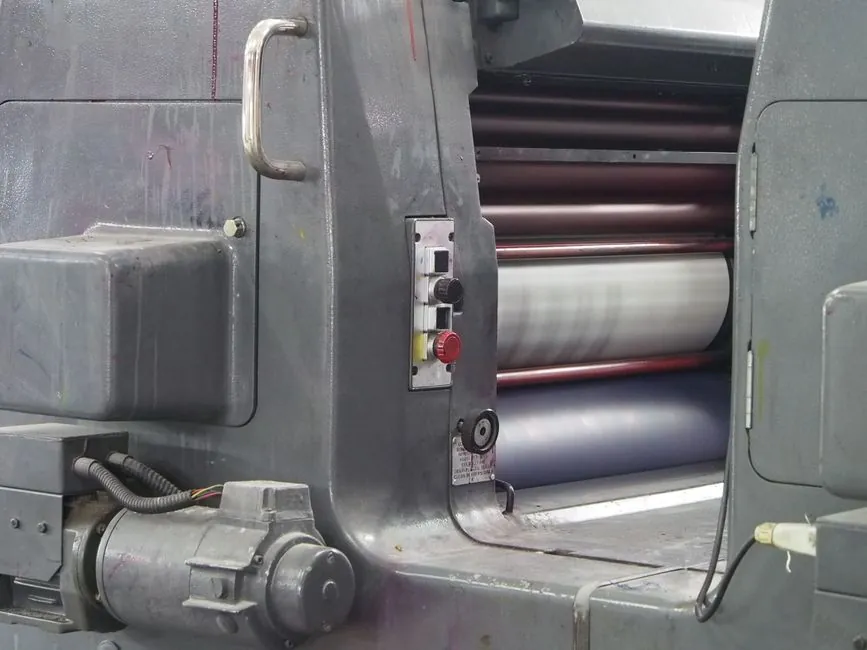
The global market for printing equipment sales is valued at USD 16.9 billion in 2025 [S1].
Market Scope and Demand Baseline
Printing and converting equipment demand encompasses machinery used to apply images, text and variable data to paper, films, labels, cartons and other substrates, plus equipment that integrates printing with converting and finishing operations [S2][S4]. The broad market definition matters because a standalone press and an inline machine have different production economics, integration requirements and capital cycles.
Three published estimates describe different market boundaries. Smithers valued global printing equipment sales at USD 16.9 billion in 2025, narrower than the USD 70.3 billion estimate for all printing machinery and equipment in 2026 [S1][S2]. The printing and converting inline machines market generated USD 4,552.11 million in 2021, USD 5,520.48 million in 2025, and is projected to reach USD 8,281.38 million by 2033, a 5.2% CAGR [S4]. These figures should not be added or treated as a single consolidated forecast because product scope and methodology differ.
For industrial planners, construction machinery and equipment offers a useful capital-equipment comparison framework. Print machinery differs because compatibility, color control, substrate handling, changeover time and inline integration can determine usable output more directly than rated power or body size.
Main Equipment Options Compared
Flexographic, digital inkjet, hybrid, offset, gravure, inline and standalone finishing systems should be selected against run length, customization, production speed and integration complexity, rather than against headline capacity alone [S2][S3].
For conventional commercial and label work, flexographic equipment remains relevant for longer runs, demanding substrates and applications requiring consistency and cost efficiency. Digital inkjet presses address faster turnaround, variable data, versioning and personalization, while hybrid configurations combine digital flexibility with flexographic stability [S3].
Selection Criteria for 2026 Procurement

Modular architecture, upgrade paths and compatibility with digital units, inspection systems and finishing equipment are central purchase considerations for flexographic investments [S3]. That makes adaptability more useful as a procurement metric than maximum nominal speed, especially where job mixes change or shorter runs become more common.
Buyers should separate five requirements: the intended monthly volume, the shortest and longest acceptable runs, the required substrate range, the degree of variable-data printing, and the required degree of inline integration. Digital and hybrid equipment is relevant where job-specific data, versioning and rapid turnarounds outweigh the economics of longer-run conventional production [S3]. Flexographic equipment is relevant where run length, substrate consistency and unit economics dominate [S3].
Machine condition also affects the calculation. For used systems, an inspection should cover print unit alignment, rollers and bearings, belts, drive components, dryer or curing performance, controls, sensors, software availability and access to spare parts. A lower purchase price can be offset by longer changeovers, higher waste, inconsistent color or unavailable components. The cited material does not provide a universal warranty period, waste reduction percentage or payback threshold, so any such figure should be validated against the proposed machine and workload.
Who Should Buy Which System
Digital and hybrid presses fit packaging converters, label manufacturers and commercial printers handling short-run, versioned or personalized work [S2][S3]. They are less compelling where every job repeats the same long-run specification and conventional equipment can meet quality and delivery targets [S3].
Flexographic systems fit converters with sustained high-volume label or packaging runs, especially where substrates are demanding and consistent output is required [S3]. Inline machines fit buyers that need printing integrated with converting or finishing and can justify the engineering effort of a complete line [S4].
The endpoint is not suitable for every operation. A plant requiring only occasional short-run personalization may gain more from a lower-complexity digital route than a full hybrid line, while a high-volume plant with stable repeat orders may obtain better utilization from robust flexographic equipment. Buyers should also assess whether plastics machinery orders and packaging demand are creating sufficient demand for substrates or finished packaging to support another printing line.
Regional Demand and Growth Signals

The inline-machine forecast places global revenue at USD 5,520.48 million in 2025 and USD 8,281.38 million in 2033, implying a 5.2% CAGR [S4]. Asia Pacific shows the strongest regional forecast CAGR at 6.306%, rising from USD 1,772.07 million in 2025 to USD 2,890.2 million in 2033; China moves from USD 565.12 million to USD 991.05 million over the same period [S4].
North America is forecast at USD 2,089.5 million in 2025 and USD 3,048.38 million in 2033, a 4.834% CAGR, while Europe moves from USD 1,272.47 million to USD 1,809.48 million at a 4.499% CAGR [S4]. India carries a 7.015% CAGR, from USD 311.35 million in 2025 to USD 535.56 million in 2033, and Southeast Asia records a 6.421% CAGR, from USD 162.68 million to USD 267.63 million [S4].
These regional figures identify where supplier development and service coverage deserve attention, but they do not establish installed-base counts, order lead times or unit shipments. Equipment vendors should still verify demand through quotations, installed-machine audits and service-part revenue before treating a regional CAGR as a sales forecast.
Automation, Digitalization and Environmental Constraints
The broader market analysis identifies Industry 4.0, cloud, big data, cybersecurity, IoT-connected ecosystems, AI and autonomous systems as technology priorities for printing machinery [S2]. It also lists rising adoption of digital and inkjet equipment, packaging-focused demand, automation, short-run production, energy efficiency and waste reduction as principal market trends [S2].
Cloud-enabled workflows and production-management systems can improve visibility and control over converting operations [S3]. For engineering review, that means checking more than the press controller: data exchange with job-planning software, inspection equipment, finishing systems, operator interfaces, cybersecurity controls and production reporting should be tested before acceptance.
Environmental claims require machine-level evidence. The available research identifies energy efficiency and lower waste as purchasing priorities, and connects improved plate quality, faster make-readies, and advances in ink and curing with reduced waste [S2][S3]. It does not state a universal power-consumption threshold, waste-reduction percentage, inkVOC limit or carbon figure for 2026 equipment. Procurement documents should therefore request measured energy use under the proposed duty cycle, substrate and throughput, plus compatible ink, plate and curing specifications.
Supply Chain and Sourcing Risk
Printing machinery demand depends on a supply chain that includes raw materials, machinery manufacturers, distributors, channel partners and end users [S2]. The risk is not limited to the press itself: ink, plates, anilox rolls, substrates, dryers, inspection systems, finishing equipment, software and spare parts must arrive in compatible sequences.
Buyers should document lead times and approved alternatives for at least the core production path: print unit, ink supply, plate or imaging system, curing or drying section, substrate transport, inspection and finishing interface. The market analysis also includes interest rates, inflation, geopolitics, tariffs and trade protection as scenario variables affecting equipment demand [S2].
For contract manufacturers, a broader reading of packaging-driven plastics machinery demand helps identify adjacent investment cycles. Print and convert equipment demand may strengthen when packaging formats, material choices and order volumes change, but the cited evidence does not quantify a direct correlation, so it should be treated as a planning signal rather than a sales multiplier.
Decision Thresholds for Capacity Investment
Proceed with a digital or hybrid press when the production plan contains enough short-run, variable-data, versioning or personalized work to justify integration, and proceed with flexographic capacity when repeat jobs provide sufficient volume and substrate coverage [S3]. For inline systems, require a completed process map covering every machine, web path, tension-control stage, curing step, inspection point and downstream finishing operation before committing to a line configuration [S4].
The broader market is forecast to grow from USD 70.3 billion in 2026 to USD 93.82 billion by 2030 at a 7.5% CAGR [S2], while inline machines are forecast to reach USD 5,807.41 million by the end of 2026 from USD 5,520.48 million in 2025 [S4]. Those two growth signals, plus verified order intake and service demand for modular, automated and hybrid configurations, form the practical basis for deciding whether additional printing and converting capacity is justified [S2][S3].