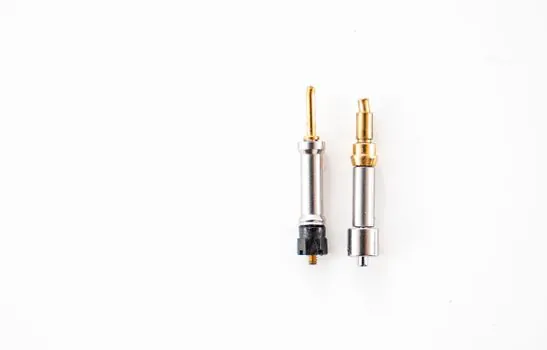
For a Pt100 probe, 1/2 NPT is the process connection and M12 is the electrical cable connection, so the correct assembly can include both.
The Southwire RTD probe family is available with 1/4 or 1/2 male NPT process connections, 6 or 10 mm 316 stainless-steel sheaths, and a 4-pin M12 cable-connector plug [S2].
Separate the Thread Interface from the Cable Interface
A 1/2 NPT process connection is a male tapered pipe thread used to install the probe into a vessel, nozzle, or thermowell. The Southwire RTD probe family offers both 1/4 and 1/2 male NPT process connections [S2].
An M12 connection is the electrical interface at the cable end. The Southwire RTD probe family uses a 4-pin M12 cable-connector plug [S2].
The terminology must therefore be read literally. A listing for “1/2 NPT with M12 connector” describes a probe installed by its 1/2 NPT process thread and wired through its M12 connector.
Thread Size Changes Installation Force and Available Insertion Depth
The cited product line offers 1/4 and 1/2 male NPT process connections, while another range includes 1/4, 3/8 and 1/2 NPT options [S2][S3].
Probe length must be checked independently from thread size. The Southwire RTD probe family lists probe lengths of 30, 50, 100, 150, 160, 260, 360, and 560 mm, and its available process connections include 1/4 or 1/2 male NPT threads [S2].
For a Pt100 RTD probe, specify insertion depth, probe length and thread size together.
Compare NPT and M12 by Their Actual Engineering Functions

Process attachment, connection form, wiring method and service requirements provide a clearer comparison than treating NPT and M12 as direct size alternatives. [S2]
The two interfaces are complementary rather than mutually exclusive. Published combinations pair 1/2 NPT with M12, while the cited materials do not establish that every M12-equipped probe has a 1/2 NPT mounting thread [S1][S2].
M12 Simplifies Wiring but Does Not Simplify Sealing
A 4-pin M12 plug removes the need for permanent field wiring directly to loose leads.
Sensor lead count and M12 pin assignment still need independent confirmation. The Southwire range includes both 3-wire, 6 mm probes and 4-wire, 10 mm probes, but the product documentation describes the M12 connection as a 4-pin plug [S2]. A Pt100 element with fewer leads does not make the M12 connector interchangeable with a 3-pin connector.
If the M12 connector is already specified in the installation architecture, verify that the probe lead count, pinout and cable accessory are compatible before ordering.
Use NPT for Permanent Process Mounting and M12 for Reconfigurable Wiring
Choose a 1/2 NPT process connection for permanent insertion into a drilled vessel, piping connection or thermowell where a threaded mounting point exists. The Southwire RTD probe family lists probe lengths of 30, 50, 100, 150, 160, 260, 360, and 560 mm, and its available process connections include 1/2 male NPT threads [S2].
Choose the M12-equipped version when fast cable disconnection, prewired installation or a standard field connector is more valuable than a wired fixed-lead probe. That configuration remains subject to the probe’s own temperature, pressure, chemical compatibility and accuracy limits; the connector does not remove those process constraints [S1][S2].
A 1/2 NPT probe with M12 is not suitable for every replacement. The mating equipment must accept 1/2 NPT, the probe must reach the required sensing depth, and the process medium must be compatible with the wetted materials. The Southwire RTD probe family uses a 316 stainless-steel sheath [S2].
Match Sheath, Temperature, Accuracy and Environmental Rating
Thread size is only one line on the procurement specification.
The Southwire RTD probe family uses a 100 ohm platinum RTD element with Class A accuracy [S2]. The Southwire RTD0100 range includes 6 mm three-wire and 10 mm four-wire probes, with listed RTD0100 models having a –40 to 150 °C sensing range [S2].
Ingress protection also differs by family. The Southwire RTD0100 models are specified at IP68 or IP69K with an appropriately rated cable, while the RTD1 models are specified at IP66/67 or IP69K with an appropriately rated cable [S2]. The connector assembly must therefore be evaluated with the actual cable, not from the probe body alone.
Build the Purchase Specification and Reject Ambiguous Listings
A complete order should state sensor type, lead count, process thread, probe diameter, insertion length, temperature range, accuracy, wetted material, electrical connector and required protection rating. One documented combination is a Pt100, Class A, 4-wire probe with 1/2 male NPT, a 4-pin M12 plug and 316L wetted parts; the RTD1 series is available in 6 mm diameter and 30, 50, 100 and 150 mm lengths [S2].
Reject a datasheet that says only “M12” when the drawing requires a process connection. The technical drawing needs to distinguish the male NPT mounting thread from the M12 cable connector, including thread size and length in millimetres. For dimensioned engineering work, RTD probe selection should be tied to the equipment nozzle drawing and the required sensing depth before the electrical pinout is finalized.
The next verification points are measurable: record the equipment-side thread designation, probe diameter, required insertion depth, sensor temperature range and connector coding, then match those five items to the manufacturer’s drawing. For engineering range configuration, ensure the transmitter span is selected against the probe’s stated temperature and accuracy limits rather than the M12 connector rating.