
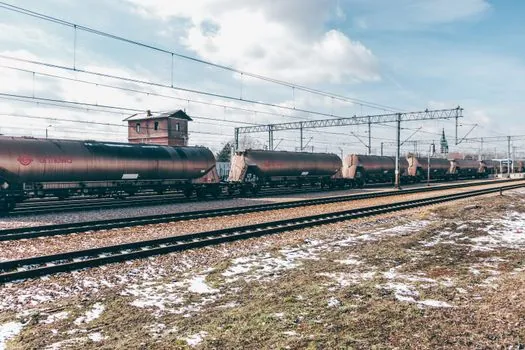
Rail buyers selecting PTFE should match filler system to duty: 25% glass-filled for general slide plates, 60% bronze-filled for high-pressure hydraulic piston and rod seals, carbon-filled for conductive/anti-static pantograph contacts, and virgin or ePTFE for chemical service on tank cars and valve stems [S1][S7].
For rolling stock, the polymer competes with nylon, UHMWPE, and HDPE in gliding plates, rail guides, and pantograph pneumatic tubing, with PTFE chosen where temperature margin, lowest friction, or chemical inertness dominates the trade-off [S5]. The reference service envelope for unfilled PTFE spans -350°F to +500°F (-212°C to +260°C); filled compounds shift that window, with bronze grades lifting pressure capability but reducing chemical resistance [S1][S3][S7].
Why PTFE sits in the rail polymer shortlist
PTFE carries the lowest coefficient of friction of any solid polymer, the broadest chemical compatibility of common engineering plastics, and a service temperature band that reaches +500°F unfilled, which is the reason it is specified for vibration-dampening gliding plates, rail-side valve seats, and pantograph air-line tubing on electric multiple units [S5][S8]. Gliding plates (also called skid or slide plates) carry heavy compression loads under the steel-to-steel sliding interfaces in bridges and expansion joints; PTFE, nylon, UHMWPE, and HDPE are all used, with PTFE selected when the contact temperature can climb toward 250°C or when dry-running lubrication is mandatory because grease cannot be retained [S5].
Freudenberg Sealing Technologies lists railway alongside chemical, food, and pharmaceutical in its PTFE market matrix, and offers dedicated food-grade PTFE (PTFE Y002) for radial shaft seal rings where contamination control overrides cost [S2]. For dynamic seals the company emphasises tailor-made compounds over stock grades, a pattern mirrored across the industry: rail-spec PTFE is rarely catalogue virgin resin.
Grade-by-grade selection map for rail duty
Virgin PTFE: highest chemical inertness, best dielectric strength, and the only grade acceptable for FDA and pharma contact zones; it is also the softest, with the highest cold-flow (creep) under sustained load, so it is rarely used in load-bearing gliding plates [S1][S3]. Glass-filled PTFE (typically 25% glass micro-spheres or fibres): raises compressive strength and drops creep, at the cost of HF and strong-alkali resistance; Durlon 9000/9000N is the commonly stocked example for chemical and rail-tank-car service [S3].
Carbon-filled PTFE: improved thermal conductivity, lower permeability, and the ability to bleed static, which is why it is the typical choice for pantograph carbon-strip contact strips and for HF service where glass filler would be attacked [S3][S7]. Bronze-filled PTFE (60% bronze): the standard choice for high-pressure hydraulic piston and rod seals, with the highest pressure capability of the filled-PTFE family; it is the wrong choice for chemical rail-tank-car service because bronze reacts with caustics and many acids [S7]. Barium sulfate-filled PTFE: specified for caustics, hydrogen peroxide, and pulp/paper; it is a credible alternative to glass-filled grades on tank cars carrying sodium hydroxide [S3].
Expanded PTFE (ePTFE): a stretched, microporous sheet that compresses into flange faces and is widely used as a gasketing sheet for low-pressure, irregular rail-car manways and as a joint sealant for glass-lined equipment; its conformability comes at the cost of lower pressure rating than solid filled grades [S1][S4].
Comparison of common PTFE grades on four rail decision criteria
Four filler families dominate rail-grade PTFE procurement. On wear/load capability, bronze-filled and glass-filled rank first, with virgin and ePTFE at the bottom. On chemical resistance, virgin and ePTFE cover the widest media list, carbon-filled covers most organics and HF, glass-filled loses HF and strong caustics, and bronze-filled is the most restricted. On temperature ceiling, virgin, glass, carbon, and ePTFE all hold +500°F, while bronze-filled grades are typically derated to about +400°F under continuous compression. On cost per kg, virgin is the cheapest filled, glass and carbon sit in the middle, bronze-filled is the most expensive, and ePTFE is sold by the linear foot or sheet rather than by weight, so apparent prices look high but yield is also high [S1][S3][S7].
The choice collapses quickly: for hydraulic rod and piston seals on rail-vehicle brake and door systems, bronze-filled is the default; for gliding plates on bridges and expansion joints, glass-filled or carbon-filled virgin; for tank-car manways, glass-filled or barium sulfate-filled; for pantograph contact strips, carbon-filled conductive grades; and for chemical or food interior seals, virgin or ePTFE [S1][S3][S5][S7].
Where PTFE replaces (or fails against) nylon, UHMWPE, POM
PTFE is heavier and more expensive than nylon 6.6, nylon 12, POM, or UHMWPE, which is why the same source recommends nylon 12 or glass-filled POM for most rail guide-rail and conduit duties where the operating temperature stays below 100°C and dry friction is acceptable [S5]. PTFE earns its slot when at least one of three conditions is met: contact temperature above 150°C, requirement for the lowest achievable coefficient of friction, or exposure to a chemical that would swell or stress-crack nylon or POM.
Two recurring failure modes drive PTFE out of rail spec. First, cold-flow creep: under sustained compression, virgin PTFE flows like slow wax; unfilled plate gaskets in rail-bridge bearings have to be re-torqued or replaced on a defined maintenance interval unless a glass or bronze filler is added. Second, abrasive wear from steel-on-polymer contact: in dusty dry-sand environments the polymer is abraded faster than the steel counter-face, and UHMWPE becomes the more economical choice because it is cheaper to machine a replacement plate [S5].
Standards and fire-safety compliance for rail interiors
European rolling stock has to satisfy EN 45545-2 for fire behaviour of materials, and procurement documents typically call out a hazard level (HL1, HL2, or HL3) and a requirement set (R1 for interior surfaces, R7 for installation air lines). PTFE in its unfilled state releases toxic hydrogen fluoride smoke in a fire and is generally restricted under EN 45545-2; the practical rail-grade solution is a filled or compounded PTFE whose filler system and additive package bring the limiting oxygen index and smoke toxicity inside the HL2 or HL3 envelope demanded by the vehicle category [S1].
For tank cars carrying hazardous chemicals, the US regulatory regime runs through AAR M-1002 tank-car specifications and DOT 49 CFR §179, with gaskets typically sourced against M-1002 appendix M and the relevant DOT §179 sub-part. The most common rail-tank-car PTFE gaskets are glass-filled sheets (Durlon 9000 class) for general service and barium sulfate-filled sheets for caustics, and several vendors list railroad tank car gaskets as a stocked product line [S3][S4]. For sealing of valve stems on rail-side and rail-mounted industrial valve assemblies, filled PTFE or graphite-filled PTFE packing rings are the default because they combine the low friction of PTFE with the strength and stability of graphite [S1].
Procurement, lead time, and verification signals to track
Buyers should lock three documents at point of order: the material data sheet listing exact filler percentage and the underlying resin ASTM or DIN grade, the EN 45545-2 certificate with the cited HL level and requirement set, and the AAR M-1002 / DOT 49 CFR §179 compliance line if the part is in tank-car service [S1][S3][S4]. Verify the operating temperature window against the filler system rather than against the resin: a bronze-filled seal at +260°C is closer to its derating limit than the same dimension in glass-filled at the same temperature [S7].
Two signals worth tracking through 2026: the conversion of remaining EMD-style freight brake systems to PTFE-lined cylinder seals, which increases the call for 60% bronze-filled rod seals in standard sizes, and the gradual replacement of virgin-PTFE manway gaskets on chlorine and HF tank cars with carbon-filled or ePTFE-jacketed grades to extend change-out intervals. A practical next step for any specifier is to map each rail PTFE part on the vehicle to one of five grade families, then require the vendor to quote the EN 45545-2 and AAR M-1002 line items on the same datasheet; suppliers that cannot, or that quote virgin resin as a default, are not aligned with current rail procurement practice [S1][S3][S4][S5][S7].
Spec-level background on the components involved: pressure transmitter.
Related analysis: How to Choose a Rubber Molded Part: Process, Material, and Manufacturer Spec Guide.