A2, D2, O1, S7, H13, M2 and powder-metal grades such as CPM 10V cover the bulk of tool-and-die steel decisions on construction and metal-forming shop floors, with cold-work grades accounting for the majority of blanking, punching and forming dies specified in 2025–2026 distributor guidance [S3][S4].
Tool steels in industrial use typically carry 0.5–1.5% carbon together with carbide-forming alloying elements (tungsten, chromium, vanadium, molybdenum), which is the metallurgical reason these grades hold a cutting edge and resist abrasion at the 60+ HRC range common in stamping and forming [S2][S4]. Selection is governed less by the AISI letter than by the dominant failure mode expected in service: abrasive wear, adhesive wear, cracking, chipping or plastic deformation [S1].
Failure-Mode Driven Grade Selection
Specifying a tool steel by the failure you can tolerate is the working method used in current forming-shop practice, where the cheapest grade that survives the expected wear pattern is chosen after the failure mode is named [S1][S5]. The four failure families a buyer or tool designer should classify upfront are abrasive wear, adhesive wear, cracking, and chipping; each maps cleanly to a different grade cluster [S1].
Abrasive wear from work-material oxides (typical in high-carbon and UHSS sheet) drives the choice toward high-chromium, high-vanadium grades such as D2 and CPM 10V; D2 typically reaches 62–64 HRC after hardening at 1800–1875°F and tempering at 900–960°F [S4]. Adhesive wear (micro-welding between tool and workpiece, common in 304/409/439 stainless) is countered with D2 plus a carbide coating or with a powder-metal upgrade [S1][S5]. Cracking and chipping from shock loading or sharp inside-corner machining redirect selection to the shock-resisting S-series, especially S7, which is the default for high-impact form stations [S2][S3]. Plastic deformation under high compressive load at elevated temperature is the H13 (hot-work) domain, used in die-casting and hot forging [S3][S4].
Cold-Work vs Hot-Work vs Shock-Resisting: Criteria Comparison
Distributors and OEMs consistently sort tool steel into six AISI/ASTM groups: water-hardening (W), cold-work (A, D, O), shock-resisting (S), high-speed (M, T), hot-work (H), and special-purpose/plastic-mold (P, L, F) [S4]. For construction and metal-forming tooling the practical decision is between three families: cold-work (A2, D2, O1), shock-resisting (S7), and hot-work (H13) [S3].
On a 2–4 criterion comparison the trade-off reads as follows: D2 wins on wear resistance and edge retention (62–64 HRC achievable, high chromium-carbide volume) but is more brittle and sensitive to heat treatment than A2 or O1; A2 is the versatile air-hardening default with good toughness and dimensional stability; O1 is oil-hardening and the most forgiving to machine and heat-treat, which is why it persists in short-run dies and toolrooms [S2][S4]. S7 trades wear life for impact absorption and is the right call whenever fracture risk dominates wear risk, including punch-side failures on UHSS [S2][S5]. H13 (hot-work, chromium-molybdenum-vanadium) is the only realistic choice when die surface temperatures repeatedly exceed ~540°C (1000°F), as in aluminum or zinc die-casting dies and hot-forging inserts [S3][S4].
Workpiece Material Is the First Spec Question
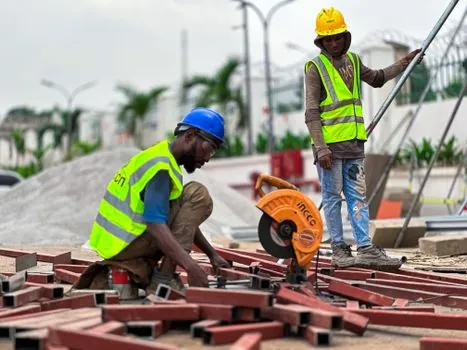
Metal-forming shops interviewed in 2025 industry coverage report that the first spec question, before any grade letter is named, is the workpiece grade, ideally backed by the mill cert [S5]. Mild steel and aluminum can be cut or formed with A2 or D2 in most setups; high-strength and ultra-high-strength steels (HSS/UHSS, including advanced high-strength steel grades used in construction hardware and automotive structural parts) snap-through at higher loads, work-harden aggressively, and gall the die surface, which forces a move up the toughness or wear ladder to S7 or CPM 10V [S5].
Construction tooling specifically cuts or forms rebar, structural plate, and high-strength fasteners, where shear forces and abrasive oxide scale push selection toward D2 (for wear) or S7 (for shock) depending on whether the die section sees steady pressure or repeated impact [S1][S2]. For construction tools that double as hand tools (masonry chisels, demolition bits, star drills) the shock-resisting S-series is the historical default, because the failure mode is impact, not wear [S2][S3].
Heat Treatment, Hardness, and Dimensional Control
Heat treatment parameters are as decisive as the grade itself, and most field failures in tool steel trace back to incorrect heat treatment rather than wrong alloy selection [S1][S2]. Manganese is intentionally kept low in many water-hardening tool steels to minimise quench-cracking, and EDM-friendly or oil-quenched "tooling blank" variants are sold as ready-to-machine stock for shops without in-house heat treat [S2].
Typical usable hardness windows reported by current distributor references are 62–64 HRC for D2 after hardening/tempering, with A2 in a similar but slightly lower range, and S7 operating at lower hardness for toughness [S4]. Distortion during quench is the practical reason air-hardening grades (A2, D2, S7) and oil-hardening grades (O1) are preferred over water-hardening W-grades for any die with large or thin sections, because water quench gives the steepest thermal gradient and the highest cracking risk [S2][S3]. Coatings (TiN, TiAlN, carbide-based) are routinely added on top of the base grade to extend abrasive-wear life and reduce adhesive pickup, especially when stainless or coated sheet is the workpiece [S1][S5].
Cost, Lifecycle, and the Powder-Metal Option
Initial price per pound is the wrong optimisation target for production tooling, and 2025 shop-floor reporting is explicit on this: the cost of an unscheduled die change or scrap batch usually exceeds the price gap between a conventional grade and a powder-metallurgy upgrade [S5]. Lifecycle cost in these analyses includes sharpening intervals, press downtime, scrap rate, and mean time between rebuilds, not just the bar-stock invoice [S5].
CPM 10V is the reference powder-metal grade cited in 2025 forming-shop case studies, with documented step-changes in uptime and edge retention when cutting 0.040 in. type 304 stainless compared with A2 baselines, and a 50,000-stroke proactive sharpening interval reported as the operating point that "pays back" the higher purchase price [S5]. Hybrid grades such as DCMX are noted as combining S7-class toughness with D2-class wear, illustrating the trend away from a single grade across an entire die toward mixed-grade, function-matched tooling [S5]. For high-volume blanking and forming of construction-grade sheet and plate, a practical rule is: start with A2 or D2, upgrade to S7 for form stations with fracture risk, and reserve CPM 10V or carbide for wear-limited, long-run sections [S2][S5].
Construction and Metal-Forming Application Map
Application-specific calls that recur in 2024–2026 distributor and OEM guidance: D2 for long-run blanking, punching, and forming dies that hold close tolerance; O1 for short-run dies, toolroom work, and applications where machinability matters more than wear life; S7 for hammer dies, chisel blanks, punches subjected to snap-through on HSS/UHSS, and any die section absorbing repeated impact; H13 for die-casting dies (aluminum, zinc), extrusion tooling, and hot-forging inserts; M2/M4 for cutting tools and tool bits where red hardness is required; A2 as the versatile air-hardening default for general stamping and forming when nothing else has been specified [S3][S4][S5].
For tool and die steel sourcing on construction projects the practical questions to put to a distributor are: AISI/ASTM grade letter, target hardness (HRC) after heat treat, heat-treatment method (air, oil, water), quench-supplier capability, and whether the application is wear-limited, fracture-limited, or temperature-limited [S1][S2][S4]. When the die also feeds a die-casting machine or inserts into a die-casting die, H13 (or a comparable hot-work grade) is non-negotiable, because cold-work grades will soften, heat-check, and crack under repeated thermal cycling above ~540°C [S3].
Two trackable signals to watch through the rest of 2026: wider adoption of powder-metal and hybrid grades (CPM 10V, DCMX-class alloys) in mid-volume stamping shops, driven by documented lifecycle-cost cases rather than per-pound price [S5]; and continued displacement of single-grade die builds by mixed-grade designs that match each die section to its dominant failure mode [S5]. Related reference reading on the broader alloy-steel landscape is available in this site's alloy steel classification guide.