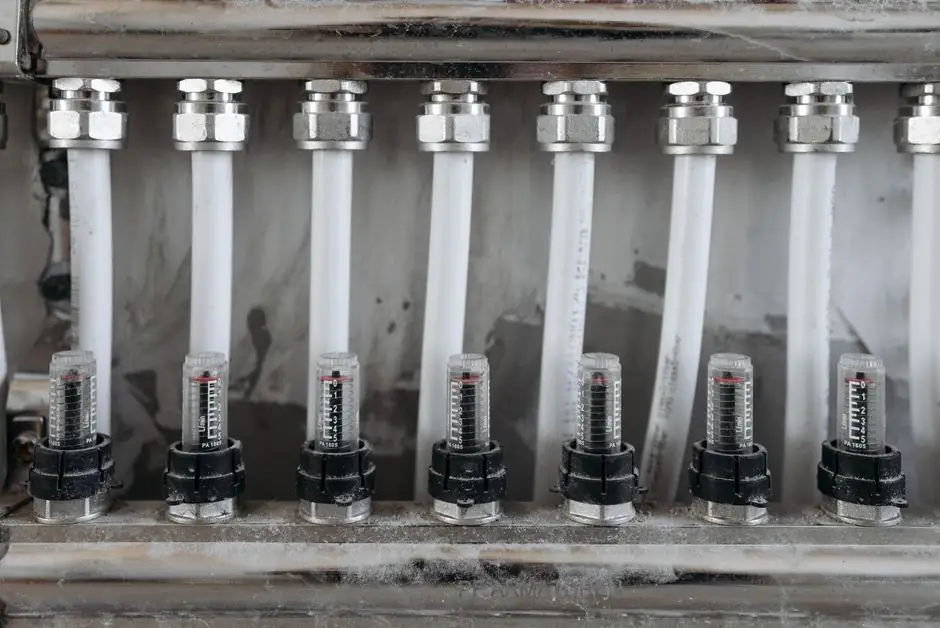
Push-in fittings (also called one-touch or push-to-connect) lock a tube in place with internal gripping claws and a release ring, eliminating PTFE tape, thread alignment, and torque wrenches, with published assembly-time savings up to 75% versus standard compression fittings [S6].
The category spans plastic-bodied units rated to about 1.0 MPa for compressed air and water [S5], all-metal (nickel-plated brass, 316L stainless) units rated to 14 bar or 20 bar for industrial pneumatics [S1][S7], and high-pressure lubrication variants rated to 80 bar standard or 150 bar on request for grease service [S10].
Body geometry and the seven functional families
Push-in fittings are catalogued first by body shape, because shape fixes how the line routes and what the fitting connects. Festo's QS standard line covers the seven functional forms: straight, elbow (90°), tee, bulkhead, reducer, plug, and Y/stack distributor, with hundreds of port-size/thread combinations [S4].
Straight couplers terminate a tube to a male thread (R1/4, G1/2, M5, NPT equivalents); elbow and tee variants re-route flow at 90° or split one inlet into two outlets; bulkhead versions pass through a panel; reducers step between two tube outside diameters; Y and manifold stacks feed multiple actuators from a single supply. The Fokca catalog explicitly lists straight, elbow, tee, bulkhead, reducer, and plug as the standard set for plastic-body units [S5], while ATG's SP Series markets the same family with a one-twist lock that the vendor claims cuts pneumatic line build time materially [S2].
Thread standards: BSPP, BSPT, NPT, and metric parallel
Thread selection is the most common sourcing error on push-in fittings, and the right pick is set by the destination machine, not the catalog. European equipment uses G (BSPP) parallel; North American lines use NPT tapered; Asian machine builders frequently run Rc (BSPT) tapered; M5 and M6 metric parallel ports appear on small cylinders and valve manifolds [S8].
The sealing strategy differs by thread form: BSPP (G) and metric parallel (M) seal on an O-ring or bonded seal washer captured on the face of the male thread, while BSPT (R/Rc) and NPT seal by thread deformation with PTFE tape or paste. Mixing NPT male into BSPP female, or vice versa, will not seat even hand-tight and is a leading cause of pneumatic leak callbacks [S8]. Real product examples confirm the convention: Festo QS-1/4-10 ships with an R1/4 tapered BSPT port [S1], QS-G1/2-12-I ships with a G1/2 parallel BSPP port with an integrated seal [S3], and NPQH-D-M5-Q4-P10 ships with an M5 metric parallel port [S7].
Pressure, temperature, and material bands
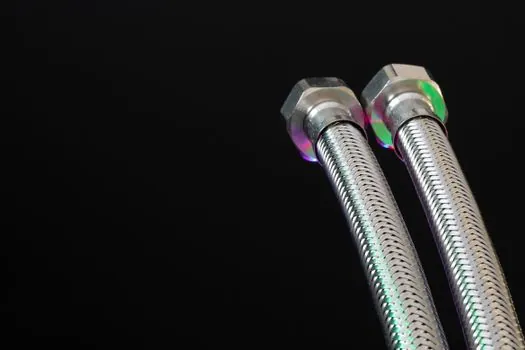
Push-in fitting envelopes cluster into three bands that map to body material and seal compound. Plastic PBT-body units with NBR seals cover 0 to 1.0 MPa working, -100 kPa vacuum, -10°C to +60°C, for compressed air and water at ≤60°C and ≤0.3 MPa [S5].
Standard nickel-plated brass units (Festo QS line) cover -0.95 bar to +14 bar, -10°C to +80°C, with NBR seals; the same brass body with FKM seals (suffix -I) holds the upper temperature limit to +150°C and raises working pressure to 20 bar, sized for hot air, oil-bearing circuits, and external heated zones [S1][S3][S7]. For a fuller comparison of pneumatic-line component ratings, the FRL Unit TCO cost-driver map is a useful cross-reference on how upstream air prep and downstream fitting choice interact on a 10-year spend basis.
Specialty variants push beyond those bands: 316L stainless push-in fittings exist for washdown, food, and mildly corrosive media (part of ATG's 316L stainless steel fittings family [S2]); lubrication-service push-in fittings in nickel-plated brass cover -20°C to +70°C at 80 bar standard or 150 bar on request, with metric threads, for grease and oil distribution [S10].
Seal compound selection: NBR vs FKM vs EPDM
Seal compound, not body, often sets the real operating envelope, and it is the most underspecified line on a purchase order. NBR (nitrile) is the default for compressed air, water, and mineral oils within roughly -10°C to +80°C; it is the seal in Fokca's plastic PBT-body line and in the standard Festo QS brass line [S1][S5].
FKM (fluoroelastomer, Festo suffix -I) extends the upper temperature to about +150°C and adds chemical resistance to many synthetic oils, fuels, and solvents, at a unit-cost premium and with a slightly higher minimum temperature [S3]. EPDM is the right pick for hot water, steam, brake fluid, and polar solvents where NBR and FKM both degrade, but it is incompatible with petroleum oils. Lubrication-service fittings ship with a grease-compatible seal package and a pressure rating 4 to 10x higher than a general-pneumatic unit of the same body size [S10].
Selection criteria: thread, OD, pressure, media, temperature, cycle life
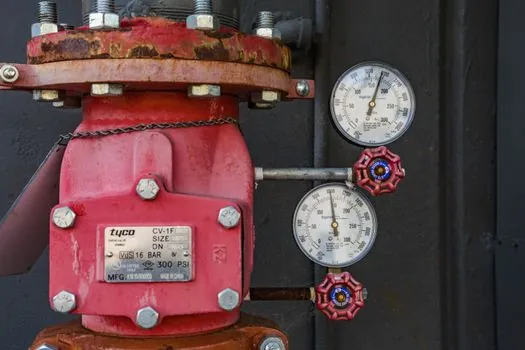
A clean push-in fitting spec carries six fields: thread form and size on port 1 (e.g. G1/2), tube outside diameter on port 2 (e.g. 12 mm), working pressure band with the media specified, ambient and media temperature range, seal compound, and the expected connect/disconnect cycle count. The cycle count is often missed: general pneumatic units rate for tens of cycles in field service, while reusable industrial lines like Dixon push-in fittings are documented for repeated connect/disconnect cycles without seal replacement [S6].
Stainless fittings carry a higher unit cost but win on chemical compatibility, cleanability, and temperature headroom, and are standard in pharmaceutical, food, and outdoor installations. Plastic PBT fittings are the lowest-cost option for clean, dry compressed air inside an enclosure and dominate OEM machine-builder pneumatic panels [S5]. For high-vibration or rotating-machine pneumatic lines, fittings with a collet-and-locking-claw design (SMC KQ style, Festo QS) retain the tube better than simple friction-grip bodies.
Failure modes and installation pitfalls
Three failure modes account for most push-in fitting service calls, and all three are installation-driven rather than part-driven. First, oval or burr-cut tube ends: the tube must be cut square and burr-free, and a proper tube cutter rather than a side cutter is required [S5].
Second, side-load on the collet: tight bend radius directly behind the fitting walks the tube out of the seal over time; Fokca specifies a minimum bend radius and warns explicitly against rotating the fitting after installation, which distorts the O-ring [S5]. Third, thread-form mismatch: an NPT male in a BSPP female will appear to seat, then leak under thermal cycling; specifying G versus NPT by machine origin avoids the issue [S8]. For broader maintenance-driven failure patterns on rotating and reciprocating equipment, the angle grinder failure-mode guide walks through a similar install-versus-part breakdown that translates to pneumatic tooling. Push-in fittings are not a substitute for pipe fitting in any threaded ferrous or stainless steel process line above about 1 inch nominal, where tapered thread engagement and mechanical strength still belong to a NPT or BSPT piping fitting category, not a plastic collet body.
Standards coverage and sourcing

Push-in fittings are governed by tubing-side standards (outside diameter, tolerance, material) more than by fitting-side standards, and the common references are ISO 14743 for pneumatic push-in fittings, ISO 4397 for tube OD dimensions, and the relevant thread standards ISO 228 (BSPP/G), ISO 7 (BSPT/Rc), ANSI/ASME B1.20.1 (NPT), and ISO 261 (metric M). Festo publishes its QS line and the higher-spec NPQH and NPQR lines against these norms, with the QS family described as functionally interchangeable across mounting dimensions with competing vendor offerings [S9].
For new sourcing in 2026, the most defensible spec packet is: thread form by destination region, tube OD in mm or inch, working pressure with a 4:1 safety factor on burst, seal compound matched to media, ambient and media temperature, and a minimum cycle count. Drop any one of those and the vendor will quote a default that is rarely the right one for the application. Trackable signals to watch: more FKM-sealed brass bodies at 20 bar and 150°C in valve-manifold catalogs, and broader 316L stainless line extensions for washdown and outdoor enclosures, both of which appeared across the QS, NPQH, and ATG 316L families in the published 2026 catalog cuts [S1][S3][S7][S2].
For component-level specifications, see construction machinery and equipment.