For K-12 and university plumbing, unplasticised PVC (PVC-U) is the default material on cold-water mains, sanitary and storm drainage, and buried irrigation laterals, with the project scoped to stay inside a 0°C to 60°C operating window and a working pressure selected from the SCH 40 / SCH 80 or Class 200 / Class 315 brackets [S2][S3].
Three driving constraints decide whether PVC-U survives a school spec: NSF/ANSI 61 certification for any line that touches potable water, a SCH or Class rating that survives the de-rating factor at the building's hottest operating point, and a layout that keeps the pipe out of direct UV on above-ground roof and façade runs [S1][S3].
Potable water mains: NSF/ANSI 61, SCH 40 vs SCH 80, and pressure class
Every cold-water service line entering a school must carry the NSF-pw marking, with NSF/ANSI 61 certifying that the compound does not leach contaminants into the drinking water at the temperatures and pressures it will actually see [S1]. Residential-scale meter and branch pressures sit in the 40 to 80 PSI band, which SCH 40 PVC-U handles comfortably on sizes from 1/2 inch through 4 inch, with the SCH 40 max-PSI table giving 600 PSI at 1/2 inch tapering to 220 PSI at 4 inch at 73°F [S3]. Where a school has a booster pump set, a multi-storey riser, or a fire-service tap, SCH 80 (1/2 inch at 850 PSI, 4 inch at 320 PSI at 73°F) buys the extra wall thickness needed to keep the same nominal size [S3]. For Australian schools following AS/NZS 1477, the equivalent pressure-rated PVC-U comes in Series 1 metric (commonly white) and Series 2 cast-iron-compatible outside diameters (commonly light blue), in classes PN 6 to PN 20 covering DN 10 upward with solvent cement or rubber ring joints [S5].
Wall thickness jumps noticeably between SCH 40 and SCH 80, so the same nominal size ends up with a smaller bore on the heavier schedule. Designers usually hold the nominal size constant and step the schedule before they step the diameter, which keeps the fitting inventory compatible across the building.
Hot-water branch lines: why PVC-U drops out and CPVC or copper takes over
Standard PVC-U softens above 60°C, with the service window quoted at 0°C to 60°C and a maximum intermittent exposure of 140°F (60°C) before derating the working pressure [S2][S3]. The derating table drops the 73°F working pressure to 0.88 at 80°F, 0.75 at 90°F, 0.62 at 100°F, 0.51 at 110°F, 0.40 at 120°F, 0.31 at 130°F, and 0.22 at 140°F, so a 1 inch SCH 40 line rated 450 PSI at 73°F falls to 229.5 PSI at 110°F [S3]. For any domestic hot water, kitchen booster heater, or science-room hot tap, CPVC rated to 93°C / 200°F, copper, or cross-linked polyethylene is the correct call, since standard PVC-U will warp and burst on a water-heater run [S1][S4]. The cold-water side of those same fixtures can stay on PVC-U, and PVC-U pipe selection for hospital plumbing: where it fits, where it fails walks the same material split for a different occupancy class.
DWV stacks, roof drainage, and lab waste: where PVC-U is the workhorse
For drain, waste, and vent stacks the material split inverts: PVC-U is the workhorse and the pressure-rated materials are unnecessary. A gravity DWV system runs cool, and the 0°C to 60°C service window is exactly the operating band, so SCH 40 PVC-U at the diameters specified by the drainage code is the standard fitting [S2][S4]. The same logic applies to storm drainage on flat-roof school buildings and to condensate drain lines from air-handling units, where the fluid stays well below 60°C. For school science labs, standard PVC-U is widely used on acid-waste dilution tanks and venting, but a high-pH or solvent attack regime must be checked against a chemical compatibility chart before the line goes in, since some organic solvents attack unplasticised PVC aggressively [S2]. Reference PVC-U pipe for the general material profile and the plastic pipe overview for how PVC-U compares with PE, PPR, and CPVC across the same service conditions.
Buried irrigation laterals and recycled-water purple mains
School irrigation laterals sit in the same 0°C to 60°C band as DWV and at modest pressures, so Class 200 (200 PSI at 73°F) PVC-U is a common flexible choice for residential-style runs and Class 315 (315 PSI) is the upgrade for higher-pressure commercial zones [S1][S3]. Burial removes the UV exposure, which is the most common failure mode on above-ground PVC-U; unprotected pipe in direct sunlight degrades, embrittles, and cracks, so any rooftop or façade run needs a UV-stabilised grey compound, a paint jacket, or a different material such as PEX or copper [S1][S2]. For campuses running purple recycled water for landscape irrigation, the purple pigment identifies a non-potable line; NSF-pw certification is not required because the line is not a drinking-water source, and Australian AS/NZS 1477 explicitly recognises purple as the special-purpose colour for recycled water [S5]. Joints on these pressure lines are either solvent cement sockets for smaller diameters or rubber ring joints for the larger Series 2 sizes [S5].
Selection matrix: which pipe goes where in a school
A simple decision matrix keeps the spec clean across the five main service categories a school plumber touches: cold potable water inside the building, hot potable water (kitchens, dorms, locker rooms), DWV stacks and branches, storm drainage, and buried irrigation. The two decision criteria that drive most of the calls are operating temperature and certification, with pressure class chosen against the de-rated working pressure at the worst-case temperature. [S1]
PVC-U vs CPVC vs PEX vs copper for the five school services: - Cold potable water: PVC-U (SCH 40 to SCH 80) is the default on sizes 1/2 inch to 4 inch; CPVC and PEX are alternates where code or jurisdictional preference applies, copper remains the legacy premium option [S1][S3][S4]. - Hot potable water: CPVC up to 93°C, PEX, or copper. PVC-U is excluded above 60°C continuous [S1][S3][S4]. - DWV stacks and branches: PVC-U SCH 40 is the standard; cast iron only where acoustic code requires [S2][S4]. - Storm drainage and condensate: PVC-U SCH 40 is standard, with UV protection required on any above-grade exterior run [S1][S2]. - Buried irrigation laterals: PVC-U Class 200 or Class 315, with purple pigment for recycled water and rubber ring or solvent cement joints per diameter [S1][S3][S5].
Fittings, jointing, and the small-spec traps
Solvent cement joints dominate the smaller PVC-U sizes and rely on the same nominal outside diameter as the pipe, so a SCH 40 2 inch socket fits both SCH 40 and SCH 80 2 inch pipe because the outside dimension is held constant across schedules [S3]. The same rule means SCH 40 pipe should never be threaded: the wall is too thin to hold threads, and a SCH 40-to-threads transition should be made with a factory moulded adapter or a SCH 80 nipple [S3]. For diameters above the solvent cement practical range, typically above DN 100 in AS/NZS 1477, rubber ring joints on an integral socket are the field-friendly option, with the standard effective length of an Australian PVC-U stick set at 6 m and 12 m as the long alternative [S5]. Pipe fitting catalogues for schools normally separate pressure fittings (SCH 80, PN-rated couplings) from DWV fittings (SCH 40 DWV pattern), and a single job should not mix the two patterns even when both are nominally the same size.
Limits, failure modes, and what not to specify
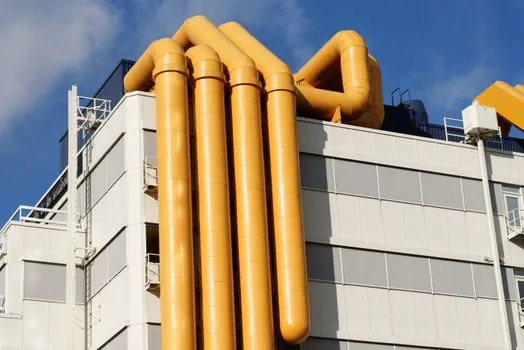
PVC-U has four well-documented failure modes that show up in school plumbing: UV degradation on exposed runs, brittle fracture in cold weather below 0°C, pressure rupture on hot-water misapplication, and solvent or chemical attack from aggressive lab waste [S1][S2]. Each of these has a clean mitigation: a protective jacket or alternative material for UV, burial depth and insulation against frost, a hot-water spec on CPVC, PEX, or copper for any line above 60°C, and a chemical compatibility check for any lab waste stream that carries organic solvents or strong oxidisers. The service temperature rating of 41°F to 122°F (5°C to 50°C) continuous, with short or intermittent peaks to 140°F (60°C), is the de facto contract between the manufacturer and the specifier, and any operating profile outside that window needs a different material [S3]. Above-ground roof drains, façade downpipes, and outside condenser water lines all sit on the wrong side of the UV limit and either need a stabilised compound or a transition to a metal or PE alternative at the point of exposure.
Two trackable signals for the next spec cycle: any update to the NSF/ANSI 61 additive positive list that tightens allowable formulations for school-age exposure, and any revision of the AS/NZS 1477 or ASTM D1785 pressure class tables that would shift the SCH 40 / SCH 80 PSI numbers used in the de-rating calculation above. Both flow through the same product category as a standard pipe clamp specification update, so spec sheets for the next term can be refreshed against the same revision calendar.