Total cost of ownership for unplasticized PVC pipework typically spans purchase, installation, operating, maintenance, and disposal phases, with the operating window dominated by a 50-year design horizon for buried pressure and drainage runs.
Buyers weighing PVC-U pipe against metallic or PE alternatives usually find the purchase line item is 30-50% lower than ductile iron or copper at the same nominal pressure class, but the installation saving — solvent-welded joints, no cathodic protection, no hot-works permit — is the line item most often undervalued in the BOM stage.
What "TCO" Actually Means on a PVC-U Line Item
TCO aggregates purchase, use, maintenance, support, and disposal costs across the asset life, exposing hidden costs that pure-capex procurement misses [S2]. For a 50-year buried utility run, the disposal line is functionally zero (the pipe stays in the trench) but the maintenance line is not — joint re-rounding, valve replacement, and tapping saddles accumulate.
USPS procurement guidance frames the same TCO logic at a system scale: a low unit price is irrelevant if downstream support and overhaul costs eat the saving, and the same arithmetic applies to a 10 km PVC-U transmission main [S2]. For any spec-driven PVC-U comparison, lock the analysis horizon first; 30 years and 50 years produce materially different energy-loss and leak-rate conclusions because friction-losses compound with the discount rate.
Cost Driver Stack, Ranked by Levers Buyers Can Pull
PVC resin accounts for roughly 55-70% of finished PVC-U pipe ex-works cost, with the balance split between calcium carbonate filler, stabilizers, lubricants, pigment (typically TiO₂ for grey potable), and conversion energy. Chinese calcium-carbide-route PVC production — 2026-2028 net new capacity projected near 0.8 Mt, with 2027 effectively zero new additions — keeps domestic resin supply pressure at a multi-year low, which is the single biggest macro tailwind for project bids priced in Q3-Q4 2026 [S4].
Driver two is wall schedule and pressure class. Moving from PN 10 (SDR 21) to PN 16 (SDR 13.6) on a 110 mm pipe roughly doubles wall mass, and resin scales with mass, so the PN class decision is a 1.8-2.0x cost multiplier at the same OD. Driver three is certification scope: potable-water approvals (WRAS, NSF/ANSI 61, GB/T 17219) and the PVC-U pipe dichloromethane-resistance test defined in ISO 9852:2007 (SANS 9852:2008 equivalent) each add audit, batch-test, and traceability cost that does not appear in the raw BOM [S3].
PVC-U vs PE vs Ductile Iron: 4-Criteria Comparison
On a 110 mm PN 16 water-main bid, the four decision criteria a process engineer should line up are unit cost per metre, install labour-hour per metre, 50-year leakage allowance, and end-of-life recyclability. PVC-U typically wins on cost per metre and install labour; high-density PE (PE pipe) wins on impact tolerance and trenchless installation; ductile iron wins on UV tolerance, mechanical abuse, and above-ground fire-service runs where heat is a concern. [S2]
On unit cost, Chinese-origin PVC-U at PN 16 is broadly in the USD 1.5-3.5/m band for 110 mm SDR 13.6 in 2026 spot quotes from export-trading suppliers; ductile iron K9 at the same DN/PN runs 4-6x higher ex-works, and HDPE PE100 sits between them depending on resin spot price [S1]. On install labour, solvent-cemented PVC-U socket joints cure in minutes with hand tools; PE needs an electric butt-fusion machine (capex USD 4-15k); DI needs a rubber-gasket bell with a torque-controlled restraint at every bend. On 50-year leakage allowance, both PVC-U and PE pressure-rated systems are commonly specified at zero allowable leakage for new mains under pressure-test protocols, while DI gasketed joints accumulate slow seepage at the 0.05-0.20 L/joint/day level over decades — a line item that rarely makes the bid sheet. On recyclability, both PVC-U and PE can be ground and reprocessed; PVC-U's chlorine content requires a dedicated stream, while PE regrounds cleanly into non-pressure applications.
Who PVC-U TCO Is For, and Who It Is NOT For
PVC-U TCO analysis is for buried potable-water, irrigation, building drainage, and industrial cold-service lines where the operating temperature stays under 45-50 °C and the fluid is chemically compatible with unplasticized PVC. It is also for projects where trenchless or shallow-trench installation matters, because the 1.0-1.5 kg/m mass advantage over ductile iron compounds across thousands of metres. [S3]
It is not for hot-service process lines (PPR or CPVC outperform above 60 °C), not for fuel or solvent lines where chemical compatibility fails, and not for above-ground fire-service risers where FM/UL-approved CPVC or steel is mandatory. The relative PPR vs PVC-U trade-off is one of the most common TCO conflations in building-services procurement; using the two interchangeably in a hot/cold matrix is the most expensive line-item error in residential riser bidding.
Service-Life Inputs and the Maintenance Bucket
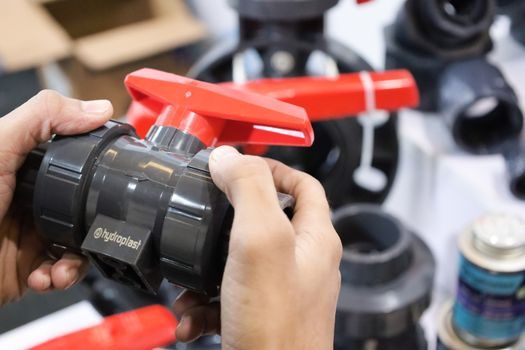
The maintenance bucket on a PVC-U TCO is dominated by three line items: valve-actuator replacement on sectionalising valves (typical 15-25 year cycle), air-valve and washout access-part replacement on a 20-30 year cycle, and joint re-rounding or saddle-repair on tapping ferrules. The PVC-U barrel itself, correctly specified for UV-protected burial or sleeved above-ground, has demonstrated in-service records exceeding 50 years in European and Australian water utilities — an empirical input that the EN ISO 1452 and AWWA C900 design factors are calibrated against. [S2]
The dichloromethane test at a specified temperature (DCMT, ISO 9852:2007) is the quality-control gate that confirms the pipe body has been properly fused during extrusion; a failure on this test predicts brittle in-service performance, so the batch-test certificate is the cheapest TCO insurance a buyer can require [S3]. Buyers should also confirm the plastic pipe system's compatibility with the pipe fitting and pipe clamp schedule, because a mismatched restraint or hanger can drive a maintenance visit that wipes a decade of resin savings.
Macro Tailwinds and 2026 Procurement Signals
Three 2026-specific signals are shaping PVC-U TCO this quarter. First, Chinese PVC supply growth has effectively halted — 2026-2028 net new capacity sits around 0.8 Mt, and 2027 looks like a zero-addition year, which historically maps to a multi-quarter soft resin spot and lower pipe ex-works offers [S4]. Second, China overtook the United States in 2025 as the world's largest PVC exporter, moving roughly 3.8 Mt (about 16% of domestic output) into overseas markets, so export-channel suppliers such as Foshan/Weifang-based multi-product plastic-pipe traders are quoting competitively on bulk container loads [S4]. Third, according to S4, geopolitical conflicts have raised overseas ethylene-route costs, leaving Japanese, Korean, and European ethylene-route PVC plant utilization below 七成 (70%), which weakens their pricing power relative to Chinese calcium-carbide-route PVC.
For a TCO-conscious 2026 buyer, the next trackable node is the Q3 2026 ethylene vs calcium-carbide cost spread (which dictates whether China's cost advantage holds into 2027), and the resin destock-to-inventory ratio published in the China Chlor-alkali Industry Association monthly — a reading under 0.4 is historically correlated with the next 90-day pipe ex-works softening. Specifying ISO 9852:2007 DCMT batch certificates, EN ISO 1452 pressure-class conformity, and a 50-year design horizon with a 3-4% real discount rate remains the most defensible TCO framework for the next 12 months.