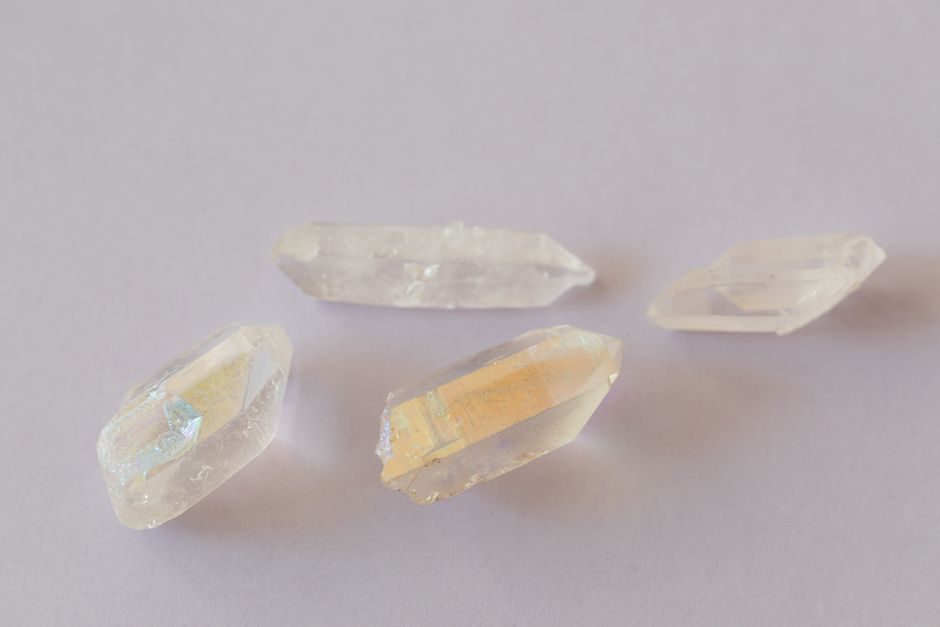
Fused quartz (≥99.95% SiO2) holds a 0.55 × 10⁻⁶ /°C coefficient of thermal expansion and continuous service to ~1100°C, which is why semiconductor diffusion tubes, optical fibres, and high-purity acid delivery lines default to it over borosilicate quartz material.
Trade-off is real: raw material and electric-fusion melting cost 5-10× equivalent borosilicate forms, and quartz loses mechanical strength above ~1150°C and dissolves readily in hydrofluoric acid and hot concentrated alkalis, so the spec gate is application-purity, not price.
Purity Grades and What Each One Buys You
Quartz is sold across four working grades. Synthetic fused silica (type I, 0-50 ppb total metal impurity) is the semiconductor diffusion-tube and EUV photomask standard; electric-fused natural quartz (type II, ~50-200 ppm) covers semiconductor crucibles and high-purity wafer carriers; flame-fused natural quartz (type III, ~100-500 ppm) is the lamp and lighting envelope grade; and opaque fused silica (type IV, fused silica grain cast into shapes) handles refractory and thermal-insulation blocks. Alumina and alkali contamination above ~20 ppm shifts softening point and dielectric loss, so process engineers should pin OH content and trace-metal assay on the MTC rather than rely on the generic "fused quartz" label. [S2]
Thermal, Mechanical, and Optical Behaviour
The headline numbers: coefficient of thermal expansion 0.55 × 10⁻⁶ /°C (0-300°C), annealing point ~1140°C, softening point ~1680°C, density 2.203 g/cm³, Mohs hardness 5.5-6.5, and compressive strength ~1100 MPa quartz material. Optical transmission exceeds 90% across 200-2500 nm in the UV/IR for premium grades, which is the working window for UV sterilisation lamps and IR heating windows. Thermal shock resistance is the practical lever: a 3 mm thick fused-quartz plate survives a ΔT of ~300°C quench, versus ~160°C for soda-lime and ~180°C for borosilicate, so cold-start furnace tubes and rapid thermal processing (RTP) wafer stages are quartz territory. Above ~1150°C, devitrification (cristobalite formation) accelerates and the part loses impact strength over hours of exposure.
Chemical Compatibility and Failure Modes

Fused quartz is fully resistant to HCl, H₂SO₄, HNO₃, and most organic solvents at all concentrations below ~300°C, which is why semi-grade wet benches, PVDF-lined acid delivery, and HF-free wet etch lines default to quartz baths. It is attacked by hydrofluoric acid (HF) at any concentration, by hot concentrated phosphoric acid above ~250°C, and by hot alkalis (NaOH, KOH) above ~200°C, where the dissolution rate climbs to 1-10 µm/h. Mechanical failure is brittle — no plastic deformation, no yield point — so designers must use generous radii, eliminate point loading, and derate for vibration; a sharp 90° corner is the classic crack initiator. Compare the working envelope: fused quartz vs. borosilicate vs. alumina-on cost, max continuous temperature, and chemical resistance — fused quartz costs 5-10× borosilicate and 2-3× alumina, but runs to ~1100°C continuous vs. ~500°C for borosilicate and ~1700°C for alumina, and is HF-free acid resistant vs. both alternatives.
Application Gates: Where Quartz Pays Back
Spec quartz when the duty crosses at least one of these gates: temperature >500°C continuous; thermal-shock ΔT >150°C; required UV/IR optical transmission; required metal-trace purity below 50 ppm; or required electrical insulation at >200°C. The 2026 sourcing map shows semiconductor diffusion tubes, EUV mask blanks, fibre-optic preforms, and high-purity acid baths still being the highest-value pull Quartz Material Installation Guide. For semiconductor diffusion and oxidation furnaces, tube diameter and wall concentricity (typically ±0.5 mm on 200-300 mm OD tubes) drive supplier selection more than grade. For solar and PV, quartz crucibles and tubes dominate continuous Czochralski and directional solidification because the thermal expansion match holds crystal yield. For lighting and UV, fused quartz envelopes retain transmission at the 185 nm germicidal line where borosilicate darkens within hours.
Where NOT to Spec Quartz
Skip quartz when the line carries HF, hot NaOH/KOH above 200°C, or hot phosphoric acid above 250°C; when mechanical impact, vibration, or point loading is unavoidable without expensive redesign; when the capex envelope cannot absorb 5-10× borosilicate cost; or when the duty stays below 500°C with no thermal-shock demand. For those envelopes, the reference chain points at high-purity sputtering target alternatives, polymer-lined steel, or PTFE for acid service, and at alumina or SiC for high-temperature structural work. Engineers tend to over-spec quartz for ambient-temperature sight glasses where an acrylic or borosilicate window does the same job for one-tenth the price, and under-spec it for acid-bath heaters where the HF-free hot-HCl service quietly eats the substitute material.
Standards, Traceability, and Sourcing Signals
The governing reference set is ASTM C169 (chemical analysis of refractory and glass materials), SEMI M1 / SEMI C1 for semiconductor process-wetted quartz, ISO 3585 for borosilicate vs. fused-quartz glass, and DIN 58970-2 for laboratory glassware. Two sourcing signals to track through the second half of 2026: published OH-content assays in the material test certificate (anything above ~200 ppm OH in a type I tube shifts UV cutoff and signals cost-cutting), and supplier disclosure of raw-quartz feedstock origin (Spruce Pine, NC vs. Chinese domestic quartz directly changes trace-metal profile and lead time by 4-12 weeks on the spot market). Hold the line on a 0-50 ppb total-metal spec for any tube, boat, or liner that sees a wafer, and a 50-200 ppm spec for non-process utility envelopes. [S2]
The underlying component specifications are covered under copper material, and magnetic material.