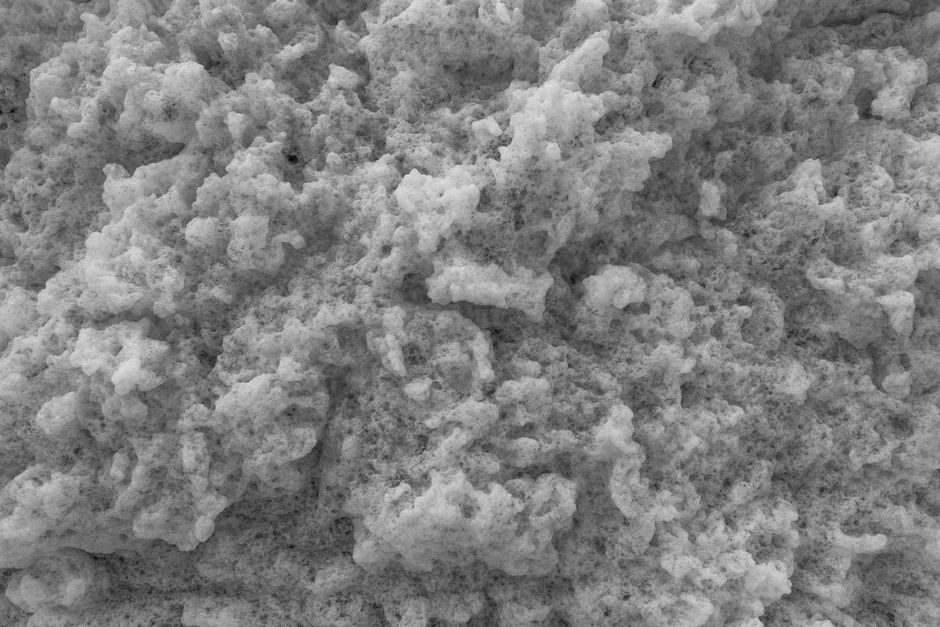
Foam fabrication spans rigid polyurethane (PU) systems based on PPO polyol and MDI isocyanate, open-cell flexible PU auxetic grades, cross-linked polyethylene, EVA, and PVC foams, with five process families dominating commercial production in 2026 [S1][S3].
The five principal fabrication routes are cast/molded foam production, thermo-mechanical compression (the Lakes process for auxetics), additive manufacturing for prototype lattices, waterjet/CNC contour cutting of bun stock, and adhesive lamination of multi-layer assemblies [S1][S3].
Cast and Molded Rigid Polyurethane Foam Systems
Cast rigid PU foam is produced from polypropylene-oxide (PPO) polyol reacted with 4,4′-methylene diphenyl diisocyanate (MDI), balanced with tertiary amine catalysts and water as a chemical blowing agent to drive the gelling and gas-foaming reactions [S1].
Sound-absorption and thermal-insulation performance of PU–ordinary Portland cement mortar formulations both improve relative to blank mortar, with the composite leveraging the co-continuous PU/cement morphology reported in earlier hydration-induced reinforcement studies [S1]. Mechanical reinforcement via fillers, fibre lengths, and bio-based polyols (castor, soybean, tung oil) is documented across density ranges typical of rigid PU panels, with filler particle size shown to govern high-density foam strength [S1].
Thermo-Mechanical Auxetic Foam Conversion
Conventional auxetic foam is manufactured by the thermo-mechanical route first reported by Lakes (1987), in which open-cell PU foam is compressed in multiple directions above its softening temperature, cooled under load, and released to yield a negative Poisson’s ratio [S3].
Recent experimental-computational work on auxetic foam fabrication isolates the thermomechanical parameters that dominate output quality and shows disparity in those parameters explains much of the historical inconsistency between published data sets [S3]. Tensile fatigue behaviour of negative-Poisson’s-ratio open-cell PU foams differs measurably from conventional foams of the same parent density, with implications for energy-absorption and seating applications [S3].
Additive Manufacturing and 3D-Printed Foam Lattices
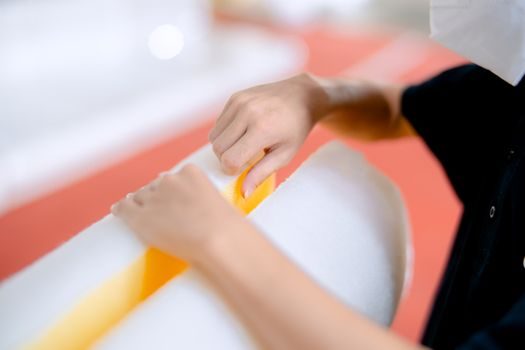
3D printing has been used to overcome the repeatability issues of thermo-mechanical auxetic foam production, with designable dual-material auxetic metamaterials demonstrated via additive routes in published studies cited alongside the conventional process [S3].
Additive foam paths are typically used for prototype lattice structures, energy-absorbing cores, and small-batch auxetic geometries, while the thermo-mechanical Lakes process retains advantages in low cost, raw-material availability, and ease of application for high-volume open-cell PU auxetic stock [S3]. Foaming-reaction control via amine catalysts remains the dominant lever in cast PU regardless of whether the final part is machined, moulded, or 3D-printed [S1].
Waterjet, CNC, and Die-Cut Fabrication of Bun Stock
Large-format foam fabricators in 2026 operate multi-axis waterjet and CNC contour cutting on bun stock, with US fabricators reporting 450,000 sq ft of manufacturing space and four-site footprints dedicated to engineered foams for consumer, medical, and industrial accounts [S2].
Case-foam fabrication is a distinct sub-segment: US case builders serve aerospace and defence, computers and electronics, industrial and distribution, medical and health, PPE, military and government, sports and entertainment, audio/video, and tradeshow markets with cut-and-glued foam inserts [S5]. Tolerance, density grade (typically expressed in lb/ft³ for PU), compression set at 50 % deflection, and fire-rating class (such as UL 94 HF-1 for cushion-grade foams) are the spec gates that fabricators quote to buyers, although the specific rating depends on the chosen polymer family [S2][S4]. For cushion and pillow lines, made-to-order lead times are commonly quoted in weeks rather than months, with US-based sourcing concentrated in the Carolinas [S6].
Polymer Family Selection by Application Segment

Rigid PU dominates building insulation and structural-foam mortar formulations; flexible PU dominates seating, bedding, and auxetic cushioning; cross-linked PE and EVA dominate case inserts, sports padding, and orthotics; and PVC foam dominates marine, signage, and lightweight panel cores [S1][S3][S4][S5].
Criteria-based comparison of the four main foam families on decision axes used by specifiers: cost per cubic foot is lowest for PE/PVC bun stock, highest for cast rigid PU; continuous-service temperature is highest for rigid PU and PVC (typically above 80 °C for rigid PU panels), lowest for standard EVA; chemical and UV resistance favours PVC and cross-linked PE; biocompatibility and skin-contact comfort favours flexible PU and EVA for medical and pillow applications [S1][S3][S4]. Auxetic conversion is feasible primarily on open-cell flexible PU; PE, EVA, and PVC foams are not converted via the Lakes process and are instead shaped by cutting, thermoforming, or moulding [S3].
Failure Modes and Process Constraints
Cast rigid PU foams require tight control of the gelling/foaming reaction balance: excess amine catalyst drives rapid gas evolution and cell collapse, while under-catalysed systems produce coarse, non-uniform cells with poor mechanical strength [S1].
Auxetic foams produced by the thermo-mechanical Lakes process suffer from batch-to-batch variability driven by disparities in compression ratio, soak temperature, and dwell time, which is why additive and hybrid routes are studied as a repeatability hedge [S3]. Waterjet and CNC contour cutting of closed-cell PE and EVA bun stock is constrained by kerf width and thermal sensitivity — kerf tolerances in foam cutting are typically held to ±0.5 mm or wider depending on density, and tapered or bevel inserts add cost per part [S2][S4].
Standards, Sourcing, and Buyer-Side Spec Checks

Buyer-side spec checks for fabricated foam typically reference density (kg/m³ or lb/ft³), compression set at defined deflection (commonly 25 % or 50 %), tensile and tear strength, cell structure (open vs closed), and fire-rating class under recognised test methods [S2][S4].
US fabricators of consumer, medical, and industrial engineered foams consolidate bulk raw stock supply, custom cutting, lamination, and distribution under single contracts, with custom ATA and plastic case builders integrating foam inserts as a turnkey deliverable for aerospace and defence primes [S2][S4][S5]. For protective-case applications, foam-fabrication sourcing is often paired with broader case-engineering decisions similar to those captured in spec-driven industrial valve and flow meter selection maps, where tolerance, material grade, and test-cert scope define the buyable specification rather than brand preference. Process engineers evaluating foam inserts for instrumentation packaging can apply the same traceable-spec discipline used for pressure transmitter sourcing, with density, fire rating, and compression set written into the purchase spec rather than left to fabricator default.
Trackable signals for 2026: continued displacement of bun-stock cutting by waterjet/CNC in case-foam fabrication, broader auxetic-foam commercial trials in seating and energy absorption, and incremental bio-based polyol substitution in cast rigid PU for building-insulation mortar formulations. Readers comparing fabrication routes can also benchmark foam-process decisions against broader industrial maps such as the PPR pipe types and classifications reference and the backhoe loader types spec tiering — same criteria-based logic, applied to foam.