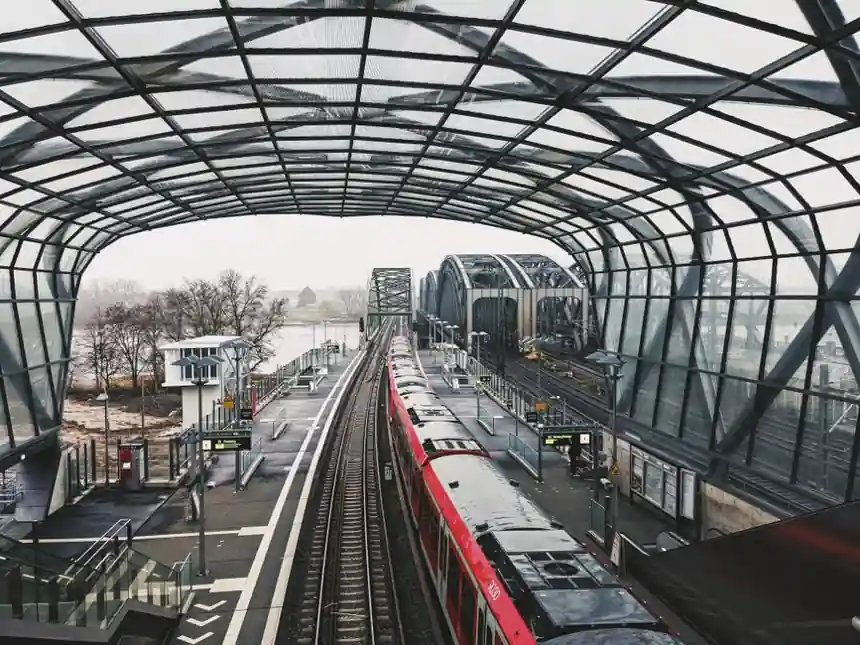
Cast polyurethane elastomers (CPU) are the workhorse material across four rail subsystems: fastening pads, RRV/shunter wheels, suspension and hydraulic seals, and two-component topcoats, with the polymer family credited for resistance to sliding, stretching, load-bearing, impacting, cutting, tearing, compression and torsional stress in service [S1].
Selection pivots on Shore A hardness, dynamic stiffness profile, axle-load class and cure route, with pad and wheel applications now commonly specified in heavy-haul freight (25–35 t axle), metro/high-speed concrete-sleeper track, and dual-mode road-rail shunters.
Rail Pads: Rubber vs Polyurethane Under Heavy Axle Load
Polyurethane rail pads deliver superior wear resistance, dimensional stability and durability under heavy axle loads compared with conventional rubber pads, and are the preferred resilient tie pad material for heavy-haul freight [S2].
The pad sits between the rail base and sleeper, damping wheel-rolling vibration and preventing steel-on-concrete wear that would otherwise cause track-gauge drift; in WJ-7 and WJ-8 high-speed fastening systems the pad is treated as a primary fatigue-control element for the concrete sleeper [S2]. Rubber remains competitive where very high elasticity and signal-isolation performance are needed, such as the Wuhan-Huangshi Intercity Railway and metro lines sensitive to stray-current and signal-spill interference [S2]. Polyurethane wins on the heavy-haul metrics: higher scrape resistance, better dimensional stability under sustained side and vertical load, and longer service life in 30 t+ axle applications such as the Fenghong and Jingshen Railway projects [S2]. SFFST specifies cast CPU pads built on CNC automatic polyurethane pouring lines, giving tighter control of pad thickness and consistency than the press-cured rubber equivalents, which directly translates to lower scatter in static and dynamic stiffness across long rail strings [S2]. The trade-off is reduced pure elasticity compared with natural rubber, so rubber still wins on pure vibration isolation and electrical insulation duty, while CPU wins on abrasion life and stiffness repeatability.
RRV and Shunter Wheels: Why Vulkollan® Is the Benchmark
Vulkollan® is a licensed, highly engineered elastomer technology recognised globally as the benchmark for heavy-duty drive and friction wheels on Rail cum Road Vehicles (RRV) and shunters, with standard rubber and basic polyurethane degrading quickly under RRV duty cycles [S4].
RRV wheels must grip both tarmac and steel rail, absorb dynamic shock loads from track transitions, and resist the cutting and chunking caused by ballast debris, and Vulkollan® delivers exceptional grip on steel rails for traction without slippage, plus extreme tear resistance that prevents chunk-out failures [S4]. A typical Zagro-spec RRV drive wheel is 457 mm diameter by 140 mm width, cast in the signature brown Vulkollan® compound, sized to support shunter dead-weight plus the railcar being moved without permanent flat-spotting deformation [S4]. Compared with commodity polyester or polyether polyurethane wheels, Vulkollan® is a specifically engineered, licensed system sourced through authorised partners (in India via Gite Industries, originating from Vulkoprin Belgium) and should not be substituted with generic PU on safety-critical shunter duty [S4]. The material also doubles as a heavy-duty load wheel for the same RRV class where maximum traction and chunking resistance are non-negotiable, eliminating the slippage events that drive mechanical failure in service [S4].
Suspension, Seals and Hydraulic Components
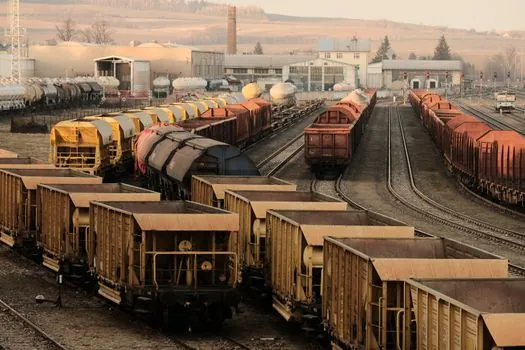
Polyurethane is used across railway hydraulic device seals, oil and pneumatic shock absorber components, and vibration-isolation parts where the material's load-bearing, damping and abrasion resistance deliver longer service life than natural rubber [S6].
Seals, O-rings and scraper elements in hydraulic brake units, pantograph air cylinders and door-drive pneumatics are routinely cast in CPU grades tuned for low compression set and hydrocarbon-fluid compatibility; the same family also covers anti-vibration pads between bogie frames and car body, axle-box spring aids, and wear strips on sliding suspension interfaces [S5]. Polyurethane's combination of high load-bearing capacity and resistance to cutting, tearing and torsional fatigue makes it a default material for parts that must absorb continuous mechanical abuse over a 30–50 year rolling-stock service life, where replacement costs dominate the economics [S1][S5]. A practical specification window is Shore A 70–95 for sealing and anti-vibration elements, with higher 90–95 D-scale hardness grades reserved for heavily loaded wear strips and bogie-bracket bushings, and this is consistent with the broader CPU property envelope used outside the rail sector [S1]. The article Polyurethane Elastomer Selection for Aerospace covers the same isocyanate/hardness mapping for aviation duty, which translates to rail mainly at the seal and bushing interface.
Coatings: Two-Component Polyurethane Topcoats on Rolling Stock
Two-component polyurethane topcoats are the standard cosmetic and weather-resistant finish for railway rolling stock, applied by HVLP or conventional air spray in dedicated spray halls and maintenance depots [S3].
The coating system on a passenger coach or locomotive has to survive continuous vibration, mechanical stress, ballast impact on underframe and bogie, cleaning-chemical exposure from pressure washing and graffiti removal, UV weathering, and (on electric traction) lubricants, transformer oil and electrical discharge, with service lives of 30 to 50 years the design target [S3]. The main occupational hazard the article flags is isocyanate exposure in 2K PU topcoats, alongside solvents in primers/intermediates, heavy metals in legacy coatings disturbed during maintenance, and particulate from surface preparation [S3]. Engineering controls (spray-booth extraction, supplied-air respiratory protection, downstream air makeup) are the dominant mitigation route, with isocyanate management treated as a non-substitutable safety control rather than a procedural item [S3]. Surface preparation, primer chemistry and topcoat selection together form a layered system, and swapping the PU topcoat for an alternative finish (acrylic, fluoropolymer) is rarely a like-for-like change because PU gives the best combined UV, chemical and abrasion performance for exterior livery duty.
Comparison: Material Options Across the Four Rail Subsystems
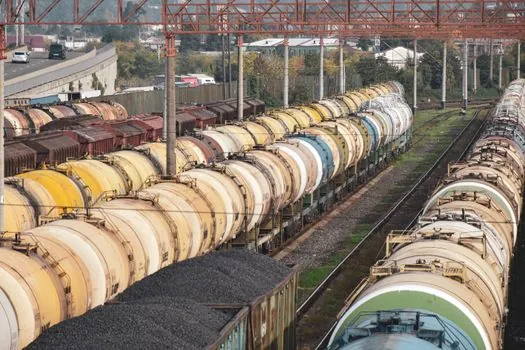
Material selection for rail elastomer and coating duty is rarely binary, and the table below lines up the realistic candidate materials against the criteria that drive a procurement decision: load/abrasion, elasticity/isolation, temperature, fluid compatibility and typical service life. [S2]
CPU rail pads lead on abrasion life and stiffness repeatability but trail rubber on raw elasticity and electrical isolation, which is why rubber still appears in metro and signalling-sensitive circuits [S2]. Vulkollan® is the licensed benchmark for RRV drive wheels where traction and chunking resistance dominate; commodity PU and rubber are not equivalent substitutes on this safety-critical duty [S4]. For hydraulic and pneumatic seals, CPU grades in the Shore A 80–95 window cover the majority of brake, suspension and pantograph seals, with hydrogenated nitrile (HNBR) or fluoroelastomer (FKM) reserved for higher-temperature or aggressive-fluid zones. Two-component PU topcoat is the default exterior finish for cosmetic and weather-resistant duty on passenger and freight stock, applied over an anti-corrosion primer system [S3]. Across all four subsystems, the common thread is that the polyurethane elastomer family is the engineering default, with the hard decision usually being the cure route (cast vs sprayed), the hardness window, and the licensed brand where failure cost is high.
Selection Workflow and Engineering Constraints
A defensible rail-PU selection starts by mapping the duty subsystem (fastening pad, RRV wheel, seal, coating) to load class, temperature window, fluid exposure and service-life target, then narrowing on Shore hardness and isocyanate chemistry [S1][S2].
For pads the key screening tests are static stiffness, dynamic stiffness and electrical resistance per the relevant fastening-system standard (e.g. WJ-7, WJ-8, S30HH heavy-haul), with polyurethane preferred where dynamic stiffness repeatability and abrasion life dominate [S2]. For RRV wheels the spec is usually locked to a licensed compound such as Vulkollan® rather than a generic PU, because traction, tear and chunking resistance are safety-critical and the industrial wheel interface is not where buyers should trade cost for risk [S4]. For seals and suspension parts, compression set, low-temperature flexibility and fluid compatibility drive grade choice, while for rolling-stock coatings the dominant constraint is isocyanate exposure control rather than the coating chemistry itself [S3]. Buyers should also demand lot-level traceability, because the difference between a service-life outcome and an early field failure on a rail PU part is often traceable to cure-cycle drift, not the nominal spec.
Trackable signals for the next spec cycle: Vulkollan®-class wheels expanding into Asian RRV fleets beyond the Zagro/Niteq install base, and increased metro adoption of CPU pads as 25 t+ axle freight pushes rubber pad service intervals down. polyurethane elastomer selection for electronics provides a useful cross-reference on hardness/pot-life mapping that overlaps with rail sealing duty.
Component reference pages worth checking: polyurethane insulation.