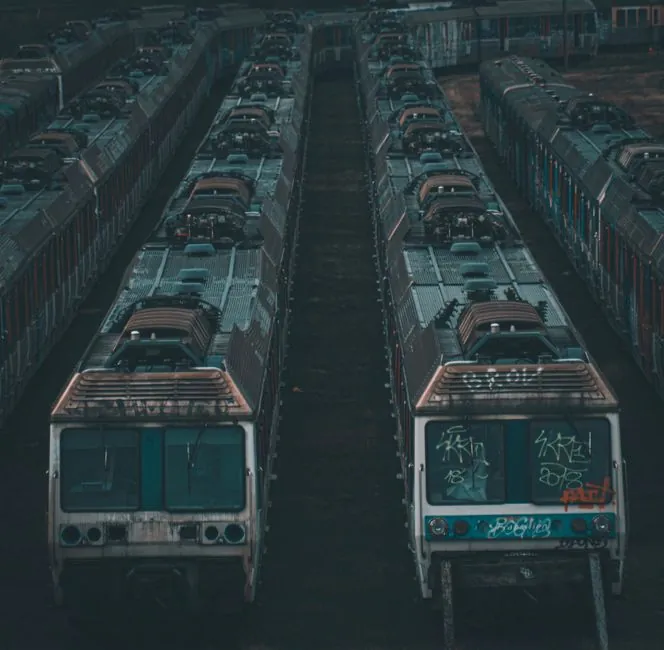
Traction motors on modern EMUs and metros are migrating from induction to permanent-magnet synchronous architectures, which forces magnet buyers to qualify SmCo or NdFeB grades against railway temperature, shock, and fire standards rather than industrial servo baselines [S2].
At the same time, semi-hard AlNiCoFe alloys are being experimentally demonstrated as the hysteresis layer in railway point-machine clutches, replacing dry-friction torque limiters to cut maintenance [S1]. On the energy-recovery side, tailored soft-magnetic cores clamped around traction return rails have been prototyped for stray-field energy harvesting, completing a three-lane material picture for any rail specifier [S7].
Three Material Families and Where They Sit on a Rail Vehicle
Hard permanent magnets, semi-hard magnetically hard alloys, and soft ferromagnetics serve different functions across rolling stock, wayside, and signalling systems. For traction motors and permanent-magnet tracks, SmCo is favoured over NdFeB when continuous operating temperature exceeds roughly 150 to 180 °C, because Sm₂Co₁₇ grades retain coercivity and resist demagnetisation under combined thermal and demagnetising-field stress [S2].
For point-machine actuation and torque-limiting clutches, multi-component AlNiCoFe alloys, classified as semi-hard magnetic materials, offer a controllable hysteresis loop, allowing torque transmission independent of slip speed once saturation is reached; prototype testing published in November 2025 confirmed their feasibility for railway point-machine throws [S1].
For inductive and energy-harvesting applications, silicon-steel laminated cores are wrapped around the current-carrying rail, capturing energy from the traction return current via electromagnetic coupling; a 2021 prototype reported a power output tuned to typical DC traction return levels [S7]. Background on grades and selection criteria lives in the magnetic material reference and in magnetic sensor families, both of which feed into rail-side instrumentation.
SmCo versus NdFeB versus AlNiCo: Decision Criteria
SmCo magnets (SmCo₅ and Sm₂Co₁₇) typically deliver high energy product with Curie temperatures above 700 °C, low reversible temperature coefficient of Br, and strong corrosion resistance, which is why they are commonly selected for traction motors on high-speed rail [S2].
NdFeB magnets (N42 to N52SH, UH, EH grades) offer higher room-temperature energy product at lower cost but require explicit derating above 150 °C and need surface coatings (Ni-Cu-Ni, epoxy, or Zn) to manage rail-side humidity; they are usually paired with rotor cooling or restricted to auxiliary rail machines.
AlNiCo alloys sit between hard and soft on the coercivity axis, with Br typically 0.6 to 1.3 T and HcJ in the 50 to 200 kA/m range, giving a wide, tunable hysteresis loop ideal for slip-independent torque transmission in clutches and brakes; Pistelok and Adamiak (2025) measured these loops on AlNiCoFe variants across temperature to qualify them for railway point-machine duty [S1].
Soft-Magnetic Cores for Traction, Energy Harvesting, and Inductors

Soft-magnetic components in rail applications must satisfy EN 50155 for electronic equipment on rolling stock, IEC 61373 for shock and vibration, and EN 45545-2 for fire behaviour of materials, which together drive the choice of bonded or laminated silicon steel, nanocrystalline ribbon, or ferrite depending on frequency [S8].
For traction inductors, chokes, and EMC filters, common choices include silicon-iron (Fe-Si 3% to 6.5%), cobalt-iron (Co-Fe 27% to 50%) for high-saturation-density inductors, and Ni-Fe permalloy grades (1J79, 1J85) for current transformers on the DC link; these are typically vacuum-impregnated and potted to meet the same rolling-stock environmental envelope [S8].
For energy harvesting from the traction return rail, a soft-magnetic core is geometrically tailored to maximise flux linkage with the current-carrying rail while staying below the rail-head clearance gauge, a constraint documented in a 2021 study that built and bench-tested such a harvester with a custom magnetic circuit [S7]. Auxiliary magnetic couplings, including rotary and linear types, are also part of this soft-magnetic landscape and are catalogued under magnetic drive pump technology, which uses the same permanent-magnet and barrier-coupling principles.
Mandatory Railway Compliance Standards for Any Magnet Spec
EN 50155 governs electronic equipment used on rolling stock, covering temperature class OT1 to OT4, humidity, supply-voltage interruptions, and surge, and is the baseline that any traction-motor magnet must be qualified against in the EU [S8].
IEC 61373 specifies random and shock vibration tests for railway vehicle bodies and bogie-mounted equipment, typically 5 to 200 Hz profiles with long-duration g²/Hz spectra, and forces magnet suppliers to validate potted assemblies rather than bare pellets [S8].
EN 45545-2 sets hazard levels HL1 to HL3 for fire behaviour; magnets and their potting compounds are tested under T01 to T10 exposure scenarios, which pushes design toward SmCo or ceramic-8 rails with non-halogenated binders rather than uncoated NdFeB assemblies in occupied spaces. NACE MR0175-style sour-service testing does not normally apply to magnets, but adjacent electrical enclosures may still need to satisfy it on tank-car or locomotive fuel-handling boundaries.
Conveyor, Holding, and Depot Magnetic Rails Are a Separate Sub-Spec
Storch Magnetic Rails (MR series), engineered for belted conveyor applications, use permanent Ceramic 8 magnet material delivering less than 1% magnetic loss in 100 years with a 304 stainless steel magnet cover to hold, guide, and position ferrous parts [S4].
Storch MR-series rails cover widths from 2.625 in (MR2-9) up to 8.187 in (MR8-65) with lengths up to 96 in, and selection must weigh part weight, air gap, belt thickness, and whether the application is horizontal, inclined, or vertical elevation; undersizing by air gap alone is the most common field failure mode [S4].
Industrial-magnet catalogues separately list magnetic conveying rails for steel-container and composite-can handling, where the rail acts as a passive guide rather than an active force source, and selection is driven by the part footprint rather than the magnet grade [S3].
Selection Workflow a Process Engineer Can Apply Today
Step one is to fix the function: rotary traction, point-machine clutch, soft-magnetic core for power or sensing, or passive depot rail. Step two is to map the thermal envelope: SmCo for sustained operation above 150 °C, NdFeB for room-temperature to 120 °C traction with controlled cooling, and AlNiCoFe for hysteresis torque elements operating between roughly −40 °C and +250 °C [S1][S2].
Step three is to enforce EN 50155, IEC 61373, and EN 45545-2 evidence in the supplier's paperwork; magnetic-component vendors serving rail typically maintain a qualification pack per part number, including temperature-cycling and vibration reports [S8].
Step four is to check the mechanical integration: air gap, tolerance stack-up, and potted-coil protection, particularly for soft-magnetic cores on the traction return rail where geometry drives flux rather than material alone [S7].