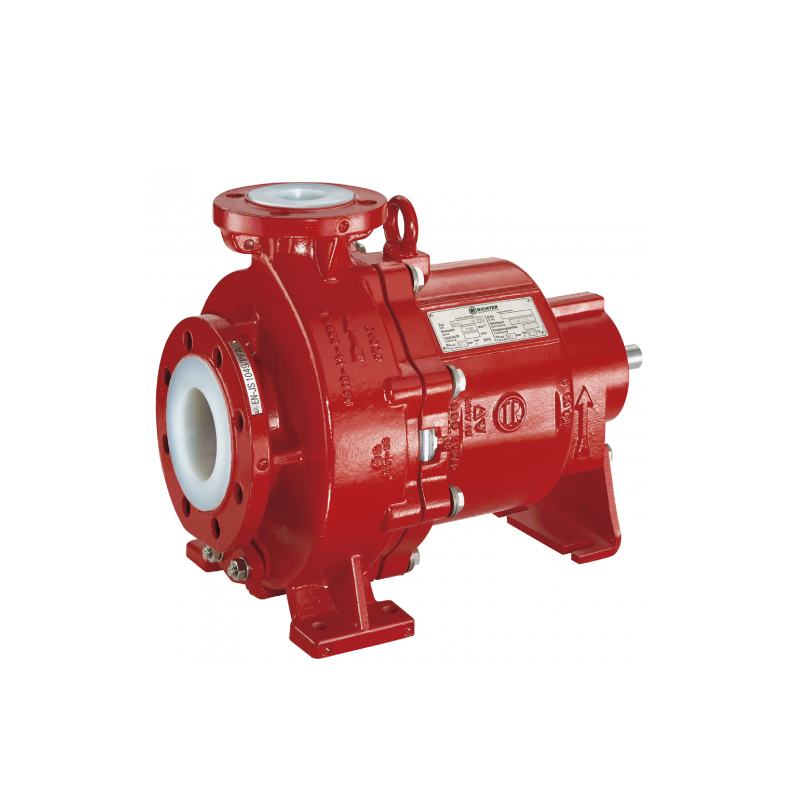
A magnetic drive pump, or mag drive pump, is a sealless centrifugal pump that transmits power to the impeller through a magnetic coupling instead of a shaft that pierces the casing. Because no rotating shaft penetrates the pressure boundary, there is no mechanical seal or packing to wear or leak. The pumped liquid is fully isolated inside a static containment shell, which makes mag drive pumps the standard answer for hazardous, toxic, flammable, high-purity, and expensive fluids where any leakage to atmosphere is unacceptable.
This category sits under Pumps, Valves & Fluid. The guide below explains how the magnetic coupling works, the trade-offs between synchronous and eddy-current designs, the materials of the containment shell, magnets, and bearings, and the API 685, ASME B73.3, and ISO 2858 standards that govern selection.
Photo: S.J. de Waard, CC BY 2.5, via Wikimedia Commons
This guide is written for industrial purchasing engineers and design engineers specifying sealless pumps for chemical, petrochemical, and clean-process duties. It covers 6 chapters: what a magnetic drive pump is and where it fits, coupling and configuration types, the physics of the containment shell and eddy-current loss, wetted materials and bearings, the key spec-sheet parameters, and the selection decision sequence, plus 7 selection FAQs. All parameters reference the public standards API 685 (3rd edition), ASME B73.3-2022, ANSI/HI 5.1-5.6, and ISO 2858.
Chapter 1 / 06
What is a Magnetic Drive Pump
A magnetic drive pump is a sealless rotodynamic pump in which torque is transmitted from the motor to the impeller across an airtight, non-rotating wall by a permanent-magnet coupling. The motor turns an outer magnet ring; the rotating magnetic field passes through a stationary containment shell and locks onto an inner magnet ring that is fixed to the impeller assembly. Because there is no shaft passing through the casing, the conventional mechanical seal, the single most common leak and failure point in a sealed pump, is eliminated entirely. Dynamic sealing is replaced by static sealing, so the only thing standing between the process fluid and the atmosphere is a welded or formed pressure boundary with no moving parts.
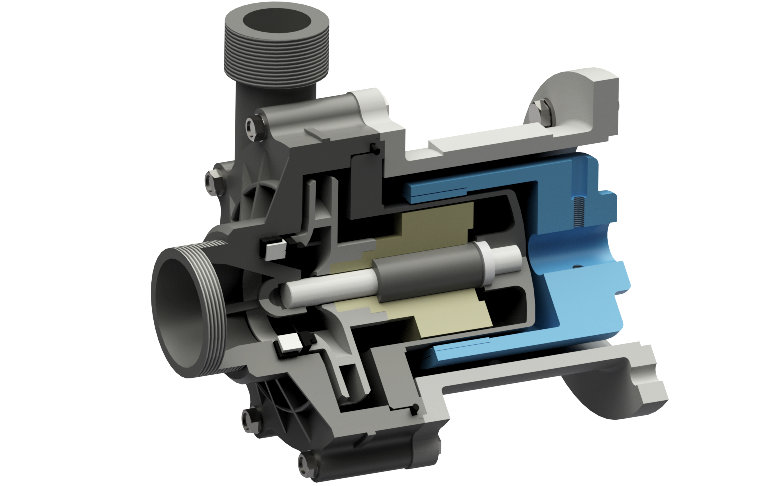
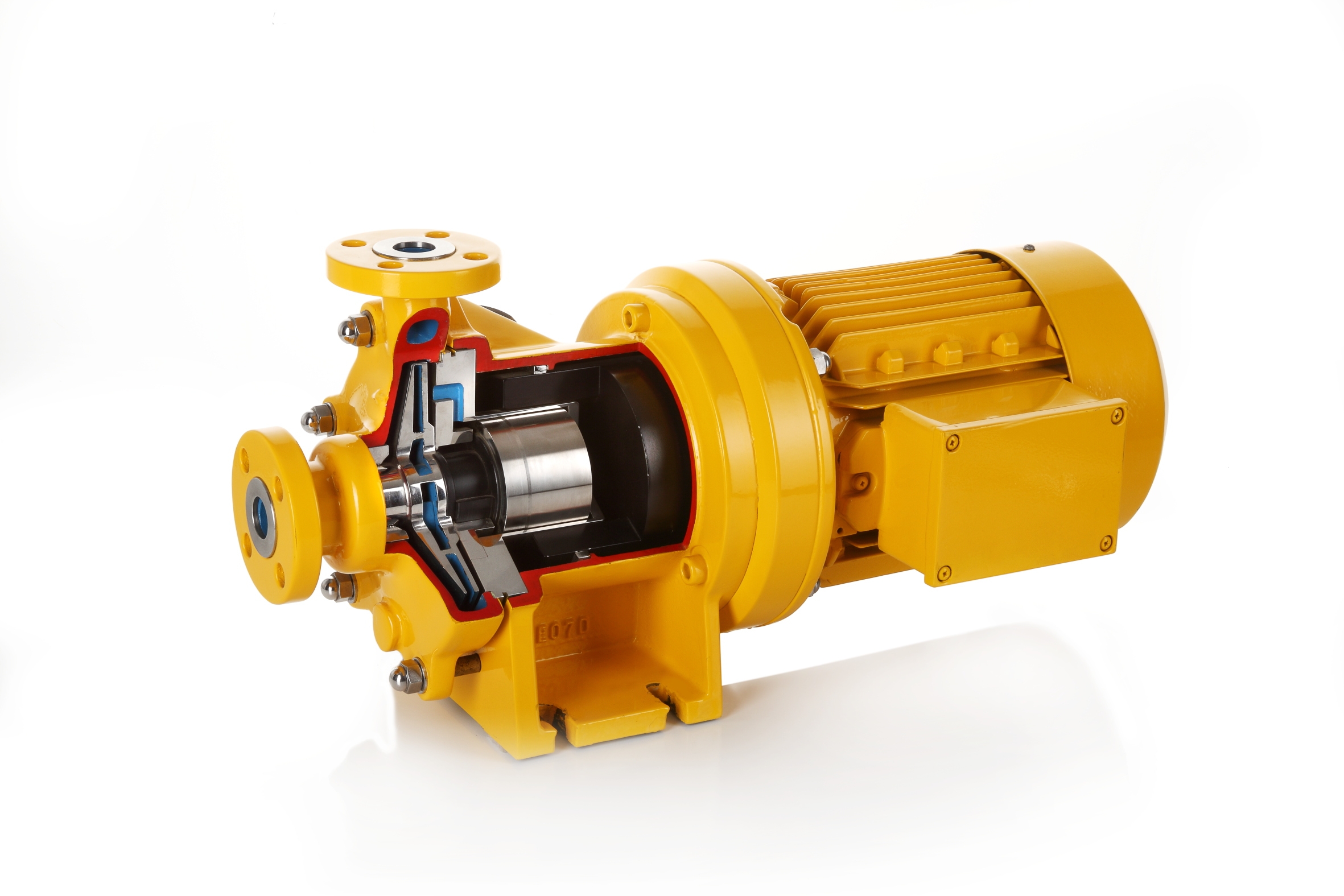
Structurally, a magnetic drive pump has four functional groups: (1) the hydraulic end, with the casing and impeller, identical in concept to any centrifugal pump; (2) the inner drive assembly, comprising the inner magnet ring, the shaft, and product-lubricated journal and thrust bearings, all running inside the process liquid; (3) the containment shell, also called the containment can or isolation sleeve, a leak-tight cup that separates the wet inner assembly from the dry outer drive; and (4) the outer drive assembly, the outer magnet ring coupled to a standard electric motor through a bearing bracket. In a close-coupled design the outer magnet mounts directly on the motor shaft; in a long-coupled design it sits on its own bearing frame driven through a spacer coupling, the layout API 685 favors for heavy duty.
The principle is old. Magnetic couplings were used in laboratory stirrers and small chemical pumps from the 1940s, but the practical industrial mag drive pump arrived with strong rare-earth magnets. Samarium cobalt, commercialized in the 1970s, and neodymium-iron-boron, commercialized in the 1980s, gave couplings enough torque density to drive real process flows. Standardization followed: ASME B73.3 first issued a sealless chemical-process pump specification, the Hydraulic Institute published ANSI/HI 5.1-5.6 for sealless rotodynamic pumps, and API issued API 685 in 2000 for petroleum and heavy-duty chemical sealless pumps, with a 2nd edition that permitted close-coupled magnetic drive pumps and a 3rd edition in 2022.
The reason a buyer pays the premium for a sealless pump is emissions and safety. A mechanical seal is a controlled leak by design: it relies on a thin liquid film between two faces, and that film, by definition, weeps a small amount of process fluid. For benign water that is harmless, but for benzene, hydrofluoric acid, molten sulphur, or a costly catalyst, even a small fugitive emission is a regulatory, safety, and cost problem. A magnetic drive pump removes the seal leak path completely, which is why it dominates duties governed by fugitive-emission rules and why API 685 was written specifically for zero-leakage service.
Magnetic drive pumps are not universal. They suit clean to mildly contaminated liquids of low to moderate viscosity. They struggle with solids, because particles damage the product-lubricated bearings and can lodge in the narrow coupling gap, and they must never run dry, because the pumped liquid is also the bearing coolant. Within those limits, a well-specified mag drive pump runs for years with almost no maintenance, since the part that normally fails on a sealed pump, the seal, no longer exists.
Chapter 2 / 06
Coupling and Configuration Types
Two design decisions shape every magnetic drive pump: how the magnetic coupling transmits torque, and how the pump is configured against a standard. The coupling can be synchronous or eddy-current; the configuration can be metallic engineered or non-metallic lined, close-coupled or long-coupled. The table below compares the two coupling principles, which is the first branch a specifier must understand because it determines efficiency, heat, and overload behavior.
Coupling type
Outer ring
Inner ring
Slip
Coupling heat
Typical use
Synchronous (permanent magnet)
Permanent magnets
Permanent magnets
Zero (locks pole-to-pole)
Low
Almost all modern process pumps
Eddy-current / torque ring
Permanent magnets
Conductive torque ring
Continuous
High
Inherent torque limiting, legacy designs
Synchronous coupling places permanent magnets on both the outer and inner rings, arranged in alternating north-south poles. The two rings lock magnetically and turn at identical speed with no relative slip. Because nothing slips, the coupling itself generates little heat and the only parasitic loss is the eddy-current loss in a conductive containment shell, covered in Chapter 3. Synchronous couplings are compact, efficient, and now the default for industrial magnetic drive pumps. Their weakness is that if torque demand suddenly exceeds the pull-out rating, the rings break synchronization, the pump decouples, stops pumping, and the motor free-spins, heating the shell rapidly until protection trips.
Eddy-current or torque-ring coupling uses permanent magnets on the outer ring only. The inner driven half is a conductive ring in which the rotating field induces eddy currents; those currents create their own field, and the interaction produces torque. By the physics of induction, an eddy-current coupling must always run with some slip to generate torque, so it constantly produces heat and is less efficient than a synchronous design. Its advantage is inherent overload protection: at stall it simply slips rather than transmitting damaging torque. Sundyne HMD Kontro, for example, has historically offered torque-ring upgrades for shock-loaded services. For most clean process duties the efficiency penalty makes synchronous the better default.
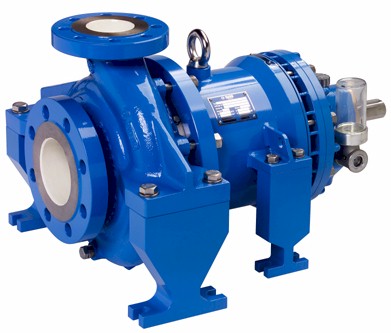
On configuration, the second branch is metallic versus non-metallic. Metallic engineered pumps use a fabricated or cast stainless or alloy casing with a metal containment shell. They handle high pressure, high temperature, and the demanding metallurgy of API 685 petroleum service, and accept secondary containment. Non-metallic lined pumps mold the wetted surfaces from fluoropolymers such as ETFE or PFA over a structural shell, with a ceramic or fiber-reinforced containment shell. They resist aggressive acids that pit even Hastelloy, eliminate the eddy-current loss of a metal shell, and dominate ASME B73.3 chemical service, but they are limited in pressure and temperature, typically below 150 degrees Celsius.
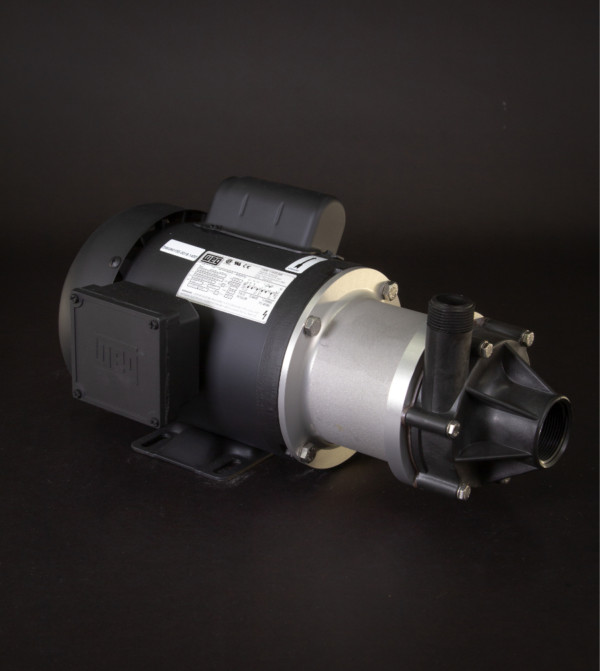
Finally, the drive layout: close-coupled mounts the outer magnet directly on the motor shaft, giving a short, low-cost, low-footprint unit suited to general transfer; long-coupled mounts the outer magnet on an independent bearing frame driven through a spacer coupling, which isolates motor bearing loads, eases maintenance, and is the form API 685 prefers for heavy-duty installations. Vertical in-line and vertical suspended sump versions exist as well, conforming where applicable to API 685 OH and VS arrangements.
Chapter 3 / 06
The Containment Shell and Eddy-Current Loss
The containment shell, also called the containment can or isolation sleeve, is the single component that defines a magnetic drive pump. It is a thin-walled cup that sits in the coupling gap, holds the full process pressure, and separates the wet inner assembly from the dry outer drive. Its material choice involves a direct trade-off between mechanical strength and electrical conductivity, because the same rotating magnetic field that drives the pump also induces losses in any conductive shell. The table below summarizes the main shell options.
Shell material
Electrically conductive
Eddy-current loss
Pressure / temperature capability
Typical use
Hastelloy C-276
Yes
High
High / high
API 685 metallic process pumps
316 / 316L stainless
Yes
High
Medium / high
General metallic chemical pumps
Reinforced ceramic
No
None
Medium / medium
Non-metallic lined acid pumps
Fiber-reinforced plastic (FRP)
No
None
Low / low
High-efficiency and small OEM pumps
The physics is straightforward induction. In a synchronous coupling the inner and outer magnets turn together, but the containment shell stays still, so from the shell's frame the magnetic field rotates. Faraday's law says a changing field through a conductor induces a voltage, and in a continuous metal wall that voltage drives circulating eddy currents. Those currents flow against the wall's electrical resistance and dissipate as heat, exactly the principle of an induction cooktop. The dissipated power is a parasitic loss that does no useful pumping work; it directly lowers pump efficiency and warms the process fluid. On larger couplings the loss can reach roughly 1 to 5 kW, and it scales steeply with shell diameter, rotational speed, and wall thickness.
That heat has to go somewhere. Magnetic drive pumps carry an internal circulation circuit: a small bleed of process liquid is routed from the discharge, through the gap around the inner magnet and over the bearings, and back to suction. This flow lubricates and cools the product-lubricated bearings and carries away the eddy-current heat and bearing friction heat. The circulation rate must be high enough that the fluid in the gap never reaches its vapor pressure, because a vapor pocket would starve the bearings and let the magnets overheat. For hot or volatile liquids the design must verify the temperature rise across the circulation path against the fluid's vapor margin, a calculation API 685 requires.
Two ways exist to cut the eddy-current loss. The first is a non-conductive shell: reinforced ceramic or fiber-reinforced plastic carries no eddy currents at all, so the loss vanishes and efficiency rises, which is why high-efficiency and non-metallic lined pumps favor them. The penalty is mechanical, since polymer and ceramic shells tolerate lower pressure and temperature than metal and ceramic is brittle under shock. The second, used where metal strength is mandatory, is a thin shell of a high-resistivity, low-conductivity alloy such as Hastelloy, sometimes built in two layers, to raise resistance and shrink the induced current.
Because the shell is the pressure boundary, its integrity is a safety matter. A breach lets process fluid into the outer drive and to atmosphere, defeating the whole reason for going sealless. For hazardous duty, API 685 addresses secondary containment: an outer pressure-retaining envelope around the drive that contains a primary shell failure and can be fitted with leak detection. Specifiers of toxic or flammable service should treat secondary containment and shell leak monitoring as standard, not optional.
Chapter 4 / 06
Wetted Materials, Magnets and Bearings
A magnetic drive pump has three material systems that each follow different rules: the wetted hydraulic surfaces, which obey ordinary corrosion-chart logic; the magnets, which are chosen almost entirely by temperature; and the product-lubricated bearings, which are chosen by wear, hardness, and dry-run tolerance. Getting any one wrong is a field failure.
Wetted surfaces follow the same corrosion logic as any process pump. Austenitic 316L stainless steel is the default for water, light hydrocarbons, and mild chemicals, but it fails against chlorides and strong acids. Nickel alloys such as Hastelloy C-276 and C-22 give five times or more the pitting resistance of 316L against hydrochloric acid, wet chlorine, and ferric chloride, and are the metallic first choice in aggressive chemical service. Where even nickel alloys pit, the non-metallic route applies: a fluoropolymer lining of ETFE or PFA gives near-universal acid resistance at the cost of pressure and temperature capability. The inner magnet capsule is itself a wetted part and is encapsulated, since bare rare-earth magnets corrode quickly.
Magnets are selected by temperature, not by chemistry, because the inner magnet is sealed away from the fluid. The choice is between two rare-earth families, compared in the table below. Note that magnets are de-rated at temperature: as they heat they transmit less torque, so the coupling must be sized at the hottest expected process temperature, not at ambient.
Magnet material
Max operating temp
Temp coefficient (remanence)
Relative field strength
Relative cost
Neodymium-iron-boron (NdFeB), standard
approx. 80 °C
approx. -0.11 %/°C
Highest
Low
Neodymium-iron-boron, high-temp grade
approx. 150 to 200 °C
approx. -0.11 %/°C
High
Medium
Samarium cobalt (SmCo)
approx. 350 °C
approx. -0.03 to -0.05 %/°C
High
High
The practical reading: for ambient water and chemical transfer, neodymium is strong and cheap and usually adequate. For hot hydrocarbons, heat-transfer oil, and premium process duty, samarium cobalt is standard because it holds its field to roughly 350 degrees Celsius with a much flatter temperature coefficient, near minus 0.03 to minus 0.05 percent per degree Celsius against neodymium's minus 0.11 percent. Sundyne HMD Kontro, for instance, uses encapsulated samarium cobalt magnets for exactly this reason. The penalty is cost and brittleness. Whatever the grade, the maximum process temperature must stay below the magnet's reversible limit, or the magnet weakens permanently and the coupling loses torque for good.
Bearings are the wear part of a sealless pump, since there is no seal to wear instead. The internal journal and thrust bearings are product-lubricated, meaning the pumped liquid is the only lubricant and coolant. Silicon carbide (SiC) is the industry-standard bearing material: it is extremely hard, chemically inert, and under clean lubricated conditions barely wears for years. Its weakness is brittleness and intolerance of dry running, where a few seconds without liquid film can crack the faces. Manufacturers such as Magnatex offer dry-run-resistant SiC grades that survive short startup dry periods, but no product-lubricated bearing tolerates sustained dry running. Carbon-graphite bearings are an alternative for some duties but wear faster and are unsuitable for abrasives.
Because the bearings live in the process fluid, solids are the enemy. Even fine abrasive particles act as a lapping compound on the SiC faces and shorten life dramatically, and larger particles can jam the narrow coupling gap. For slurries and particle-laden liquids a magnetic drive pump is usually the wrong choice; a sealed slurry pump or a different sealless arrangement fits better.
Chapter 5 / 06
Key Specification Parameters
A magnetic drive pump datasheet carries both the ordinary centrifugal-pump parameters and a set of sealless-specific ones. The hydraulic numbers, flow, head, and efficiency, are read like any pump, but the coupling, NPSH, and temperature numbers carry extra weight because the sealless design has less margin for error. The parameters below are the ones that actually decide a selection.
Flow and head define the duty point. Industrial magnetic drive pumps span roughly a few cubic metres per hour for small chemical transfer up to several hundred cubic metres per hour for large API 685 process units, with heads from a few metres to a few hundred metres for multistage designs. As with any centrifugal pump, the operating point should sit near the best-efficiency point (BEP), and prolonged operation far to the left or right of BEP causes recirculation and bearing load problems that, in a sealless pump, directly threaten the only wear component.
Coupling pull-out torque is the headline sealless parameter. It is the maximum torque the magnetic coupling can transmit before the rings break synchronization and decouple. It must exceed the worst-case shaft torque with margin, conventionally at least 1.5 times the maximum calculated demand, including cold viscous startup and the highest specific gravity the process can reach. The rating must be quoted at the maximum process temperature, since the magnets de-rate when hot.
NPSH required (NPSHr) matters more on a mag drive pump than on a sealed one, because the internal circulation bleed and the heat it carries raise the local fluid temperature near the impeller eye and reduce the available margin against vapor pressure. A correct selection verifies that NPSH available comfortably exceeds NPSHr at the duty point, with extra allowance for the temperature rise across the bearing and coupling circuit. Insufficient margin causes cavitation that, again, lands on the product-lubricated bearings.
Temperature limits come in three layers: the maximum process temperature the wetted parts tolerate, the magnet's reversible temperature limit (Chapter 4), and the allowable temperature rise across the internal circulation path. A high-temperature heat-transfer-oil pump may use samarium cobalt magnets and a metallic shell rated to 350 degrees Celsius, while a polymer-lined acid pump may cap out near 150 degrees Celsius. The lowest of the three governs.
The remaining datasheet fields read like a standard process pump, but each interacts with the sealless design:
Casing pressure rating: maximum allowable working pressure, set by the casing and, critically, by the containment shell, which is the weakest pressure element on many designs.
Eddy-current / coupling loss: the parasitic power burned in a metal containment shell, which lowers efficiency and heats the fluid; near zero for non-metallic shells.
Process connections: flanged to ASME B16.5, EN 1092, or JIS; ASME B73.3 and ISO 2858 fix the dimensional envelope for interchangeability with sealed pumps.
Hazardous-area and safety certification: ATEX or IECEx for explosive atmospheres, plus API 685 reliability and, for toxic or flammable duty, secondary containment with leak detection.
Bearing material and dry-run grade: standard SiC versus dry-run-resistant SiC, which sets the short-term dry tolerance during priming.
One field that does not appear on the datasheet but should be designed in from the start is protection instrumentation. Because decoupling and dry running both destroy a mag drive pump fast, a power or current monitor with a 2 to 3 second trip, plus low-level and low-flow interlocks, is part of the specification, not an afterthought.
Chapter 6 / 06
Selection Decision Factors
To turn the preceding chapters into a specific model, follow the decision sequence below. Most magnetic drive pump failures trace not to a single wrong number but to skipping the early questions, especially the suitability check and the coupling sizing. These steps work as a fixed RFQ template.
Confirm the pump type is even suitable: a magnetic drive pump fits clean to mildly contaminated liquids of low to moderate viscosity that must not leak. If the fluid carries abrasive solids, is run dry intermittently, or must operate far off its duty point on demand, reconsider; a sealed pump or a canned motor pump may be the right answer instead.
Fix the duty point and curve: rated flow and head, plus the full operating range, so the impeller sits near BEP and the worst-case run-out torque is known. Specify specific gravity and viscosity at every operating condition, including cold startup.
Choose metallic or non-metallic: decide by media corrosivity, pressure, and temperature. Metallic engineered, often Hastelloy, for high pressure, high temperature, and API 685 petroleum service; non-metallic ETFE or PFA lined for aggressive acids at lower pressure and temperature.
Size the magnetic coupling: select pull-out torque at the maximum process temperature for at least 1.5 times the worst-case shaft torque, and verify the motor cannot deliver more than the coupling can transmit.
Select magnets by temperature: neodymium for ambient duty, high-temperature neodymium or samarium cobalt as the process temperature rises, with samarium cobalt standard above roughly 150 degrees Celsius. Confirm the maximum temperature stays below the reversible magnet limit.
Verify NPSH and circulation: confirm NPSH available exceeds NPSHr with margin for the internal circulation temperature rise, and that the gap fluid stays below its vapor pressure across the bearing and coupling path.
Specify bearings and dry-run protection: standard or dry-run-resistant SiC, plus the protection package: a power or current monitor with a 2 to 3 second trip, low-level and low-flow interlocks, and, for hazardous duty, containment-shell leak detection.
Match standards and certifications: ASME B73.3-2022 or ISO 2858 for dimensional interchangeability, ANSI/HI 5.1-5.6 for sealless design and test, API 685 (3rd edition) for petroleum and heavy chemical service with secondary containment, ATEX or IECEx for explosive areas.
One last dimension that buyers underweight is manufacturer serviceability: local stock of containment shells, bearings, and magnet assemblies, field rebuild capability, and proven references in the same fluid. Because a sealless pump moves the wear from the seal to the internal bearings and shell, repair turnaround on those specific parts determines downtime after years in service. Sundyne HMD Kontro, Klaus Union, Teikoku, Magnatex, Ansimag, Iwaki, and March all support industrial magnetic drive pumps; confirm the exact series, wetted materials, and certifications against the current datasheet before committing, and never carry over a spec from a sealed pump unchanged.
FAQ
What is the difference between a magnetic drive pump and a canned motor pump?
Both are sealless pumps that remove the shaft seal, but they differ in how torque reaches the impeller. A magnetic drive pump keeps a standard separate electric motor that turns an outer magnet ring; the field crosses a stationary containment shell and drags an inner magnet ring carrying the impeller. A canned motor pump merges pump and motor into one unit: the rotor sits in the process fluid and is sealed by a thin metallic can lining the stator bore. Magnetic drive pumps allow the motor to be re-rated or replaced independently and are easier to repair locally, while canned motor pumps are more compact and tolerate higher pressures but are dedicated to one duty point. API 685 covers both as MDP and CMP classes.
Why does the metallic containment shell cause eddy-current losses?
In a synchronous coupling the magnetic field that crosses the containment shell is rotating relative to the stationary shell wall. If the shell is an electrical conductor, such as Hastelloy C-276 or 316 stainless steel, that rotating field induces circulating eddy currents in the wall, which dissipate as heat and represent a parasitic power loss, commonly 1 to 5 kW on larger couplings. The lost power heats the process fluid and must be removed by the internal circulation flow. Non-conductive shells made of reinforced ceramic or fiber-reinforced plastic eliminate this loss entirely, which is why polymer-lined ANSI magnetic pumps and high-efficiency designs favor them, though they tolerate lower pressure and temperature than metal.
Why must a magnetic drive pump never run dry?
The internal bearings that support the inner magnet and impeller assembly are product-lubricated: the pumped liquid is also the bearing coolant and lubricant. Silicon carbide bearing surfaces rely on a thin liquid film. Run the pump dry and that film disappears, friction heat spikes within seconds, and the bearings or containment shell can be destroyed almost instantly. Dry running also lets the magnets overheat past their reversible temperature limit and weaken permanently. Protection is mandatory: a power monitor with a 2 to 3 second automatic trip, plus low-level interlocks. Some makers offer dry-run-resistant bearing grades, but these only buy a short startup margin, not continuous dry operation.
Which magnet material should I choose, samarium cobalt or neodymium?
The deciding factor is process temperature. Sintered neodymium-iron-boron (NdFeB) has the highest field strength and lowest cost, but standard grades are limited to roughly 80 degrees Celsius and high-temperature grades to about 150 to 200 degrees Celsius, and they lose strength fast at minus 0.11 percent per degree Celsius. Samarium cobalt (SmCo) holds its magnetism to about 350 degrees Celsius with a much flatter coefficient near minus 0.03 to minus 0.05 percent per degree Celsius, so it is the standard choice for hot hydrocarbon and heat-transfer-oil duties and for premium process pumps. SmCo costs more and is more brittle. For ambient-temperature water and chemical transfer, NdFeB is usually adequate and cheaper.
How do I size the magnetic coupling and avoid decoupling?
Decoupling, or magnet slip, happens when the torque the pump demands exceeds the coupling's pull-out rating; the inner and outer rings break sync and the pump stops delivering while the motor keeps spinning and overheats the shell. Size the coupling for at least 1.5 times the maximum calculated shaft torque, and include the worst case: cold viscous startup, the highest specific gravity the process can reach, and run-out flow at the far right of the curve. Account for the magnet de-rating at the maximum process temperature, since hot magnets transmit less torque. Verify the motor cannot deliver more than the coupling rating, or add a power monitor that trips before the pull-out point is reached.
Which standards govern magnetic drive pumps?
For chemical process service in North America, ASME B73.3 (current edition 2022) specifies sealless horizontal end-suction centrifugal pumps, including metallic and polymer-lined magnetic drive types, with dimensional interchangeability so any compliant pump fits the same baseplate and nozzles. The Hydraulic Institute standard ANSI/HI 5.1-5.6 covers sealless rotodynamic pump nomenclature, design, and testing. For petroleum, heavy-duty chemical, and gas service, API 685 (3rd edition, 2022) sets the requirements for both magnetic drive and canned motor pumps, including secondary containment and reliability. ISO 2858 defines the dimensional envelope for end-suction pumps so a sealless unit can replace a sealed one. Hazardous areas add ATEX or IECEx.
Which manufacturers make industrial magnetic drive pumps?
For API 685 heavy-duty petroleum and chemical service, Sundyne HMD Kontro (GSP and GT series, samarium cobalt magnets and silicon carbide bearings), Klaus Union (SLM series), and Amarinth supply metallic engineered units. For ASME B73.3 chemical process duty, Teikoku, Magnatex, and PumpWorks offer metallic sealless pumps, while Ansimag and similar lines provide non-metallic ETFE or PFA-lined pumps with ceramic containment shells for aggressive acids. For smaller OEM, laboratory, and original-equipment chemical transfer, Iwaki, March, and Finish Thompson cover thermoplastic and metallic small-flow magnetic pumps. Always confirm the exact series, wetted materials, and certifications against the current manufacturer datasheet.
Magnetic Drive Pump Manufacturers
Source-backed product routes. Open a company dossier for procurement scope and cited evidence.
HMD Kontro documents GTA/GTI general-transfer sealless magnetic-drive pumps for specified process duties.
Published product fact
HMD Kontro GTA/GTI general-transfer sealless magnetic-drive pumps, with the GT design range published from −40°C to +260°C and an 18.9 bar design working pressure.
Klaus Union documents sealless magnetic-drive pump products from its Bochum, Germany headquarters.
Published product fact
Klaus Union SLM-AVP horizontal sealless centrifugal magnetic-drive pumps for petroleum, heavy-duty chemical and gas service, with API 685 cited on the product page.
March Manufacturing documents the TE-7R-MD as a sealless magnetically coupled plastic chemical pump.
Published product fact
March TE-7R-MD centrifugal sealless magnetically coupled chemical pumps in polypropylene and Ryton, with a published maximum of 53 GPM and 60 ft of head.
RICHTER documents MV/MVP as PFA-lined diaphragm-valve variants with modified PTFE diaphragms.
Published product fact
RICHTER MV/MVP PFA-lined diaphragm valves in manual and remote-actuated variants.
Published product fact
RICHTER MNK Heavy Duty PFA/PTFE-lined centrifugal magnetic-drive pump configurations, including frame-mounted and close-coupled designs with permanent-magnet coupling.