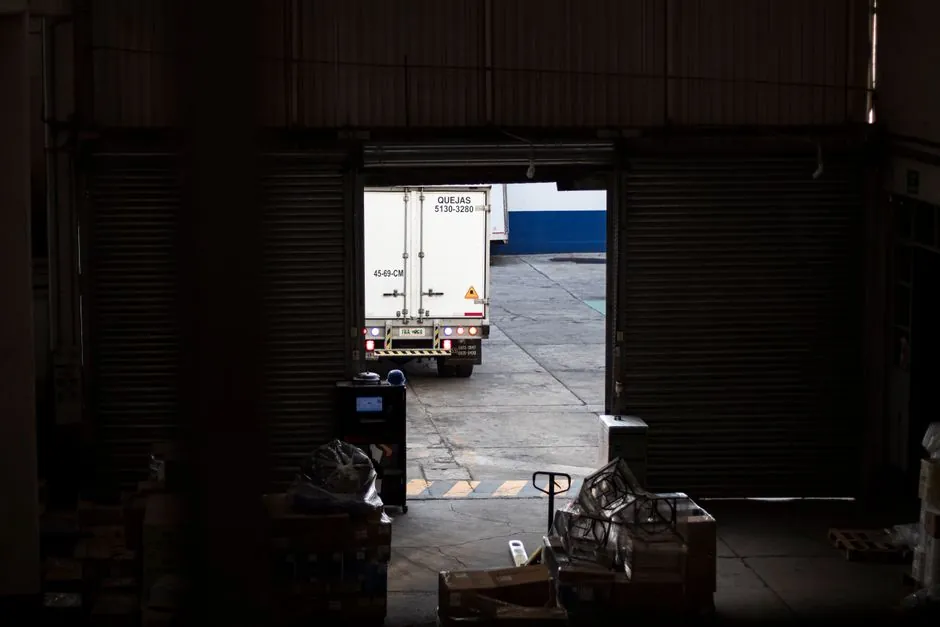
For a standard ISO 1000 x 1200 mm pallet, the reach truck's published right-angle stacking aisle (Ast) depends on which way the load is indexed, and that one decision can swing the working aisle by 100-200 mm in a real warehouse [S5][S9].
Crosswise loading (forks engaging the 1000 mm face) almost always produces a narrower Ast than lengthwise loading (forks engaging the 1200 mm face) on a single-reach truck, because the truck pivots around a shorter load footprint [S5][S9]. Practical single-reach floors land near 7 ft 6 in (2.29 m) in OEM literature and near 9 ft (2.74 m) in integrator guidance, while double-reach trucks need an extra 12-18 in (305-457 mm) on top of the single-reach figure [S2].
How pallet orientation changes the Ast number on a spec sheet
Manufacturers publish two Ast values for the same truck because the geometry is genuinely different. The CAT NTD13N3/NTD15N3 data sheet, for example, lists a "Working aisle width (Ast) with 1000 x 1200 mm pallets, load crosswise" line and a separate "Working aisle width (Ast) with 800 x 1200 mm pallets, load lengthwise" line, with a turning-radius value that anchors the two [S9]. On most single-reach chassis, the crosswise Ast on a 1000 x 1200 pallet lands roughly 100-150 mm below the lengthwise Ast, because the 1000 mm face lets the truck rotate over a shorter swept path before the forks reach the rack [S5][S9].
Three numbers from the spec sheet matter in this decision: overall truck width (does it clear the doorway), turning radius Wa (geometric envelope), and Ast for your specific pallet orientation (the rack-entry number) [S5]. Linde-type data sheets explicitly separate 1000 x 1200 across the forks from 800 x 1200 along the forks, and the rack layout must be checked against the orientation that matches the actual loading practice on the floor [S5].
Class boundaries: where reach trucks sit against counterbalance and VNA
Toyota-style classification puts standard warehouse aisles at roughly 3.2 m (10.5 ft) or wider, narrow aisles at 2.6-3.2 m (8.5-10.5 ft), and very narrow aisles at 1.5-2.1 m (5-7 ft) [S5]. Reach trucks fall into the narrow-aisle band, with published minimums as low as 7 ft 6 in (2.29 m) from the OEM side and integrator recommendations typically settling at 9 ft (2.74 m) for single reach and 10 ft to 10 ft 6 in (3.05-3.20 m) for double reach [S2][S7]. Counterbalanced trucks generally need 12 ft (3.66 m) and VNA turret trucks can compress that to roughly 4 ft 4 in to 6 ft (1.32-1.83 m) when wire-guided [S2].
On a 1000 x 1200 ISO pallet, the crosswise reach-truck Ast typically lands in the 2.6-2.8 m band, while lengthwise operation trends toward 2.7-2.9 m; that is the practical range most European and US spec sheets quote [S5][S7][S9]. The Raymond Reach-Fork truck, for instance, is published to operate in an aisle "just over 8 feet" (about 2.44 m) when configured for the application [S8]. Going below those numbers means moving to a turret truck with a guidance system, not pushing a reach truck harder [S2][S5].
Cost of an extra inch: why integrators pad the OEM minimum
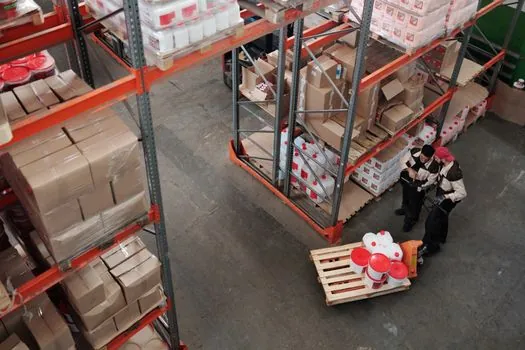
Lean MH worked a concrete example for a 10-aisle, 20-deep rack layout: adding 6 in (152 mm) of aisle width across 10 aisles costs 60 in (5 ft) of total racking length, which on a 100,000 sq ft building quietly erodes pallet positions [S3]. That is exactly why designers are tempted to publish the OEM floor of 7 ft 6 in (2.29 m) instead of the integrator comfort figure of 9 ft (2.74 m) [S2][S3].
The equation behind those numbers is straightforward: Ast_min is roughly head length plus load length plus 12 in (305 mm) for maneuverability plus 6 in (152 mm) for pallet overhang; on a 1000 x 1200 pallet taken crosswise, the load-length term shrinks, which is why the crosswise orientation is usually the cheaper aisle to build [S2]. ForkliftAction forum data shows a counterbalance-to-reach conversion (12 ft to 9 ft, or 3.66 m to 2.74 m) yielding about 25% more storage for each commodity class that moves into narrow-aisle reach operation [S4].
Decision matrix: crosswise vs lengthwise on 1000 x 1200
Three decision criteria usually decide the orientation on a new reach-truck aisle: required Ast, operator sightline, and rack beam compatibility. On the required Ast criterion, crosswise wins for 1000 x 1200 ISO pallets because the swept path over the 1000 mm face is shorter, giving roughly 100-150 mm of headroom against lengthwise loading on a typical single-reach chassis [S5][S9]. On operator sightline, lengthwise loading (forks engaging the 1200 mm face) gives the driver a clearer view down the rack and is preferred for mixed-SKU operations where fork-tip alignment matters [S2]. On rack beam compatibility, crosswise loading tends to interact with beam-step and wire-deck layouts more cleanly because the pallet mass is centered closer to the mast [S8].
For new builds running mixed SKUs at typical 1-1.5 t load weights, crosswise on a single-reach truck at 2.7-2.8 m (8.9-9.2 ft) is the safest call. For double-reach operations handling 1.5-2.0 t loads with the 1200 mm face engaged, plan 3.0-3.2 m (10-10.5 ft) and accept the storage-density hit [S2][S3][S7]. Engineers laying out a new European-style narrow-aisle block around reach truck operation should also leave 100-150 mm per side for rack-protector compression, on top of the published Ast, because pallet overhang and column proximity are the two failure modes that the OEM figure does not capture [S2][S5].
What the OEM minimum actually leaves on the table

Three failure modes bite installations that run at the published floor. First, pallet overhang beyond the 6 in (152 mm) the formula assumes will eat the maneuverability buffer and stall the rack-entry cycle [S2]. Second, rack uprights and end-of-aisle columns are not part of the Ast geometry, so the clear site width must be measured against real obstructions, not blueprint dimensions [S5]. Third, operator skill is built into the integrator's recommended 9 ft (2.74 m) figure; an inexperienced driver on a 7 ft 6 in (2.29 m) OEM-minimum aisle is a near-certain rack-damaged incident [S2].
On a 1000 x 1200 pallet, the single-reach truck's published crosswise Ast is genuinely the tighter of the two orientations, and that is the number to anchor the rack layout on; the lengthwise figure should only drive the layout when product, fork-tip alignment, or operator workflow forces the 1200 mm face into the rack [S5][S7][S9].
Trackable signals for the next planning cycle: any new OEM data sheet that lists a sub-2.5 m Ast on a 1.5-2.0 t single-reach chassis for the 1000 x 1200 crosswise case, and any integrator bulletin pushing the comfort figure below 9 ft (2.74 m) for general-merchandise narrow-aisle layouts. Both moves would compress the cost-of-aisle curve laid out in the Lean MH worked example [S3].
Detailed specification references: industrial x ray, and dump truck.
Background reading: Fe 500 vs Fe 500D vs Fe 550D: Spec-Level Decision for TMT Bar Grades.