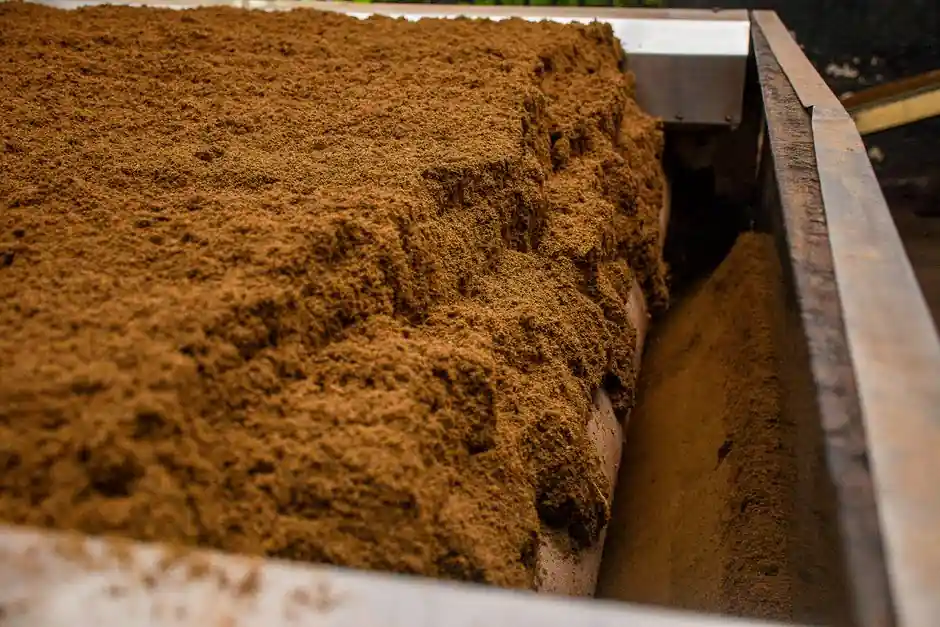
For unit handling lines carrying cartons, totes, packaged food, and small-parcel logistics, PVC belts typically run 30%–50% lighter per foot than equivalent rubber constructions, with common tensile ratings of 75–250 PIW versus 150–660+ PIW for 2- to 6-ply rubber [S2].
The trade is range and durability: standard rubber covers from -25°F to 225°F (-32°C to 107°C) with high-temperature compounds reaching 400°F–700°F (204°C–371°C), while PVC holds a narrower -10°F to 160°F (-23°C to 71°C) band, with some formulations to 200°F (93°C) [S2]. Pick the duty class first, then the polymer.
Where PVC Wins in Unit Handling
PVC belts dominate light-duty unit handling because their non-absorbent covers resist moisture, oils, and most acids, alkalis, and mild chemicals better than standard SBR rubber, and FDA food-grade PVC compounds are widely stocked for direct-food-contact conveyors [S2]. Typical PIW ratings of 75–250 cover the 50–500 kg unit loads found on packaging, sorting, and warehouse transfer lines without over-specifying the carcass [S2].
The lower mass is not just a handling convenience: lighter belts cut motor load, and PVC's flexibility lets designers run smaller pulley diameters in compact incline or curved layouts common in distribution centers. The general conveyor-belt scope covered by ISO 21183-1 (light conveyor belts) typically governs these constructions, separate from the heavier ISO 14890:2026 textile belting used in bulk handling [S3]. For a primer on what "light conveyor belt" means in spec language, see the light conveyor belt basics reference page.
Where Rubber Is the Correct Answer
Rubber covers are the right call when the unit-handling line sees heavy tote drops, sharp-edged components, cold-room operation, or oil mist. Standard SBR/NR rubber carries operating temperatures from -25°F to 225°F and stays flexible in sub-zero cold stores where PVC stiffens and can crack on small pulleys [S2][S7]. Cut-resistant compounds and rip-stop carcasses extend service life where metal-edged or glass-handling loads would slice a PVC cover.
Tensile strength is the differentiator: 2- to 6-ply rubber reaches 150–660+ PIW, and steel-cord rubber constructions handle the longest, highest-tension unit-handling runs, well beyond anything PVC offers [S2]. For unit loads above roughly 250 PIW of design tension, or anywhere impact at loading exceeds PVC's puncture threshold, rubber is the only defensible spec. The trade-off is weight and cost: rubber commands a higher per-foot price and pulls more motor power, though longer service life in severe duty often drops total cost of ownership below a PVC-replacement cycle [S2].
Decision Matrix: PVC vs Rubber on Five Criteria
Lining the two options up against the criteria that actually drive unit-handling procurement gives a clear, defensible shortlist. The numbers below come from side-by-side manufacturer and supplier data, not generic descriptions. [S2]
Temperature range: standard rubber -25°F to 225°F, specialty HT compounds 400°F–700°F; PVC -10°F to 160°F, select formulations to 200°F, no high-temperature grade available [S2]. Abrasion and impact: rubber excellent (Grade 1 DIN X compounds for crushed rock, ore, sand, angular aggregate), PVC moderate, with PVC vulnerable to cracking or puncture under heavy impact and not recommended for crusher discharge or heavy loading zones [S2]. Tensile strength (PIW): rubber 150–660+ across 2–6 plies plus steel cord, PVC 75–250 and not available in high-PIW constructions for heavy mining or long-distance conveying [S2]. Belt weight: rubber significantly heavier per foot, especially at higher ply counts, with PVC 30%–50% lighter, which lowers energy consumption and simplifies handling [S2]. Chemical and oil resistance: standard SBR vulnerable to oils and solvents and needs MOR, nitrile, or neoprene compounds, while PVC carries good baseline resistance to vegetable and mineral oils, plus most acids, alkalis, and mild chemicals [S2].
Splicing, Cleaning, and Hygienic-Grade Specs
Splicing method is a real spec differentiator. Rubber takes a vulcanized finger splice, the strongest and most permanent option, plus mechanical lacing (Clipper, Alligator) for field repair; PVC cannot be vulcanized and is joined by heat welding, overlap cementing, or mechanical lacing, which simplifies field installation but caps ultimate joint strength [S2].
For food, pharma, and cosmetic lines, FDA food-grade PVC and TPU are the default hygienic picks; rubber's textured, porous surface is harder to sanitize and can absorb grease and oils, which is why rubber is rarely specified for direct-food-contact conveyors [S2][S5]. Moisture behaviour reinforces the split: PVC is non-absorbent, does not wick, and resists mildew and rot, while rubber needs sealed edges in wet environments even though polyester carcasses absorb less moisture than nylon [S2]. Buyers writing a washdown spec should default to PVC or TPU and treat rubber as a fallback only when the duty demands it.
Limitations and Failure Modes to Engineer Around
PVC's two hard limits are temperature and impact. Performance typically holds below 60°C (140°F), and PVC softens or deforms above that threshold, so any unit-handling line near ovens, autoclaves, or hot-product infeeds should be ruled out for standard PVC [S4]. Cold-side failure is symmetric: PVC stiffens below about -10°F (-23°C) and can crack on small-diameter pulleys, which is why rubber is the safer choice for sub-zero cold stores and outdoor winter operations [S2][S7].
Rubber's failure modes are different. Standard SBR swells and degrades in oil and solvent exposure, so specifying MOR (moderate oil resistance), nitrile, or neoprene compounds is mandatory on lines with lubricant mist or cutting fluid splash [S2]. Excessive top-cover wear on rubber usually points to loading-zone problems, trapped material, damaged idlers, or a misadjusted cleaner, not a belt-quality issue, so lifecycle planning should include conveyor-condition audits alongside compound selection [S3].
Procurement Signals and 2026 Standards Baseline
Two trackable signals are worth watching into late 2026. First, ISO 14890:2026 now governs rubber- or plastics-covered textile conveyor belting for general surface use, and it explicitly excludes light conveyor belts described by ISO 21183-1, so any quote that does not state which of those two standards the belt is built to should be questioned [S3]. Second, the TPU-versus-PVC-versus-rubber conversation is no longer academic: TPU is now specified for FDA and EU food-grade lines, offers better low-temperature flexibility than PVC, and is being adopted in pharmaceutical and packaging unit handling where both hygiene and small-pulley layouts matter [S5].
For a unit-handling buyer, the practical 2026 checklist is short: confirm duty class and PIW demand, set the temperature window including cold-store or washdown extremes, name the chemical and oil exposure, pick the relevant ISO standard, and only then choose the polymer. That sequence prevents the most common spec error, treating "PVC" or "rubber" as a material decision instead of a duty-class decision. For adjacent selection logic in the broader material handling stack, the comparison framework is the same.
Spec-level background on the components involved: pvc u pipe.
Related analysis: Semi-Trailer vs Rigid Truck Concrete Mixer: Spec-by-Spec Selection.