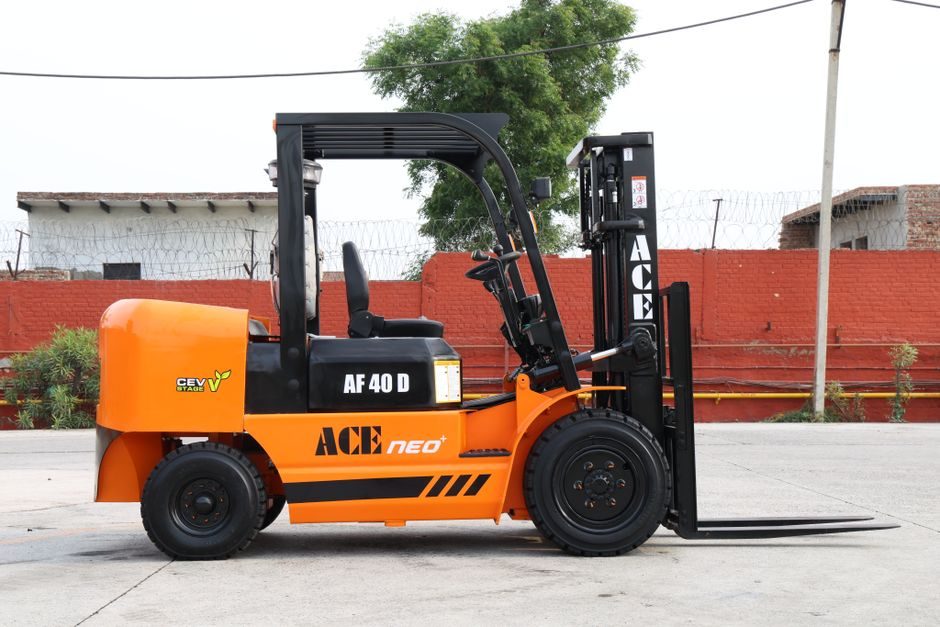
A reach truck is a stand-up electric narrow-aisle truck built around a wheelbase that is shorter than its load wheelbase, letting the forks reach forward into a rack slot. In typical 2025-2026 spec sheets, lift heights cluster between 4.5 m and 12 m, residual capacities run 1.0 t to 2.5 t at the rated lift, and the minimum stacking aisle with 1000 mm-wide EUR pallets lands near 2.6-2.9 m [S1][S2].
The machine is engineered for one job: put pallets in and pull pallets out of deep rack bays in a warehouse. Compared with a dump truck (a tipper for loose bulk on construction sites) or a concrete mixer truck (a drum carrier for site-mixed concrete), a reach truck is indoor-only, battery-powered, and physically small enough to fit an aisle most counterbalance forklifts cannot enter.
Where the Reach Truck Wins: Throughput, Footprint, Ergonomics
Reach trucks can lift 8 m on a chassis that turns inside an aisle only 1.0-1.2 m wider than the load, because the drive wheel sits under the operator and the outrigger legs stay inside the rack profile. That is the core physical reason warehouse specifiers choose them over truck scale-style dock layouts where pallet flow is straight-through [S1].
Cycle time is the second win.
Ergonomics matter in cold-storage and 3PL sites. The stand-up position, low-step entry, and seated stand-up variants (Toyota 8BRU18, Linde R14-R20, Crown RT 4000-series) drop operator fatigue on 8-hour shifts and keep the operator inside the stability rectangle, so the truck can lift to top rack without a reduced-speed "creep" mode that sit-downs need past ~5 m [S2].
Where It Loses: Floor, Aisle Discipline, Cost, Multi-Direction Travel
Reach trucks need a flat, level, joint-free concrete floor with a surface tolerance inside roughly ±3 mm over 3 m, because a 1.0-2.5 t load on a wheelbase that is shorter than the load wheelbase is dynamically sensitive to racking and floor bumps. Any slope above ~1-2% starts to affect the stability triangle during extended-reach travel; that is why outdoor yards, loading-dock aprons, and mezzanines with cross-traffic are reach-truck no-go zones [S1][S2].
Travel direction is a hard limit. Reach trucks only drive in the direction the forks face (forward to pick, backward to travel), so mixed-load operations that need to push, pull, side-shift, or work a concrete pump truck boom's delivery pattern need a different machine. The forks extend about 600-900 mm beyond the outriggers, which is exactly what makes narrow-aisle work possible, and exactly what makes rough-ground use unsafe [S1].
Acquisition cost is the third brake. A 1.6 t / 8 m reach truck in 2025-2026 list runs roughly 1.4-1.9× the price of an equivalent counterbalance electric forklift, and the multi-stage mast, reach mechanism, side-shifter, and 48 V traction pack add to the service bill. When pallet flow does not justify the aisle width saving, the payback math collapses [S2].
Decision Comparison: Reach Truck vs Counterbalance Electric vs Articulated
For spec-stage comparison, the three machines line up against four decision criteria. A reach truck wins on aisle width and lift height, loses on purchase price and surface tolerance; a counterbalance electric is the opposite; an articulated (bendi-type) sits in the middle but tops out lower.
These are typical operating ranges from current OEM catalogues, not lab test figures; duty cycle, battery option, and mast stage will move every number [S1][S2].
Use Cases, Misuse, and Operator Training
Reach trucks fit distribution-centre racking, cold-storage warehouses, automotive parts aisles, and 3PL cross-docks where 80%+ of moves are pallet-in / pallet-out against a fixed rack. They are a poor choice for construction sites, lumber yards, outside-the-fence operations, and any application that needs the truck to leave the aisle and run on a public road. For a multi-application fleet, a dump truck-style rough-terrain handler or a telehandler covers what the reach truck cannot [S1].
Operator training is non-negotiable in this segment. Reach trucks have a smaller stability margin than counterbalance trucks, and a sideways tip at 8 m is fatal. Standards like OSHA 1910.178(l) and EN 1726-1 require practical training, daily checks, and load-chart compliance; the load chart is the only document that authorises a given lift height / load / reach combination, and ignoring it is the most common accident cause on record [S1][S2].
Standards, Sourcing, and Trackable Signals

Specification should be cross-checked against the OEM's published residual-capacity chart (load kg vs lift height mm, with reach extension and mast tilt), the truck's EN ISO 3691-1 / ANSI/ITSDF B56.1 conformance, and battery spec to UN 38.3 for lithium packs. Buyers should also confirm mast stage (2-stage limited free-lift vs 3-stage full free-lift), reach stroke length, side-shift travel, and minimum stacking aisle with the OEM's own VDI 2198 cycle worksheet, not a brochure number [S1][S2].
Two signals to watch over the next 6-12 months: lithium 48 V and 80 V drop-in replacements for legacy lead-acid reach-truck batteries (cycle life, opportunity charging, cold-storage behaviour), and integrated telematics that log operator reach / lift / reverse events for ISO 3691-1 compliance reporting. Both shift the reach-truck TCO math noticeably and are likely to set the next purchasing cycle. Operators weighing the same aisle-vs-cost trade-off can also compare the dock leveler advantages and disadvantages breakdown for a related narrow-bay decision.