Reach trucks and counterbalance forklifts overlap on basic pallet duty but diverge hard on aisle width, lift height, mast geometry, and operator stance. The selection pivot is not "reach vs no reach" — it is aisle clearance, stacking height, and load centre distance, with each machine type carrying a published spec envelope that disqualifies the other on the wrong job.
Both machine classes now run almost exclusively on electric drive, with 48 V AC traction motors typical in 1.4-2.0 t reach trucks [S1] and lithium-battery packs offered as a factory option across both categories [S4][S8]. Used-forklift channels in the Benelux and Chinese export lanes carry both classes from 1 t to 10 t, and treat reach trucks and forklifts as separate inventory families rather than substitutes [S3][S4].
Definition, Aisle Class, and Stacking Envelope
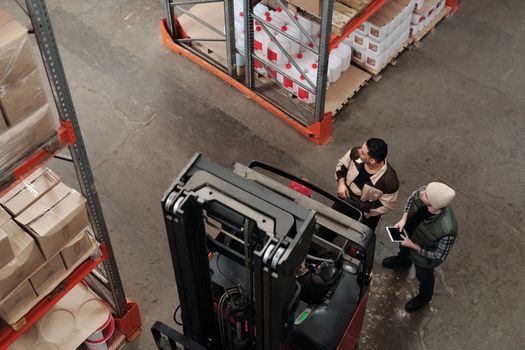
A reach truck is a narrow-chassis, electric, stand-up or side-seated warehouse truck whose mast reaches forward beyond the front wheels, allowing the chassis to retract into the rack footprint and shrink working-aisle width to roughly 2.5-2.8 m [S1][S7]. The TCM RT series, for example, posts an overall chassis width of 1,120 mm (44.1 in) at 1,400 kg capacity and 600 mm load centre, sized for very-narrow-aisle (VNA) and standard narrow-aisle racking [S1].
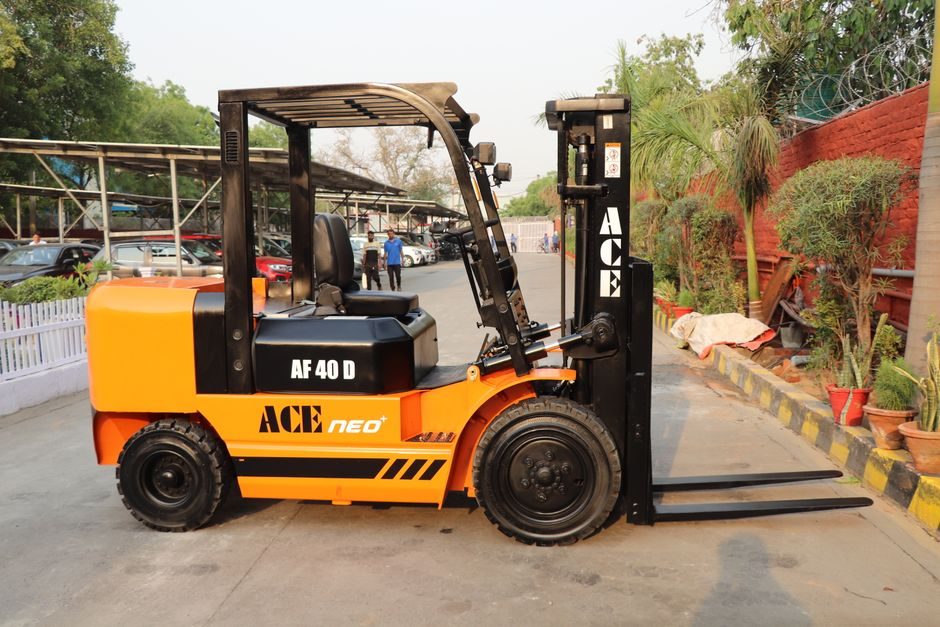
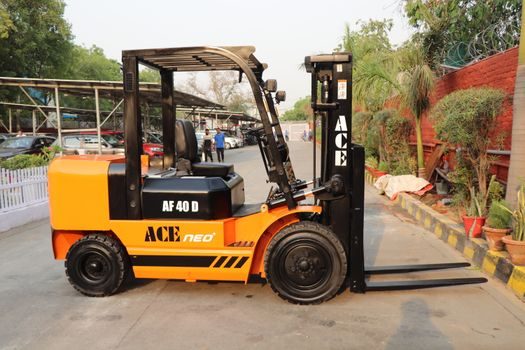
A counterbalance forklift carries its load outboard of a rear counterweight, so the truck itself needs no outrigger legs and can drive into a standard pallet footprint from either side. That geometry is why a counterbalance unit typically demands 3.5-4.5 m of right-angle stacking aisle versus roughly 2.5-2.8 m for a reach truck on the same 1.2 × 1.0 m pallet [S3][S7]. Used-forklift inventory in the 1-10 t range is dominated by counterbalance electric and diesel/LPG units, kept as a separate product family from reach trucks [S3].
Lift-height ranges diverge by machine class. The Zowell FRB reach-truck line stacks to a maximum of 9 m on a 2.0 t chassis, marketed specifically for high-rack systems in food, paper, and electronics warehousing [S5]. Counterbalance electric forklifts more typically stack to 4-6 m on 1.5-3.5 t chassis; diesel and LPG forklifts in the 3-10 t band routinely lift to 3-6 m with heavier load centres [S3][S4].
Selection Criteria: Aisle, Load, Height, Floor, Operator
Four criteria separate the two classes in practice, and each has a numerical anchor worth pinning down. First, working-aisle width: 2.5-2.8 m for a reach truck versus 3.5-4.5 m for a counterbalance forklift on the same pallet — below 3.0 m, a counterbalance cannot complete a 90° pallet pick [S3][S7]. Second, lift height: up to 9 m on a 2.0 t stand-up reach truck versus roughly 6 m on a comparable-tonnage counterbalance electric [S5].
Third, load capacity and load-centre distance: TCM's RT-series reach truck is rated 1,400 kg at a 600 mm load centre with a 1,120 mm chassis [S1]; NOELIFT's TFB series covers 1.0-2.5 t in 4-direction reach-truck configuration, and the same supplier's electric counterbalance forklift range covers 1.0-3.5 t [S4]. Counterbalance diesels in the Van der Spek inventory go from 1 t up to 10 t, a band a reach truck does not enter [S3]. Fourth, travel speed: 13 km/h default on the TCM RT with a 14.5 km/h high-power option, while heavier counterbalance IC forklifts often run lower loaded travel speeds to manage stability on uneven yard surfaces [S1].
Flooring, dock work, and outdoor duty decide the next tie-break. A reach truck is an indoor, finished-floor, pallet-on-rack machine; a rough terrain forklift is the outdoor alternative, and the standard counterbalance forklift bridges the indoor-outdoor gap with cushion or pneumatic tyres. The Zowell FRB reach truck is explicitly positioned for indoor racking, food and beverage, paper, and electronic components, with no outdoor duty claim [S5].
Comparison: Reach Truck vs Counterbalance Forklift
The table below lines the two machine classes up against the four decision criteria. Numbers are pulled from the cited spec sheets and dealer inventories; where the research gives a range rather than a single figure, the range is preserved.
Working-aisle width (right-angle stack, 1.2 × 1.0 m pallet): Reach truck 2.5-2.8 m, Counterbalance forklift 3.5-4.5 m — reach truck wins by 1.0-1.7 m of aisle [S3][S7]. Maximum lift height: Reach truck up to 9 m at 2.0 t (Zowell FRB) [S5], Counterbalance electric roughly 4-6 m at 1.5-3.5 t — reach truck wins on stacking height up to about 2.0 t. Load capacity: Reach truck typically 1.0-2.5 t, Counterbalance 1.0-10 t — counterbalance wins on heavy loads. Duty environment: Reach truck indoor finished floor / racking only, Counterbalance indoor, dock, yard, and rough terrain — counterbalance wins on duty envelope.
For buyers who already run an electric fleet, the cross-reference to a dump truck is a useful sanity check: dump trucks, reach trucks, and forklifts all share hydraulic-lift principles but live in completely different aisle and terrain envelopes, so spec overlap is minimal. Operator stance is another separator: TCM's RT series uses a side-facing seated position with a tilting seat and mini steering wheel for repetitive narrow-aisle work [S1], while counterbalance forklifts more commonly use a forward-facing seated cab or stand-on rear-pivot stance for dock and yard work [S3].
Use Cases: When Each Class Earns Its Slot
A reach truck earns its slot when the warehouse has racking above 4 m, aisles below 3 m, and standardised 1.0-1.6 t pallet loads. Zowell's FRB line is sold into food and beverage, paper, automotive, clothing, electronic components, logistics, and racking-system operators with a 2 t / 9 m envelope [S5]. TCM positions the RT series as a 24/7 narrow-chassis heavy-duty unit with soft-stop mast technology and a fully damped reach system for high-throughput precision storage [S1].
A counterbalance forklift earns its slot on the dock, in the yard, on the loading bay, and wherever pallet sizes or load weights exceed the reach-truck envelope. The Van der Spek range stocks electric, diesel, and LPG forklifts from 1 t to 10 t as a separate product family, with reach trucks handled as a parallel but distinct inventory line [S3]. NOELIFT's portfolio treats the two as complementary: 1-3.5 t electric counterbalance forklifts and 1-2.5 t reach trucks are sold into the same end-customer but specified to different jobs [S4].
A useful rule of thumb that survives every spec sheet in the research: if the aisle can be widened to 4 m and the load stays under 3.5 t, the counterbalance forklift is the lower-risk, lower-cost, easier-to-train choice; if the aisle is fixed below 3 m and stacking goes above 6 m, the reach truck is the only compliant option [S1][S3][S5][S7].
Failure Modes, Limitations, and Buyer Pitfalls
Reach trucks fail in three well-documented ways: tip-over during elevated travel with an off-centre load, mast damage when operators retract the load at height without confirming fork-to-pallet engagement, and accelerated wheel wear on uneven floors because the narrow chassis has no tolerance for floor spalling. The TCM RT series counters this with a Truck Computer that caps default travel speed at 12.5 km/h and an ASR (anti-slip regulation) option that further trims acceleration on wet floors [S1].
Counterbalance forklifts fail in two complementary ways: rear-stability loss on tight turns with elevated loads (a geometry problem the rear counterweight cannot solve), and tyre wear on mixed indoor-outdoor duty that no cushion-tyre spec anticipates. Used-forklift dealers in the Benelux routinely supply both machines "fully inspected, with full warranty," which is a buying-protection signal but does not retire the stability risk on either class [S3].
Buyer pitfalls fall into three traps. First, substituting a counterbalance forklift into a 2.7 m aisle — the truck will physically complete the cycle but lose cycle-time compliance on every pick, negating any capital saving. Second, substituting a reach truck into yard or dock work — the chassis, mast, and tyres are not designed for outdoor debris or dock-edge ramps, and the manufacturer documentation does not cover that duty cycle [S1][S5]. Third, treating "electric reach forklift" and "electric counterbalance forklift" as interchangeable on price: Made-in-China listings put a 1-3 t reach forklift at roughly US$ 5,200-19,500 per unit, while a comparable-tonnage electric counterbalance sits in a lower band, so the price gap reflects capability, not supplier markup [S8].
Sourcing, Standards, and Trackable Signals
The sourcing landscape splits cleanly into OEM-direct channels, dealer networks, and used-equipment resellers, with no dominant single channel. TCM sells the RT series through manufacturer-direct quotation on DirectIndustry with a sub-12-hour response SLA from the Belgium office [S1]. NOELIFT and Zowell sell factory-direct from China through Made-in-China and proprietary storefronts, with NOELIFT covering 1-3.5 t electric counterbalance, 1-2.5 t reach trucks, stackers, pallet trucks, and tow tractors as one product line [S4][S5]. Van der Spek Heftrucks B.V. in the Netherlands runs a used-forklift and reach-truck inventory covering electric, diesel, and LPG forklifts up to 10 t, with a service network that includes statutory inspections [S3]. Redlift runs a multi-brand line-up that explicitly partitions reach trucks, multi-direction trucks, IC trucks, and warehouse equipment into separate catalogue families [S9].
No single international standard governs the choice between the two machine classes; selection is driven by aisle width, lift height, load centre, and duty cycle rather than a named regulation. For cross-class buyer due diligence, the more useful reference is the electric forklift vs forklift selection map, which lines up the same counterbalance class on power-source criteria and complements the reach-truck decision.
Trackable signals worth watching through the rest of 2026: a wider roll-out of 48 V lithium packs on 1.4-2.0 t reach trucks — the 2025-2026 Made-in-China listings show "certified industrial-grade lithium battery" reach-forklift SKUs at US$ 5,200-19,500 [S8] — and any dealer-channel inventory split that pushes reach trucks into a separate sales desk from counterbalance forklifts, the way Van der Spek and Redlift already structure it [S3][S9]. For fleets that also handle dock-side weighing, the truck scale and aerial work truck spec pages sit one level up the material-handling stack and are worth a cross-read.