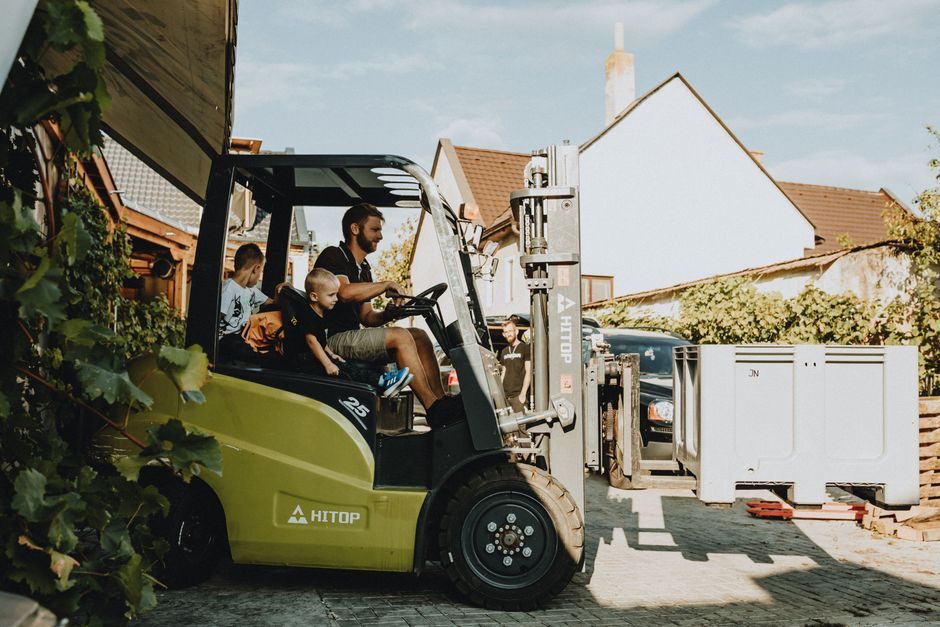
An electric forklift is a battery-powered self-propelled truck with forks, designed for lifting and moving palletised loads in warehouses, logistics depots, and loading bays, as classified in OEM industrial-drive application notes [S1].
Conventional forklifts (the broader category) include electric, diesel, LPG/gasoline, and rough-terrain variants; ISO and OSHA definitions have governed the truck class since the 1932 commercialisation of the hydraulic-lift version [S8]. A 2026 buy-side decision is dominated by three specs: load capacity (1-5t electric vs 5-16t+ IC), battery or fuel energy density, and site emissions/ventilation requirements.
Power-source decision: voltage, kWh, fuel, and emissions
Counterbalanced electric forklifts on the 2026 China-domestic market ship commonly at 80V/150-230Ah for ~3.5t class with 3m two-stage masts, and 76.8V/840Ah for 5t class with Curtis controllers and side shift [S3]. Lithium iron-phosphate packs have displaced lead-acid in most new Chinese OEM builds because opportunity charging removes battery-swap rooms; 24V/48V classes remain standard for electric pallet trucks and stackers, and 1-3t 4-wheel electric counterbalance units typically run 48V or 80V architectures.
Diesel and LPG forklifts retain their advantage where (a) shift length exceeds battery swap tolerance, (b) ambient temperature is below -10°C and battery capacity sags, or (c) the duty cycle demands >5t at >4m lift with continuous run. Rough-terrain and container-handling forklifts — a distinct sub-class covered in the rough terrain forklift reference — are almost exclusively diesel-driven in the 4-10t range, with 4WD and high ground clearance [S5].
Load class, mast, and chassis geometry
Three capacity bands dominate 2026 industrial procurement: 1-2.5t (electric, 3-wheel or 4-wheel, 3m-4.5m lift, often 48V); 3-5t (electric 80V or IC diesel/LPG, 3m-6m two/three-stage masts); and 5-16t+ (IC diesel, often with cab, side-shifter, and 600-700mm load centres) [S3]. Fork length on standard 1-3t units runs 1070-1220mm; outside those dimensions you are specifying a non-standard attachment and need to confirm ISO 2328 carriage class.
Mast type matters more than marketing brochures admit: two-stage limited-free-mast lifts suit standard 3m warehouse racks; three-stage full-free masts are required for container or drive-in racking where collapsed mast height must clear doorways. Pneumatic (air) tyres are spec'd for outdoor/uneven surfaces, cushion tyres for smooth indoor floors — a hard floor with cushion tyres shortens tyre life and degrades traction; a yard with pneumatic tyres burns more energy rolling.
Total cost of ownership: electricity vs diesel vs LPG per shift
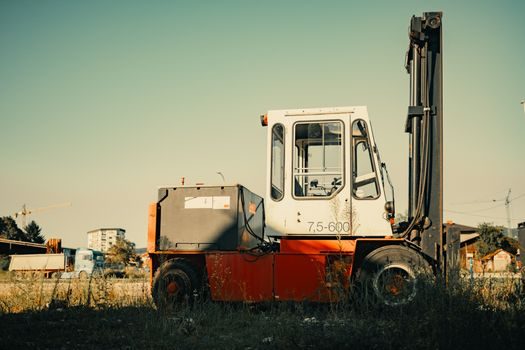
List prices in the 2026 China B2B channel sit at US$390 for a 1t semi-electric pallet reach stacker with 1150mm forks (lead-acid), US$9,980-12,780 for a 3.5t lithium counterbalance, US$14,500-18,900 for a 4t lithium unit, and US$25,600-29,800 for a 5t CPD50 with 76.8V/840Ah pack [S2][S3]. Per-shift energy cost favours electricity at roughly 1/3 to 1/4 of diesel on equivalent kWh vs litre basis, but battery replacement (lead-acid ~1,500 cycles, LFP 3,000-4,000 cycles) must be amortised into the comparison.
Maintenance diverges sharply: electric units have no oil filters, no engine oil, no DPF/AdBlue on diesel Tier 4f, and no spark plugs on LPG; their main wear items are motor brushes (older AC designs are brushless), hydraulics, and mast rollers. For a fleet spec'ing a 5-year TCO model, electric wins decisively in single-shift indoor operations, IC diesel wins in continuous outdoor multi-shift, and the break-even depends on local electricity tariff, diesel price, and ventilation code. A storage cage TCO analysis uses the same 5-year engineering model framework applicable to fleet planning.
Site rules: ventilation, ATEX, and indoor air quality
Electric units produce zero tailpipe emissions at point of use, which is the decisive spec for cold-store operations, food/pharmaceutical warehouses, and enclosed distribution centres under OSHA/NIOSH indoor-air guidance [S1]. LPG forklifts are still allowed in many well-ventilated warehouses but trigger CO and NOx monitoring; diesel forklifts in enclosed spaces require catalytic converters or active exhaust scrubbing, plus continuous gas monitoring — the same risk envelope addressed by an IR vs catalytic gas-detector selection map.
For Zone 1/Zone 2 hazardous-area sites (chemical, paint, fuel depots), specifying an electric forklift still requires ATEX/IECEx-certified truck variants; standard industrial electric forklifts are NOT Ex-rated and must not be substituted on the assumption "electric = safe." The forklift encyclopedia entry lists the explosion-proof conversion kits and temperature-class options that apply when the work envelope overlaps flammable-vapour atmospheres.
Who electric is for — and who it is not for
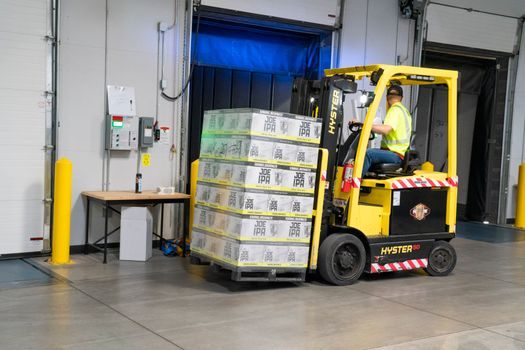
Electric forklifts are the right call for: indoor warehouses, cold storage, food and pharmaceutical DCs, retail backrooms, and any site with noise or emissions restrictions; typical runtime 6-8 hours per charge with opportunity charging on breaks. They are NOT the right call for: continuous 24/7 heavy outdoor handling, very high lifts (>6m with heavy loads where battery sag hurts productivity), or sites without reliable 3-phase power for chargers. [S1]
Conventional IC forklifts (diesel, LPG, gasoline) remain the default for: outdoor yards, construction sites, lumber and steel yards, ports, and any site with >10 hours/day continuous duty. Rough-terrain forklifts with 4WD and oversized pneumatic tyres are a separate sub-class for unprepared ground and form the only practical option in many agricultural and mining-support applications [S5].
Spec comparison: electric vs IC vs rough-terrain, criterion by criterion
On energy source, electric runs 24V-80V DC battery, diesel/LPG runs internal combustion — the fundamental divide [S1][S3]. On load class, electric typically covers 1-5t (with 8t LFP units emerging), IC covers 2-16t+, rough-terrain covers 2-10t [S3][S5]. On refuel/recharge time, electric needs 1-2 hours opportunity charge or 8 hours full; LPG needs 5-minute bottle swap; diesel needs 5-minute nozzle fill. On emissions at point of use, electric is zero; LPG is low CO/NOx; diesel requires treatment. On noise, electric is ~65-70 dB(A), IC is ~85-95 dB(A). On upfront unit cost in 2026, a 3.5t Chinese lithium electric lists US$9,980-12,780 while a comparable diesel sits higher once Tier 4f aftertreatment is included [S3]. On 5-year TCO, electric wins indoor single-shift, IC wins outdoor multi-shift.
On 2026 channel activity, the China export market lists 1-3t electric models from at least eight OEM clusters (Xingtai, Suzhou, Hangzhou, Hefei) and US dealers in Hialeah, FL stock replacement parts for all makes including legacy IC models [S6]. Alibaba's verified supplier pool for electric forklift loaders shows heavy concentration in South America, South Asia, and Africa as export destinations [S7].
Selection flow and procurement signals to track
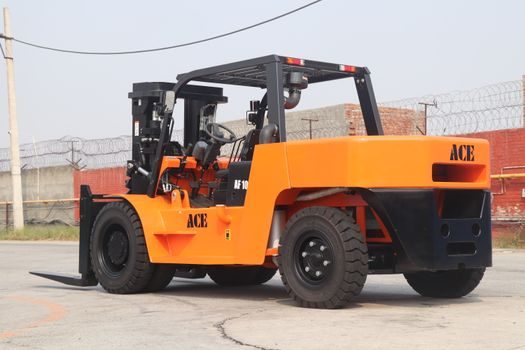
Step 1: confirm load weight, lift height, aisle width, and shift pattern. Step 2: confirm site power (3-phase available?) and ventilation. Step 3: pick energy source. Step 4: pick capacity and mast. Step 5: pick tyre type and options (side-shift, fork positioner, cab, heater for cold store). Two trackable 2026 signals: (1) continued LFP displacement of lead-acid in 1-3t counterbalance classes across Chinese OEM catalogues, with 80V architecture becoming the de-facto 3.5-5t standard [S3]; (2) growing ATEX/IECEx-certified electric variants for Zone 1/Zone 2 chemical and fuel-handling sites, mirroring the explosion-proof motor spec landscape.