For residential foundations, slabs, and walls, ready-mix concrete is specified by required 28-day compressive strength (commonly 2,500–4,000 psi / 17–28 MPa for houses), maximum aggregate size, slump range at the point of pour (typically 75–100 mm / 3–4 in for slabs, 100–150 mm / 4–6 in for walls and pumped placements), and exposure class driving water-cement ratio and optional admixtures [S2][S5].
Selection for a single-family home is governed by four practical levers: structural requirement, placement method (chute, pump, wheelbarrow), haul time from the batch plant, and ambient temperature at pour, all of which together dictate the mix code a residential contractor should order and the cost premium — typically a few percent over a baseline 3,000 psi mix — paid for each upgrade in strength, slump, or durability [S1][S2][S5].
Strength Classes and Mix Codes Used on Houses
Residential 28-day compressive strength in North American practice clusters at 2,500 psi (17 MPa) for non-structural slabs on grade, 3,000 psi (21 MPa) for footings and interior slabs, 3,500 psi (24 MPa) for exterior slabs and driveways exposed to freeze-thaw, and 4,000 psi (28 MPa) for foundation walls in many jurisdictions, with the cement content of an ordinary ready-mix roughly tracking 280–360 kg/m³ for these grades [S2][S5].
Engineering data for ready-mix plants serving Topeka, eastern Kansas, and Central Texas explicitly lists 3,000, 3,500, and 4,000 psi mixes alongside 5,000 and higher psi structural mixes in their product menus, and Central Oregon and Maine suppliers deliver the same set to single-family residential customers through standard ASTM C94 truck-mixed deliveries [S1][S2][S7][S8]. Mix design on a residential ticket is normally confirmed by the producer against ACI 318 exposure categories and the local building official's adopted IRC table, not by the contractor's preference alone [S2][S5].
Slump, Admixtures, and Placement Method
Slump is the most-argued single number on a residential order: 75–100 mm (3–4 in) for direct-chute slabs, 100–125 mm (4–5 in) for typical residential wall pours, and 125–180 mm (5–7 in) for pumped concrete, with the producer typically dosing a mid-range water reducer to hit the upper end without raising water-cement ratio above 0.50 for exterior exposure and 0.45 for severe exposure per ACI 318 [S5].
Concrete admixtures for residential work stay in the standard water-reducer / air-entrainer / retarder set; specialty shrinkage-reducing or corrosion-inhibiting admixtures are normally reserved for slabs on metal deck or coastal foundation walls, not single-family pours [S1][S2][S5].
Haul Time, Temperature, and Slump Loss
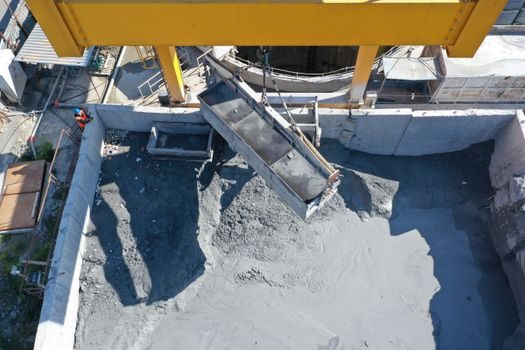
ASTM C94 caps ready-mix discharge at 90 minutes from the start of mixing or 300 revolutions of the drum, whichever comes first, and residential suppliers in central Maine, eastern Kansas, central Texas, and central Oregon all publish delivery radii of roughly 30–50 miles (50–80 km) consistent with that window [S1][S2][S7][S8].
In summer a producer will switch the mix to a retarded design with chilled water or ice at the plant when haul time plus placement exceeds 60 minutes, because ambient heat and drum friction can cost 25–50 mm of slump in the first 30 minutes on a 32°C (90°F) day, pushing the as-delivered slump below the spec line if the mix was not pre-conditioned [S5]. A two-hour delay on a non-retarded residential ticket is the most common cause of rejected loads on hot afternoons, and the practical response — ordering a higher initial slump and a retarder — adds roughly $8–15 per cubic yard at 2026 plant pricing per regional supplier rate cards [S2][S7].
Residential Mix Options Compared on Decision Criteria
Volumetric-mix trucks, which batch on site, are an alternative for low-volume residential pours under 2–3 yd³ where a barrel-mix truck would either short-load or slump out, and several residential suppliers offer them for backyard projects and small foundation repairs [S8][S9]. For a typical 4–6 yd³ driveway or 8–10 yd³ residential foundation, a barrel-mix plant delivery is more economical because the volumetric setup fee is amortised over a larger volume [S8]. Ready-mix concrete selection at residential scale therefore hinges less on material chemistry and more on ordering the right volume at the right slump from a plant within the 90-minute discharge window [S1][S2][S5][S8].
What Ready-Mix Cannot Solve for Residential Builders

Ready-mix cannot compensate for poor subgrade preparation, inadequate forming, or missing reinforcement, and the most common residential failures — cracking at control joints, scaling on driveways, and honeycombing in foundation walls — are traceable to sub-base moisture, joint spacing, and vibration rather than the mix ticket itself [S5][S8].
Crack-control fibre reinforcement, when specified, belongs to a different ordering line; polypropylene or macro-synthetic fibres are typically added at 0.5–1.5 kg/m³ for residential slabs, and the supplier will bill them as a separate add rather than as part of the standard mix [S5]. Concrete fibres are a complement to, not a substitute for, proper joint layout and curing, and a 3,000 psi slab with correctly spaced control joints and 7 days of moisture retention will out-perform a 4,000 psi slab placed on dry subgrade with no curing compound every time [S1][S5].
Curing, Sampling, and Acceptance on Site
Acceptance testing on a residential pour is a single 152 × 305 mm (6 × 12 in) cylinder set cast from the first truck, with 28-day breaks taken at a lab and reported to the building official; some jurisdictions also require a slump cone and air-meter test at discharge, both of which the supplier's dispatcher will run on the truck's tail chute before the driver releases the load [S2][S5].
Curing on a residential slab is normally done with a sprayed curing compound at the rate published on the product data sheet, or with 4-mil polyethylene for 7 days, and suppliers across all four cited regions stock spray-on curing compound in 1-gallon and 5-gallon containers for the same trip as the concrete [S5][S7][S8]. A failed cylinder set is rare on residential work because the loads are small and the plant's quality control is calibrated for the local code — but when failures occur, they are almost always traced to over-watering at the chute by the finishers, not to the producer's mix design [S5][S8].
Sourcing and Standards to Reference

Residential ready-mix should be ordered from a plant certified by the National Ready Mixed Concrete Association (NRMCA) and operating to ASTM C94 for production and delivery, with the mix design filed against ACI 318 exposure categories and the local adopted building code [S2][S5].
For renovation-scale or smaller residential pours where a barrel-mix truck is uneconomic, the same ACI/ASTM rules apply to volumetric-mix deliveries, and curing compounds should be specified to ASTM C309 Type 1 or Type 2 for compatibility with the slab finish [S5][S8]. For a typical residential project, the action is straightforward: pull the structural drawing, identify the required f'c, exposure class, and placement method, then order from the closest NRMCA-affiliated plant with that exact mix code and a haul time that keeps the truck inside the 90-minute ASTM C94 discharge window [S1][S2][S5][S7].
What to Track on the Next Decision Node
The two trackable signals on the next residential ready-mix order are the plant's NRMCA certification status — confirmable at the nrmca.org member directory — and the local 28-day break history for the same mix code on prior residential jobs, which a quality producer will share on request. The ACI/ASTM residential pour for a typical single-family foundation is a solved engineering problem; the variable is plant discipline and haul time, not mix design. For related selection logic on adjacent residential materials, the cement selection map for renovation projects covers the bagged-cement cases that precede a small pour, and residential slab finishing depends on proper concrete vibrator choice for walls and footings. [S2]