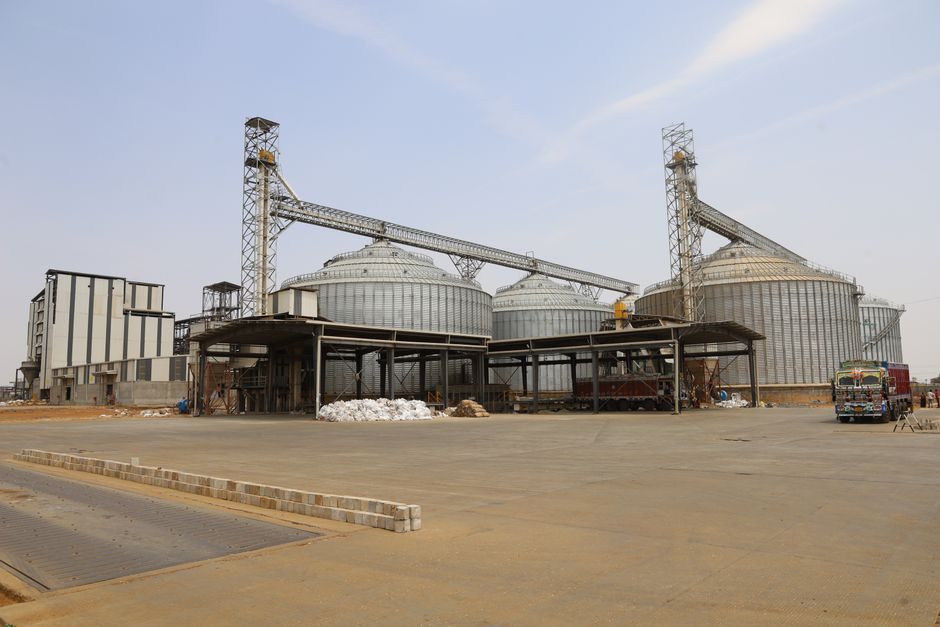
Industrial-facility concrete rarely fails because of bad mixers or bad vibrators; it fails because the specifier picked a general-purpose cement for a chemical plant, a marine terminal, or a 1.5 m thick raft where a sulfate-resistant or low-heat blend was the only defensible answer. AASHTO M 85 and M 240 list the cement universe the U.S. supply chain actually ships: Types I, II, II(MH), III, IV, V under M 85, and Types IL, IP, IS, IT under M 240 [S3].
This article lays the cement family out against the six axes that drive a real industrial order: exposure class, structural element, mass-pour heat, SCM level, strength class, and source-mill logistics. The data points come from FDOT Section 346 (July 2022), the standard most U.S. transportation and process-infrastructure engineers are handed on day one [S3], cross-checked against the steel-fabrication market in which industrial cement is consumed [S2].
Cement Family by ASTM/AASHTO Designation
Type I is the unmodified general-purpose portland used for bridge superstructures and CIP substructures in slightly aggressive environments per FDOT Table 346-1 [S3]. Type II adds moderate sulfate resistance (about 0.10% max C3A by mass in most mills) and is the workhorse for moderately aggressive exposure. Type II(MH) is moderate heat of hydration, the default for mass concrete elements on FDOT work, and is allowed for both superstructure and substructure in extremely aggressive environments [S3]. Type III is high-early strength (roughly 1-day strengths near the 3-day strength of Type I), used when form-cycle time or cold-weather curing drives the schedule. Type IV is low-heat, reserved for very large mass pours and rare on industrial jobs. Type V is high sulfate resistance, used where soluble sulfate in soil or water exceeds 0.20% by mass or 1,500 ppm.
The M 240 blended cements — IL (portland-limestone), IP (portland-pozzolan), IS (portland-slag), and IT (ternary) — are not weak substitutes; they are engineered blends where the supplementary cementitious material is pre-blended at the mill. FDOT requires Type IL, IT, or II(MH) for all mass concrete elements regardless of exposure class [S3], because limestone, slag, and ternary blends drop the heat of hydration 10–20% versus straight portland. For industrial tank pads, thick raft foundations, and large equipment plinths, that delta is the difference between a sound pour and a thermal crack that shows up six months later.
Environment Classification Drives the First Cut
FDOT Table 346-1 maps cement choice to three environmental buckets: slightly aggressive, moderately aggressive, and extremely aggressive [S3]. Slightly aggressive permits Type I or Type III; moderately aggressive expands the menu to Type I, IL, II, III, IP, or IS; extremely aggressive restricts the list to Type II(MH), IL, IT, or a ternary blend, with Type III still allowed for precast superstructure and prestressed elements [S3].
For an industrial specifier the translation is mechanical: slightly aggressive covers dry, indoor, non-chloride process buildings; moderately aggressive covers below-grade foundations in soils with sulfate in the 0.10–0.20% range or above-grade wettings with de-icing salt exposure; extremely aggressive covers coastal process plants, wastewater treatment headworks, and any substructure in soils above 0.20% sulfate or with chloride-bearing groundwater. The standard also lets you "use a more aggressive cement in a less aggressive environment" — so a Type II(MH) is legal in a slightly aggressive pour, just uneconomic unless mass-pour heat is the real driver [S3].
Mass Concrete vs. Structural Concrete: A Separate Decision
Mass concrete is typically defined by the smallest dimension: ACI 207 and most state DOTs flag 0.9 m (3 ft) for Type I/II and 1.2 m (4 ft) for Type IV or highly blended mixes, though the trigger is usually a max internal temperature limit of 70–77 °C with a 20 °C delta to the surface, not the dimension alone. FDOT sidesteps the dimension debate and hardwires the rule: use Type IL, Type IT, or Type II(MH) for all mass concrete elements, full stop [S3].
For industrial work this matters in three places: thick raft foundations under rotating equipment, turbine and compressor blockouts, and large-diameter clarifier walls in water and wastewater treatment. In a cement plant preheater tower or a kiln foundation, where continuous vibration and thermal cycling are normal, the low-heat blend also reduces the long-term drying-shrinkage risk that opens construction joints.
Supplementary Cementitious Materials: Fly Ash, Slag, Silica Fume
ASTM C 618 Class F fly ash, C 618 Class C fly ash, C 989 slag cement, and C 1240 silica fume are the four SCMs that move the needle on durability and heat. FDOT requires SCMs to come from the Approved Product List and treats them as a Section 929 material separate from the cement [S3]. The standard allows ternary blends pre-blended at the mill (Type IT) and also allows separate addition at the mixer up to typical limits of 25–35% for Class F fly ash, 50–70% for slag, and 5–10% for silica fume, with the exact ceiling driven by the mix design approval and the strength class required at 28 or 56 days.
The decision tree is short. If sulfate attack is the dominant risk, slag at 50% or a Type V / Type II(MH) is the right move. If early strength is the constraint, the SCM level has to come down or a Type III or Type IP (with a faster-reacting pozzolan) has to be selected. Mass concrete almost always means the SCM is already in the cement; you should not be field-dosing 50% slag into a mass pour.
Source-Mill and Logistics: A Real-World Filter
No spec survives contact with the local cement supply. S&S Steel Fabrication, a large U.S. structural fabricator with active cement, mining and minerals, and water and wastewater treatment project lines, runs nationwide and lists cement among its core served industries — a useful proxy for the breadth of U.S. cement demand beyond highways [S2]. A specifier in Tampa will have Type I, II, and IL in bag and bulk from at least two terminals within hauling distance; a specifier in rural Montana will see Type II(MH) and ternary blends only on extended lead times, and that fact often overrides the engineering optimum.
Three logistics checks belong on the purchase order: confirm the mill is on the FDOT or state-DOT Production Facility Listing, which is the gating document for U.S. transportation work and a good proxy for QC discipline on private industrial work [S3]; require the mill certificate to show both AASHTO M 85 or M 240 compliance and the specific Type designation; and lock the SCM source on the Approved Product List, since the cement and the SCM often come from different suppliers and SCM substitution is the most common field failure mode on industrial pours [S3].
Criteria Comparison: Five Cement Choices Against Six Industrial Demands
The cleanest way to set a Type is to line the candidate cements up against the six axes that decide a real industrial order. The table below uses FDOT Table 346-1 categories as the exposure anchor and common industry limits elsewhere [S3]. Type II(MH), IL, IT, and ternary blends are the right answer for mass pours and extremely aggressive exposure, and a specifier should not be running straight Type I on a thick raft or a sulfate site [S3].
Lead time on Type II(MH) and IT in the U.S. is usually 1–3 weeks; in remote sites it can stretch to 6 weeks, which is the single most common reason an "optimum" Type is swapped at the purchase-order stage.
Limitations and Failure Modes
Three failure modes show up repeatedly on industrial pours where the cement was technically code-compliant but operationally wrong. The first is thermal cracking in mass concrete where Type I was allowed in a thin-looking but actually thick element; the fix is the FDOT rule — use Type IL, IT, or II(MH) for all mass elements, period [S3]. The third is alkali-silica reaction (ASR) where reactive aggregate is combined with a high-alkali cement; the fix is a low-alkali cement (typically Na2O equivalent below 0.60%) or a Class F fly ash or slag blend at levels that meet the project's ASTM C 1293 or C 1567 testing requirement. None of these are exotic — they are the bread-and-butter of the FDOT Section 346 framework and the parallel ACI 318 durability provisions that govern building-side work [S3].
For a specifier who wants one short list to carry to a project kickoff, the order of operations is: classify the exposure (slight, moderate, extreme per FDOT 346-1 [S3]); identify the mass-pour elements and assign Type IL, IT, or II(MH) to them; pick the SCM strategy against the dominant durability or heat driver; verify mill availability and Approved Product List status on both the cement and the SCM; and write the mix design acceptance criteria around 28- and 56-day strength plus the relevant durability tests (sulfate resistance per ASTM C 1012, chloride penetration per ASTM C 1556, ASR per ASTM C 1293).
For related plant-side context on the steel frame that sits on top of this concrete, the S&S Steel Fabrication industrial project portfolio gives a read on which U.S. industrial verticals — cement, mining, water, oil and gas — are actively pouring structural concrete in 2026. Trackable signals worth watching over the next two quarters: any update to FDOT Section 346 Table 346-1 expanding the Type III envelope, and any AASHTO M 85 or M 240 revision that shifts the C3A limits on Type II and Type V.
Component reference pages worth checking: industrial adhesive, industrial borescope, and industrial buzzer.
This topic is covered further in Aluminum Coil vs Aluminum Die Casting Machine: Spec Map for Buyers.