
Interior finishing crews cutting rebar for slab-on-grade infills, partition reinforcement, and stair landings overwhelmingly specify portable electric-hydraulic rebar cutters rated for 10-25 mm (#3-#8) bar, with model prices clustering between USD 275 and USD 499 in North American retail channels as of August 2026 [S3].
Selection is driven by three hard constraints: bar diameter range, cuts per shift (driven by hydraulic cycle time), and indoor power availability (110 V/220 V single-phase vs. no-grid sites needing gasoline). Lightweight manual and hydraulic shear tools cover #3-#5 trim, while the electric-hydraulic portable class is the workhorse for finishing trades [S1][S2].
Three machine classes sized to interior rebar work
Manual cutters handle #3 (10 mm) and #4 (13 mm) bar in 0-20 cuts/shift duty and cost under USD 100 at retail; the cutoff where crews switch to electric-hydraulic is roughly 50 cuts/day on #4 rebar, beyond which operator fatigue and cut quality drop measurably [S3].
Electric-hydraulic portables dominate the 14-25 mm bracket. Published retail models include the RC-165C (up to #5 / 5/8 in., 16 mm, USD 275), RC-227C (up to #7 / 7/8 in., 22 mm, USD 450), and RC-258C (up to #8 / 1 in., 25 mm, USD 499), all listed as grade 60 rebar and round bar compatible [S3]. Capacities step in 6-9 mm increments because cutter-blade sets and hydraulic cylinder bores are sized to specific bar diameters, not continuously variable.
Heavy electric and gasoline-driven machines cover 32-42 mm bar, but these are typically overkill for interior finishing. South Korean OEM TAEYEON B&C, distributed by CNB Machinery in the Philippines, offers 10-42 mm capacity across its electric bar cutter and bender lines, with the TYB-HD42D flagship bender rated to 42 mm rebar [S2]. Such machines ship 80-150 kg and require 380-415 V three-phase or a 5-13 HP engine, neither common on interior fit-out sites [S1][S2].
Selection gates: bar size, cuts per shift, power, weight
Gate 1, bar diameter: pick the machine whose published max bar rating equals the largest rebar in the project plus one standard size buffer. The GQ50 portable steel bar cutting machine is widely deployed for construction-site bar cutting and is a common reference point for the 50 mm-class (G50 series) Chinese-market portable [S1]. Using a #8-rated cutter on #3 bar wastes hydraulic capacity and reduces blade life.
Gate 2, cuts per shift: cycle time on portable electric-hydraulic units runs 2-4 seconds per cut on bar up to 20 mm, extending to 5-7 seconds on 25 mm bar, which translates to roughly 400-700 cuts/hour sustained before motor thermal limits cut in. For interior finishing crews typically producing 100-200 cuts/shift, this headroom is fine; for repetitive pre-assembly of dowel baskets it may not be.
Gate 3, power source: indoor finishing sites almost always have 110 V or 220 V single-phase. The RC-series models listed run on standard single-phase mains; the Loncin G200FA 5.5 HP gasoline engine (USD 399) is offered for off-grid applications but introduces exhaust and noise that make it unsuitable for occupied interior spaces [S3].
Gate 4, weight and handling: the RC-165C through RC-258C portables are designed to be carried by one operator to in-slab locations, a critical feature when cutting dowels already cast into partial slabs. Stationary hydraulic cutters above 100 kg require wheeled carts and are tied to a fixed cutting bay.
Cutting-edge saws vs. shear cutters for interior trim
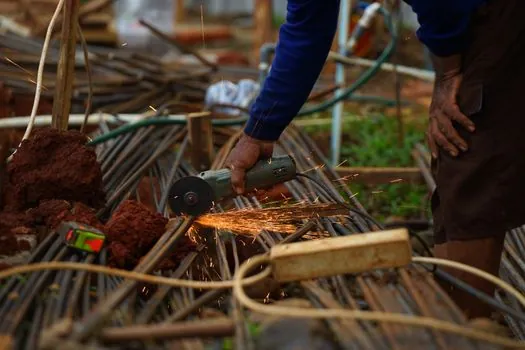
Abrasive and cold-cut saws occupy a different niche. The California Concrete Tool RCS-40A Electric Cutting Edge Saw cuts up to #8 (1 in.) rebar and round bar using a carbide-tipped blade, was listed at USD 309 and discounted to USD 199 in August 2026 [S3]. Cold-cut saws produce a clean, square end with no deformation, which matters when rebar is being threaded into mechanical couplers or epoxy-set anchors, both common in interior retrofit work.
Shear-style hydraulic cutters crush-cut the bar, leaving a slightly upset end that can block a coupler sleeve. For dowel embedment into wet concrete the shear end is irrelevant; for mechanical-splice interior retrofits, switch to a cold-cut saw. The trade-off is cut time: a shear cutter finishes a #8 bar in 3-5 seconds, while a portable cold-cut saw runs 15-30 seconds per cut with coolant required for blade life.
Combo machines for small-finishing contractors
Combo cutter-benders compress two tools into one chassis and make sense for small finishing contractors running both operations. The RBC-258 combo machine is rated to cut and bend up to #8 (1 in. / 25 mm) grade 60 rebar at USD 2,399 retail, compared with USD 499 for a standalone RC-258C cutter and USD 2,100-2,399 for a dedicated heavy-duty bender like the RB-258A [S3].
Combo units trade 20-30% cycle time on each operation for the cost saving of one machine, one power cord, one maintenance log. For crews cutting and bending fewer than 50 pieces per day, the economics favor the combo; above that volume, two dedicated machines out-produce one combo by a measurable margin. A standalone electric hydraulic bender like the RB-258N is rated to #8 (1 in.) rebar at USD 879 and is the typical partner to a portable cutter in a finishing-trades van [S3].
Standards, blades, and consumables

No single ISO or ASTM standard governs portable rebar cutter geometry; blade hardness and hydraulic pressure ratings are OEM-defined. What does matter for interior work is grade 60 (420 MPa yield) compliance, which the RC-165C, RC-227C, RC-258C, and RBC-258 models explicitly list, with grade 80 bar requiring the next size class up [S3].
Consumable cost is dominated by cutter blocks and carbon brushes. The RC-196C part 4 and 11 cutter blocks list at USD 27 per set, and the RC-196C part 44 carbon brush is a USD 4.50 consumable, both retail items as of August 2026 [S3]. Budget roughly USD 50-100 per 10,000 cuts for wear parts on a 16-22 mm portable.
Limitations and failure modes in interior environments
Three failure modes dominate inside finishing work: (1) blade binding on rusty or epoxy-coated rebar, which forces operators to over-cycle and burns out the hydraulic seal; (2) carbon-brush wear on units run continuously for more than 4 hours without a cool-down, an issue on dowel-prep shifts; (3) hydraulic oil leakage, a particular problem in finished interior spaces where any spill triggers rework of the slab or floor finish [S3].
Electric-hydraulic portables are not rated for use in standing water, so slab-on-grade work where the cutting bay sees groundwater seepage needs a dry platform. For interior work above ground level, the limiting factor is typically the cord, not the machine: a 110 V cutter drawing 10-15 A needs a heavy-gauge extension cord under 15 m to avoid voltage drop and motor stall mid-cut.
Who this is for, and who should look elsewhere

Interior finishing contractors doing partition reinforcement, mechanical-room infill slabs, stair landings, and elevator-pit rebar will land on the electric-hydraulic portable class (RC-165C to RC-258C) with optional cold-cut saw for coupler work. Pre-fabrication yards producing dowel baskets in volume should jump to the 32-42 mm heavy electric class typified by the TYB-HD42D line, with three-phase power and dedicated cutting bays [S2].
Landscape and decorative crews cutting light bar (under 13 mm) for garden walls or small footings can stay with manual cutters and save the cost of a hydraulic unit. For rebar selection, a useful rebar bender selection map for landscaping covers the smaller-diameter end of the spec space and pairs naturally with the manual cutter class.
For general spec context, the rebar cutter encyclopedia entry consolidates duty-cycle ratings and hydraulic-class definitions used across the portable, industrial, and gasoline classes. Adjacent finishing-trade tools like concrete groove cutters and marble cutters share the same portable-hydraulic form factor and the same 110 V/220 V power constraints, so the same extension-cord and ventilation rules apply on interior sites.
Trackable signals over the next quarter: retail price moves on the RC-258C and RCS-40A (the two highest-volume interior finishing SKUs at California Concrete Tool), and any new cordless 18-36 V portable hydraulic cutter that breaks the 110 V mains cord pattern. The Loncin G200FA 5.5 HP gasoline engine SKU and matching walk-behind power trowel (36 in., USD 1,599) are the bellwether items if interior finishing shifts back toward off-grid pour schedules [S3].